

India Advisory On China Airport Transit After Detention
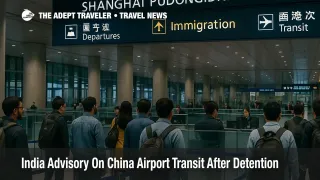
India's new India China airport transit advisory turns a single high profile detention into a broader planning issue for anyone routing Indian passport holders through Chinese hubs such as Shanghai and Guangzhou. On December 8, 2025, the Ministry of External Affairs, MEA, publicly urged nationals to "exercise due discretion" when travelling to China or transiting through Chinese airports, and tied that warning directly to a recent case at Shanghai Pudong International Airport (PVG). For most leisure and business travellers, the immediate task is to reassess itineraries that depend on mainland Chinese hubs, add buffer time, and consider switching connections to Singapore, Doha, or Dubai where possible.
In practical terms, the India China airport transit advisory tells travellers to treat mainland Chinese airports as higher friction transit points for now, especially if they hold Indian passports that list birthplaces in contested border states such as Arunachal Pradesh.
What Prompted The Advisory
The trigger was the detention of Prema, also reported as Pema, Wangjom Thongdok, an Indian citizen from Arunachal Pradesh who now lives in the United Kingdom. On November 21, 2025, she was travelling from London to Japan on a ticket with a three hour layover at Shanghai Pudong. Chinese immigration officers allegedly declared her Indian passport "invalid" because it listed Arunachal Pradesh, which Beijing refers to as Zangnan and claims as part of Tibet, as her birthplace, then held her for about 18 hours and blocked her from boarding her onward flight.
New Delhi responded with a formal demarche in Beijing and Delhi, describing the episode as "arbitrary detention" and stressing that Arunachal Pradesh is an "integral and inalienable" part of India. At a December 8 weekly briefing, MEA spokesperson Randhir Jaiswal said India expects Chinese authorities to provide assurances that Indian citizens "will not be selectively targeted, arbitrarily detained or harassed" during airport transits, and confirmed that the ministry would advise nationals to exercise "due discretion" when travelling to or through China. China has rejected the harassment claims and says its border staff acted in accordance with domestic law.
This advisory also lands against a wider backdrop of volatile India China ties, where a slow thaw after the deadly 2020 Ladakh clash has included renewed high level visits and incremental reopening of visa channels, but deep mistrust remains.
How The Advisory Changes Trip Planning
The MEA language is deliberately measured, but it still raises the planning stakes for Indian nationals using Chinese hubs purely as transit points. When a government signals that citizens should exercise "due discretion," it is effectively saying that travellers need to make more conservative choices than they might on a normal route, especially where local authorities take a hard line on disputed territories and security laws.
The immediate practical shift is around connection time. Corporate mobility teams and visa specialists are already nudging clients to allow longer minimum connection windows through Shanghai, Guangzhou, and Beijing, to avoid tight banks where any secondary questioning could trigger missed onward flights and forced overnights. For independent travellers, the same logic applies, move away from minimum legal connection times toward comfortable two to four hour buffers on single tickets, and avoid same day separate tickets that would require clearing immigration and rechecking bags.
Documentation is the second pillar. Travellers should carry printed copies of their full itinerary, boarding passes, hotel confirmations, and visas, plus digital backups on a phone and in cloud storage. Those travelling for work should add employer letters explaining the trip purpose, particularly if transiting to Japan, South Korea, or other high scrutiny destinations. Consular hotlines for Indian embassies and consulates in China, as listed on official MEA sites, should be saved in contact lists before departure rather than searched on the fly under pressure.
The final new element is monitoring. Given the political sensitivity, travellers should expect that further incidents, clarifications, or Chinese responses will show up first in Indian media, MEA briefings, and perhaps in carrier specific travel alerts. Anyone with China linked transit legs over the next few months should set news alerts for "India China airport transit" and check for updates as departure dates approach.
Who Faces The Highest Risk
Not all Indian travellers are equally exposed. Based on the Shanghai case and official statements, the highest practical risk lies with passport holders born in Arunachal Pradesh or other areas that Beijing contests, as their place of birth sits at the heart of the dispute. For this group, the safest default is to avoid itineraries that transit mainland Chinese airports entirely, and to favour routings through neutral hubs even if that adds time or cost.
The next tier includes Indian citizens who live and work abroad but still hold Indian passports, especially those on multi country trips routed by cheapest fare rather than by political risk. These travellers may not be closely plugged into day to day India China diplomacy, yet they are the ones most likely to be booked on complex routings through Shanghai, Guangzhou, or Beijing that optimise for price or frequent flyer status.
At a broader level, the MEA wording applies to all Indian nationals, including tourists, students, and business travellers. That means Indian citizens with no border state link still need to assume a higher level of scrutiny at Chinese transit points, and to build extra margin into plans, even though the Shanghai pattern so far is narrow rather than systemic.
Comparing China Transit With Alternate Hubs
Mainland Chinese hubs have historically offered competitive fares and good connectivity between India and North Asia, North America, and parts of Europe. However, when political risk spills into passport validation and long detentions, the cost benefit calculation changes.
Alternate routings are not hard to find. Singapore Changi Airport (SIN), Hamad International Airport (DOH) in Doha, and Dubai International Airport (DXB) all act as major connectors between India and East Asia, Oceania, and the Americas, without the same territorial disputes over Indian states. For many itineraries, a one stop India Singapore Japan or India Doha Japan routing will now be preferable to a cheaper or shorter itinerary that relies on Shanghai Pudong or Guangzhou Baiyun International Airport (CAN), particularly for travellers from Arunachal Pradesh.
Travellers focused on East or Southeast Asia can also look to Hong Kong, Bangkok, and Kuala Lumpur as practical alternatives, though each has its own protest, weather, and visa context that should be considered alongside price and schedule.
Scenario Planning For Existing Tickets
If you already hold a ticket that routes through a Chinese hub, the best strategy depends on timing, cost, and personal risk tolerance.
For trips departing in the next few weeks, start by checking whether your carrier has issued any flexibility or waiver policies for India China itineraries, even informal ones through travel agents. Some airlines will allow a no fee change of transit point, especially for corporate accounts, if you raise the issue early and reference the MEA advisory and the Shanghai detention case.
If your passport lists Arunachal Pradesh or another disputed area as place of birth, a stronger case exists for asking to reroute via a neutral hub such as Singapore or Doha, even if this means a slightly longer journey. For lower risk profiles, for example travellers born in non disputed Indian states, the more realistic move may be to keep the routing but to extend connection time and tighten documentation and backup plans.
Separate tickets need the most attention. Travellers who bought one ticket to a Chinese hub and a second ticket onward may face a forced immigration clearance to collect bags or recheck, which is precisely where disputes over passport validity can bite. In those cases, consolidating onto a single through ticket that keeps you airside, or rebooking altogether through a third country hub, is the safer choice.
Corporate travel managers should also update internal guidance and traveller briefings. That can include red flagging mainland Chinese hubs for staff from border states, adding MEA advisory language into trip approvals, and pre loading insurance and crisis response information into itinerary tools for any journeys that must still pass through China.
Background, Arunachal, And Airport Checks
The advisory cannot be separated from the long running dispute over Arunachal Pradesh. China refers to the Indian state as Zangnan, claims it as part of Tibet, and has repeatedly objected to visits by Indian leaders and foreign officials, while India insists the state is an integral and inalienable part of the country. When that territorial argument spills into decisions about whether an Indian passport is "valid," it crosses a line that directly affects the predictability of airport transit.
Visa and transit rules also frame the issue. Shanghai Pudong offers limited visa free transit options, but those rules assume that the traveller is holding a recognised passport for a third country trip. Once border staff question the passport itself, normal protections tied to airline tickets, global distribution systems, or even Montreal Convention claims become much harder to assert in the moment.
How To Monitor And Prepare
Going forward, the MEA's own channels are the primary reference for updates. Travellers should review MEA travel advisories and the December 8, 2025 weekly briefing transcript before booking or re confirming trips that involve Chinese airports, then check for fresh statements as departure dates near.
Adept Traveler readers can also use prior coverage to put this development in context. Our earlier piece, Shanghai Layover Rules Put Arunachal Travelers At Risk, tracked the original Shanghai detention and the ways visa free transit can fail. Asia Advisories And UAE Visit Visa Extensions summarises how countries such as Australia frame risks of arbitrary detention and security law exposure in China and Macau. For structural background on visas and transit planning, the evergreen Visa Requirements for U.S. Travelers: A Global Guide explains how fast border and visa rules can change and why printed documentation still matters, even in the era of e visas and mobile boarding passes.
For now, the advisory stops short of telling Indians to avoid China altogether. However, by naming airport transit as a specific concern and calling for assurances that Indian citizens will not be selectively targeted, it effectively raises the bar on when routing via Shanghai, Guangzhou, or Beijing is worth the extra geopolitical risk. Until those assurances are delivered in a way that sticks, the safest play is to treat the India China airport transit advisory as a binding planning constraint, especially for travellers from disputed border states and for corporate trips where duty of care obligations are strict.
Sources
- Transcript of Weekly Media Briefing by the Official Spokesperson, December 8, 2025
- India seeks assurance from Beijing that it will not target Indians in transit through China
- Exercise discretion while travelling through China: MEA
- India warns citizens to 'exercise due discretion' while travelling to or through China
- India presses Beijing for guarantees after Arunachal born passenger detained in Shanghai transit