

Lithuania Emergency Over Belarus Balloons Hits Flights
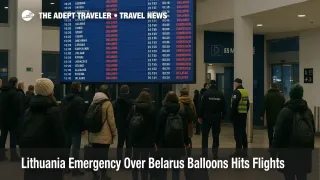
Lithuania has moved into a formal emergency footing after repeated waves of contraband laden balloons launched from Belarus forced multiple shutdowns of Vilnius International Airport (VNO) and disrupted air routes across the Baltic region. On December 9, 2025 the government declared a nationwide state of emergency, citing growing security risks from meteorological balloons that have repeatedly violated Lithuanian airspace and endangered civil aviation. Travelers flying into or out of Vilnius, or connecting through the Baltic capitals, now face a higher baseline risk of short notice ground stops, diversions, and tighter checks at borders and airports.
aIn practical terms, the Lithuania Belarus balloons flights emergency means that anyone using Vilnius or the country's secondary Kaunas Airport (KUN) should plan for possible last minute schedule changes and allow wider buffers on the same ticket or when connecting to separate tickets. Those with more complex itineraries can increasingly look to Riga International Airport (RIX) in Latvia or Warsaw Chopin Airport (WAW) in Poland as more stable regional alternatives for long haul and intra Europe links, especially for trips that cannot easily be rescheduled.
The nut of the change is that Lithuania's government has shifted from treating the balloons as a serious but discrete smuggling and safety problem to framing them as a nationwide hybrid attack that directly targets its aviation system and border security. That reclassification unlocks new powers to deploy the army alongside police and border guards, restrict movement in defined zones, search vehicles, and detain suspects while still promising minimal direct impact on everyday civilian life.
How often Vilnius has been forced to close
Lithuanian and international reporting shows that balloon incursions have already tested the resilience of Vilnius Čiurlionis International Airport repeatedly since early autumn. By early December, authorities and newswires estimated that Vilnius alone had been closed for more than 60 hours since October, affecting roughly 350 flights and about 50,000 to 51,000 passengers, while Lithuania's two main airports, Vilnius and Kaunas, have together had to shut down their airspace at least 15 times.
In one of the most serious recent incidents, Lithuanian officials said that around 60 balloons were launched from wooded areas inside Belarus, with some 40 drifting into zones that are critical for aviation safety near Vilnius's runways and forcing an 11 hour suspension of operations. Earlier, on October 24, Lithuania had already temporarily closed both Vilnius and Kaunas airports and shut all border crossings with Belarus after similar incursions, signalling that the country was willing to take disruptive steps even before the formal state of emergency.
Why balloons from Belarus are seen as a hybrid attack
The balloons themselves are described in official and media accounts as meteorological type devices, filled with helium and equipped with rigs that can carry cartons of cigarettes and other contraband into EU territory, where resale margins are much higher. Lithuanian officials argue that while the smuggling motive is clear, the pattern, timing, and intensification of launches, including regular targeting of airport approaches and critical airspace, indicate a broader hybrid attack orchestrated from Belarus and aligned with Russian interests.
European Commission President Ursula von der Leyen has publicly called the incursions a completely unacceptable hybrid attack by the Lukashenko regime, and signalled that Brussels is preparing further sanctions in response. Lithuania's resolution frames the emergency as necessary to manage risks not only to civil aviation, but also to national security, human life, health, property, and the environment, and appoints the interior minister as national operations manager to coordinate agencies.
Belarusian President Alexander Lukashenko, by contrast, denies that Minsk is conducting hybrid attacks, claims the balloons pose no real threat to civil aviation, and accuses Lithuania of politicising the issue while calling for dialogue and insisting that Belarus does not want war. That mismatch between Lithuanian and EU assessments, and Belarusian denials, is part of what makes the situation particularly sensitive for travelers and airlines relying on predictable airspace management along the eastern flank of the European Union and NATO.
What travelers flying to or from Lithuania should expect
For passengers, the most visible short term effects are likely to be intermittent ground stops at Vilnius, occasional closures or restrictions at Kaunas, and a higher chance of flights being held, diverted, or cancelled at relatively short notice when balloons are detected on radar near flight paths. Airlines and air navigation services have already shown they are willing to suspend operations for several hours at a time to gain confidence that the airspace is clear.
Because the emergency powers are targeted, Lithuanian officials say they do not expect sweeping curfews or mass internal travel restrictions. Travelers should still anticipate more visible military and border guard patrols around airports, fuel depots, radar sites, and on some road and rail approaches to Vilnius. Land border crossings with Belarus have already been closed or severely restricted in earlier waves of the crisis, and the new measures make it easier to tighten those controls again if needed.
Alternatives and buffers via Riga, Kaunas, and Warsaw
For point to point trips to Vilnius, Kaunas can serve as a backup if airlines are able to shift some operations, but it has also seen closures and sits within the same national airspace. This makes Riga International Airport and Warsaw Chopin Airport particularly important contingency hubs for trips that must arrive in the region on a fixed date, for example cruises starting in the Baltic, business conferences in Vilnius, or time sensitive family visits.
Where budget permits, travelers planning new itineraries over the next several weeks can reduce risk by booking through Riga or Warsaw in the first place, especially if their airline offers through checked bags and protected connections. Those with existing Vilnius tickets should log in to airline apps daily, reading any schedule change notices carefully, and consider voluntarily moving from tight same day connections to overnight stops or longer layovers.
Travelers who want a deeper operational timeline for earlier balloon related closures and Lithuania's October decision to shut airports and border crossings can review Adept Traveler's background coverage in our Lithuania balloon incursions airport closures primer, which tracks each shutdown event since early autumn, and our guide to Baltic security alerts and hybrid threats for travelers that explains how advisories, sanctions, and border measures interact. These resources can help frame whether to treat upcoming Vilnius departures as acceptable risk or to pre emptively reroute via other hubs.
Documentation, insurance, and practical steps
Because this is a security driven state of emergency rather than a pandemic or natural disaster, entry rules for most nationalities have not changed, and Schengen area rules continue to apply as before. However, passengers arriving from Belarus or with Belarusian residence ties may encounter additional questioning or checks, and those driving in from other EU states should keep passports or ID cards, vehicle paperwork, and documentation for any expensive goods clearly organised in case of roadside inspections.
On the financial side, travelers should check whether their travel insurance treats state of emergency declarations or hybrid attacks as covered disruption causes, or whether only weather and mechanical issues are clearly included. Policies that cover strikes, airspace closures, or government ordered shutdowns are more likely to respond when a balloon incursion forces the cancellation of a flight segment, though coverage terms vary widely. Booking flexible or semi flexible fares, and avoiding separate tickets that require re clearing security and passport control in Vilnius, will give travelers more leverage to be rebooked if operations are paused.
Finally, anyone with multi country Baltic or Poland and Lithuania itineraries should allow extra time between trains, buses, and flights, and avoid hard back to back connections, particularly during late afternoon and evening peaks when previous balloon launches have most often led to airport suspensions. Treating Vilnius as a higher risk but still functioning hub, and using Riga or Warsaw as safety valves when plans are rigid, is the most practical way to navigate Lithuania's balloon driven state of emergency until the situation stabilises or EU pressure changes Belarus's incentives.
Sources
- Lithuania declares state of emergency over smuggler balloons from Belarus
- Lithuania declares national emergency over security risks posed by balloons from Belarus
- Belarus accused of sabotaging Lithuanian airspace as balloon incursions mount
- Lithuania declares state of emergency over balloon incursions from Belarus
- EU Commission chief warns situation at Lithuania Belarus border worsening amid unacceptable attacks
- Lithuania shuts airports and Belarus border crossings after weather balloon incursion
- Vilnius International Airport, airport profile and 2025 balloon closure note