

South Korea Rail Metro Strike Cuts From December 11
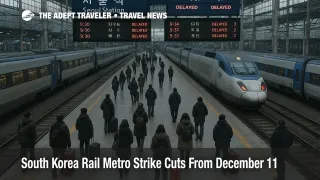
South Korea rail strike December 11 will cut KTX and commuter services across the country as the Korail union begins an open ended walkout, followed by a Seoul Metro strike that will thin subway frequencies just as holiday travel ramps up. Travelers using trains to move between cities or connect into Seoul for flights face reduced timetables, more crowded carriages, and heavier reliance on buses in the greater Seoul region. Anyone holding December rail tickets should now treat schedules as provisional, add generous buffers, and identify backup routes that do not depend on a single train line.
The South Korea rail strike December 11 will reduce national Korail capacity and force Seoul Metro to rely on emergency timetables, which means fewer trains and more crowding for visitors heading through Seoul and on to airports or KTX hubs.
What Is Happening
After last minute talks collapsed on 10 December 2025, the National Railway Workers Union confirmed that Korail staff will start an indefinite general strike from 9 a.m. on 11 December, with no fixed end date. Korail is the state controlled operator for most of South Korea's intercity rail network, including KTX high speed services from Seoul to Busan, Gwangju and other major cities, as well as Mugunghwa and ITX Saemaeul regional trains.
Seoul Metro unions, which operate urban subway lines 1 through 8, have already been running a work to rule action and are now scheduled to escalate to a strike from 12 December, overlapping with the Korail walkout. Line 9 is covered by a separate union that has also filed a strike notice, although the city says it has enough staff to maintain normal service there.
To limit gridlock, the national transport ministry and multiple city and provincial governments, including Seoul, Incheon and Gyeonggi, have activated 24 hour emergency transport headquarters and started rolling out contingency plans that favor morning commuters and shift extra demand to buses.
How Korail Services Will Be Cut
Korail's own strike plan gives the clearest guide to what travelers can expect. During the strike, the company says it will run KTX trains at about 66.9 percent of normal capacity, with Saemaeul and Mugunghwa services at 59 percent and 62 percent respectively. Metropolitan commuter trains under Korail will be prioritized in rush hours, where more than 90 percent of usual services should operate, but the daily average will fall to around 75.4 percent of normal.
For travelers, this does not mean trains stop altogether, but it does mean longer gaps between departures, fewer same day options, and a higher chance that popular trains between Seoul, Busan, Gwangju and other tourist hubs will sell out or be heavily crowded. Freight trains, which Korail expects to run at barely a fifth of normal volume, are likely to be hit hardest, which could indirectly affect supply chains and logistics dependent tours.
KTX services that share tracks or station platforms with non striking SRT high speed trains may also feel indirect pressure, because passengers who can shift will chase whichever departure still has seats. At the time of writing, SRT's workforce is not part of the Korail labor action, so its trains are not directly on strike, but they operate on overlapping corridors and may experience spillover demand and occasional knock on delays.
Seoul Metro And City Transit Plans
Inside Seoul, the main risk is not a complete shutdown but narrower time windows when service is close to normal. The Seoul Metropolitan Government has confirmed that on 11 December, the first day of the Korail strike, it will expand bus capacity by extending peak hours on 344 city routes, shifting the morning peak from 7 to 9 a.m. to a longer 6 to 9 a.m. window and stretching evening peak from 5 to 8 p.m., which it says is equivalent to about 2,538 extra bus trips.
If the Seoul Metro strike begins on 12 December as planned, subway lines 1 to 8 will run at 100 percent of normal during the 7 to 9 a.m. rush, but the evening picture is more mixed. Lines 2 and 5 through 8 are expected to operate normally from 6 to 8 p.m., while overall subway operations are kept to about 88 percent of the usual schedule by using non striking staff and contractors, roughly 80 percent of the normal workforce.
Beyond the capital, cities such as Incheon and Yangju have published their own emergency timetables. Incheon will leave Incheon Subway Lines 1 and 2 running normally, boost metropolitan bus frequencies on routes that parallel Korail's Gyeongin and Suin lines, deploy 165 reserve buses around major stations, and work with taxi and car sharing firms on late night capacity. Yangju expects Korail commuter trains to run at about 75.4 percent and Seoul Metro commuter services at around 72.7 percent, so it is adding standby buses on multiple routes serving Yangju, Deokgye and Deokjeong stations.
Airport Transfers And Long Distance Trips
Airport access remains a critical concern for visitors. Incheon International Airport (ICN) and Gimpo International Airport (GMP) should stay reachable, but the best route may change by time of day. Airport Railroad Express services are not operated by Korail, so they are not central to this strike, yet they share infrastructure with other busy links and will likely see heavier crowding as some passengers shift away from the subway.
For downtown to airport trips, Seoul and Incheon are both encouraging greater use of airport limousine buses, city buses feeding airport bus stops, and taxis, especially during peak periods when rail platforms are busiest. The city also plans to hold some subway trains in reserve on lines 2, 3 and 4 to deploy immediately if station congestion spikes, which may help keep transfers to Seoul Station and key interchange hubs moving.
Anyone with early morning flights should consider staying near Seoul Station, major airport bus stops in districts like Myeongdong or Gangnam, or near the airports themselves the night before departure, to reduce exposure to delayed trains. Once you reach the airport, check in and security processes should run normally, but the time to get to the terminal could be more volatile than usual.
What This Means For Your Itinerary
If you are planning to use Korail between 11 and 14 December, treat your tickets as reservations rather than guarantees of exact timings. Assume that your train will run, but be ready for it to be rescheduled, combined with another service, or replaced by a slower train type. Keep a screenshot or printout of your current reservation and monitor updates through the Korail website or app in the days before travel.
For city movements, visitors can expect Seoul Metro to feel busier than usual on lines 1 and 2, especially around Seoul Station, City Hall, Gangnam, Jamsil and other transfer hubs that were already highlighted as pressure points in earlier strike warnings. Work to rule tactics and slightly longer dwell times will add to the effect of reduced staffing, even if raw train counts hold near 88 to 100 percent in the peaks.
If your itinerary depends on a specific long distance KTX service, for example a same day Seoul to Busan leg that connects into a cruise, consider building a plan B using an earlier KTX, SRT where available, or an intercity bus. South Korea's express bus network is extensive and will not be directly affected by railway labor action, although road congestion around Seoul may increase.
Practical Steps For The Coming Days
First, audit every trip segment that falls on or after 11 December and uses Korail or Seoul Metro. Highlight any connection where a delayed train would cause you to miss a flight, a tour departure or hotel check in, and move those segments earlier in the day if possible.
Second, map out at least two alternative routes for critical city transfers, such as Seoul Station to Incheon International Airport or Gimpo International Airport, that do not rely on a single subway line. Combine airport buses, city buses and taxis so that if one corridor is clogged you can pivot quickly.
Third, download and bookmark the key tools that local authorities are using to share live updates, including Seoul's TOPIS traffic information site, subway status apps and Korail's own service alerts. These channels will be more current than static timetables and will often flag short notice changes to bus or reserve train deployments.
Finally, keep an eye on Adept Traveler's existing coverage of the Seoul subway dispute in our earlier piece, Seoul Subway Strike Threatens December 12 Travel, and our broader Strikes in South Korea hub as the situation evolves. Together, these resources can help you understand both the immediate disruption and the wider pattern of labor action that has affected Korean rail services over the past year.
Sources
- Railway Union to Launch Indefinite Strike at 9 a.m. Tomorrow... KTX at 67%, Freight Trains Plunge to 22%
- The Seoul Metropolitan Government announced on the 10th that it will preemptively operate an emergen..
- Korail, Seoul Metro unions begin indefinite strike Thursday, gov'ts implement emergency transport measures
- Incheon City Implements Emergency Transportation Measures Ahead of Railway Strike... Increases Metropolitan Bus Services
- Yangju City Mobilizes Emergency Transportation Measures in Full Response to Railway Strikes
- Railway, Subway Unions Announce Back-To-Back Strikes, Raising Fears of Year-End Travel Chaos