

Bulgaria Gen Z Protests And Government Fall Hit Travel
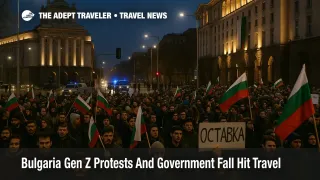
Gen Z led protests in Bulgaria have just claimed their first government, with Prime Minister Rosen Zhelyazkov and his coalition resigning on December 11, 2025 after weeks of mass rallies against a contested 2026 budget and entrenched corruption. Crowds in Sofia have repeatedly passed the 100,000 mark, filling central boulevards and squares around parliament and government offices. For travelers this means a capital where demonstrations, road closures, and heavy police presence can collide with airport transfers, city breaks, and winter trips that run straight into the January 1, 2026 euro changeover.
The Bulgaria Gen Z protests travel disruption now combines large scale youth dominated rallies with the uncertainty of yet another caretaker administration, just weeks before Bulgaria replaces the lev with the euro and becomes the eurozones twenty first member.
What Happened And Why It Matters For Travelers
The immediate trigger was the governments draft 2026 budget, the first framed fully in euros, which would have raised social security contributions and taxes while channeling fresh money to controversial institutions. Young Bulgarians, many already frustrated by low wages, underfunded healthcare, and the influence of sanctioned oligarch Delyan Peevski, turned social media campaigns into nightly demonstrations in Sofia and other cities starting November 26.
As protests swelled and opposition parties pushed a no confidence vote, Zhelyazkov first withdrew the budget, then resigned his minority cabinet minutes before the vote could topple it on December 11. It is Bulgarias eighth government collapse in four years, and it comes just as the country finishes technical preparations to adopt the euro on January 1, 2026, with conversion rates and dual pricing already locked in by European Union decisions.
For visitors, the headline is not state collapse in the sense of closed borders or grounded flights. It is a capital and a country that have grown used to political churn, now pushed into a new round of street politics at exactly the moment many travelers are planning city breaks, ski trips, and cross border itineraries around the euro switch.
How The Gen Z Protests Are Shaping The Street Level Experience
Most demonstrations so far have focused on symbolic locations, for example the Largo complex, parliament, and major ministries in central Sofia. Marches have periodically blocked key intersections, and in earlier years similar protest waves created rolling road closures and tent camps at major crossroads.
Current reporting suggests that public transport continues to run, and Sofia Airport remains open with normal security screening, but airport buses, taxis, and rideshares that cross the city center can experience delays when protests intersect their routes. Travelers heading to or from Sofia Airport should plan extra time when large rallies are announced in the late afternoon or evening and consider metro routes that avoid surface traffic for at least part of the journey.
In other cities, such as Plovdiv, Varna, and Burgas, solidarity protests have periodically filled central squares in past anti corruption waves and could do so again. That usually affects access to old town districts or municipal buildings more than highways, but visitors booked into central boutique hotels should expect noise, crowds, and short notice police cordons during peak protest nights.
Euro Adoption Still On Track, With Added Political Noise
Despite the governments fall, there is no sign yet that Bulgaria will miss its scheduled euro adoption on January 1, 2026. The European Union approved the accession earlier in 2025, fixing the lev conversion rate at 1.95583 per euro and setting rules for dual pricing and cash exchange.
For travelers in late December and early January, that means two overlapping storylines. On the financial side, card payments and ATM withdrawals should continue smoothly as banks and payment processors complete their migrations, with lev cash accepted during an official transition window and converted at the fixed rate. On the political side, a caretaker cabinet or fragile new coalition will be trying to shepherd the process while protesters test how far their new leverage goes.
Visitors who arrive before January 1, 2026 should avoid over withdrawing lev cash and instead lean on cards and bank machines that automatically apply the conversion rate once the switch occurs. Trips that cross the new year should assume some bureaucratic hiccups, for example slow service at smaller bureaus or temporary confusion over rounded prices, even though core financial plumbing is designed to stay stable.
Travel Risks: So Far Contained, But Fluid
Unlike full national strikes or airport specific protests, the current Gen Z mobilization has not targeted transport infrastructure directly. There are no reports of systematic attempts to block Sofia Airport, railway stations, or key border crossings. However, the mood is one of deep frustration with elites and state capture, and similar protest waves in the region have occasionally pivoted toward blockades if governments ignore demands.
Travelers should treat large announced marches and nights following major political developments, such as failed cabinet formation talks, as higher risk for road closures and confrontations with police, especially near party headquarters and parliament. Avoid driving directly through the Largo, presidency, or parliament zones when rallies are scheduled, and route airport transfers along ring roads or alternative corridors when possible.
Tour groups and individual travelers should also factor in soft impacts. Museums or attractions near the protest core may close early on heavy demonstration days. Restaurant and bar service can be disrupted if staff or guests struggle to reach central streets. Hotel guests overlooking major squares may experience noise late into the night.
How This Fits A Wider Gen Z Protest Wave
International coverage has framed Bulgarias crisis as part of a broader wave of Gen Z driven protests that has shaken governments from Nepal to Madagascar and fueled unrest in Indonesia, the Philippines, and Tanzania. Common threads include social media organization, meme heavy protest art, and a sharp focus on corruption, elite impunity, and cost of living pressures.
In Bulgaria specifically, coverage notes that many of the most visible faces on the streets are in their late teens and twenties, a generation that has grown up with European Union membership yet sees persistent inequality, outward migration, and scandal plagued institutions. For travelers, that matters less as a safety question and more as context, especially for those who come to Bulgaria for cultural tourism or longer stays and want to understand why central squares are filled night after night.
Planning Trips During Bulgarias Political Transition
For short city breaks in Sofia over the next several weeks, the simplest approach is to book accommodation either squarely inside the central pedestrian zone, where you can walk around protests rather than through them, or clearly outside the main ring roads with straightforward access from the airport and train station. Avoid relying on tight ninety minute door to door windows that require multiple changes across the city center.
Rail and intercity bus travelers should check schedules as usual but focus more on station access and last mile connections than on national timetables. If a major protest is called on your arrival or departure date, add one or two hours of buffer and consider arriving early to stations on foot or via metro instead of taxis that might get stuck in traffic.
For road trips that cross into or out of Bulgaria, monitor both Bulgarian and neighboring country news feeds for any sign that solidarity actions are targeting border crossings or highways, similar to farmer and trucker blockades seen elsewhere in the Balkans in 2025. Build backup routes via alternative crossings where feasible, and avoid planning same day airport connections that depend on a single land border staying open.
Finally, travelers whose trips straddle the January 1, 2026 euro adoption should keep documentation of prebooked prices, use credit cards where possible, and be prepared for slightly longer checkouts or ticketing interactions as staff handle dual currency displays. The political story will be noisy, but for most visitors the main operational changes will be in their wallets, not at the airport gate.