

Porter Dispatchers Strike Mandate Threatens Canada Flights
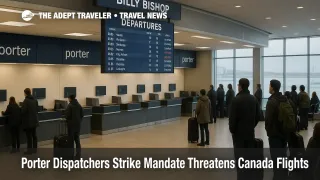
The Porter dispatchers strike Canada flights risk is now a real planning factor for travelers using Toronto and other Canadian hubs after flight dispatchers at Porter Airlines voted 100 percent in favour of strike action on December 11, 2025, following more than 14 months of bargaining for a first collective agreement. The mandate covers all 35 certified dispatchers who oversee Porter operations across its domestic, transborder, and international network. No strike date has been set, but the union and the airline both confirm that conciliation under federal labour law is under way, which means any walkout would follow formal cooling off periods and notice rules rather than erupt overnight.
The Porter dispatchers strike Canada flights scenario moves a boutique carrier that many passengers use to avoid big hub congestion into the same risk bucket as larger airlines that have already gone through hard wage rounds in 2025. For winter and early 2026 trips into and out of Billy Bishop Toronto City Airport (YTZ), Toronto Pearson International Airport (YYZ), Ottawa Macdonald Cartier International Airport (YOW), and Montréal Pierre Elliott Trudeau International Airport (YUL), travelers now need to weigh strike timing, backup tickets, and refund rules alongside the usual weather and congestion issues.
What The Strike Mandate Actually Means
The Canadian Airline Dispatchers Association, CALDA, says its members at Porter voted unanimously to authorise strike action after negotiations that began when dispatchers unionised in August 2024 failed to produce a first contract. Union statements describe complaints about pay, workload, and respect, and sharply criticise the airline for training non union staff to potentially replace dispatchers in the event of a work stoppage, which the union calls unsafe and irresponsible for an aviation safety role.
Dispatchers occupy a critical niche in airline operations. CALDA notes that licensed flight dispatchers share legal responsibility for each flight with the pilot in command, planning routes and fuel, monitoring weather and air traffic control, and issuing operational decisions once flights are under way. If they walk out, airlines cannot simply push all work onto pilots or frontline staff without materially changing risk profiles, which is why both unions and carriers treat any dispatcher strike mandate as a serious escalation.
For now, Porter emphasises that conciliation is ongoing and insists there is no risk of an immediate labour disruption, stressing that it values dispatchers and has made what it calls fair and meaningful proposals. That combination, a unanimous strike mandate plus management messaging that a strike is not imminent, is typical of the mid stage in a Canadian labour dispute, where both sides raise pressure while federal processes continue in the background.
How The Strike Timeline Works Under Canadian Law
Airlines like Porter fall under federal jurisdiction and the Canada Labour Code, which sets structured steps before any legal strike or lockout for most air transportation workers. Once a notice of dispute is filed, the Federal Mediation and Conciliation Service can appoint a conciliator for a period that usually runs up to 60 days. After conciliation ends, there is a mandatory 21 day cooling off period, and only after that can either side issue a 72 hour notice of strike or lockout before stopping work.
CALDA and Porter both indicate that conciliation is in progress now, which means passengers are looking at a staged runway rather than a cliff edge. If conciliation wrapped up toward the end of December 2025, the earliest fully legal strike window would likely land in late January or early February 2026 after the cooling off period and a 72 hour notice, but the timeline could easily move later if conciliators extend talks or the parties agree to mediation beyond the initial window.
For travelers, this matters because it turns a vague sense of risk into a rough calendar. Winter trips in the very early weeks of January may face lower strike odds than long weekends and business travel deeper into February and March, although any forecast remains conditional on how bargaining evolves.
Which Porter Flights Would Be Hit Hardest
Porter has grown from a niche turboprop operator at Billy Bishop into a network carrier with Embraer E195 E2 jets serving 24 domestic and 21 international destinations across six countries as of early December 2025. Its main bases are at Billy Bishop and Toronto Pearson, with significant operations at Ottawa and Montreal plus focus cities at Halifax Stanfield International Airport (YHZ) and Vancouver International Airport (YVR).
If dispatchers withdraw their labour, the brunt of cancellations would fall on:
- Shuttle style links such as Billy Bishop to Ottawa and Montreal that serve business travellers who rely on same day returns.
- High frequency Toronto Pearson routes feeding connections to U.S. cities like New York and Boston, and winter sun gateways in the United States and the Caribbean.
- Cross country and transcontinental routes linking Toronto or Ottawa with Western Canada, where aircraft and crews are tightly scheduled and harder to reassign if operations are constrained.
Because dispatchers sit upstream of individual flights, a walkout would be more like a network shutdown or severe thinning than a handful of isolated cancellations. Travelers using Porter as a positioning carrier into Pearson or Trudeau to connect with separate tickets on other airlines would be particularly exposed, since misconnects on separate itineraries do not carry through protections.
How To Book Porter Trips Around The Risk
The Porter dispatchers strike Canada flights risk does not mean every winter itinerary needs to be abandoned, but it does justify a more conservative booking posture, especially for high value trips in early 2026. A practical approach is to split plans into three buckets.
First, for non essential leisure trips that are still flexible, travellers can either delay committing to Porter until more is known about conciliation outcomes or price comparable itineraries on Air Canada, WestJet, or other carriers out of the same cities. Paying slightly more now for a ticket that is insulated from this specific dispute may be worthwhile if travel dates are fixed and alternatives are limited.
Second, for essential trips where Porter offers the best schedule or airport, such as short hops into Billy Bishop for downtown Toronto meetings, consider booking fully refundable or flexible fares, or using points tickets that can be redeposited with low penalties. Building a backup on another carrier for key segments, for example a later same day flight on a different airline into Toronto Pearson, can provide a safety net if strike notices emerge close to departure.
Third, for complex journeys that involve cruises, package tours, or once daily long haul flights, it is safest to avoid relying on Porter for same day connections while strike risk is elevated. Instead, aim to arrive at your cruise port or long haul gateway city at least one full day early, even if that means paying for an extra hotel night. Earlier Adept Traveler coverage of Air Transat labour negotiations, including Air Transat Strike Averted For Canada Winter Flights, shows how quickly controlled shutdown plans can evolve when unions issue 72 hour notices and airlines start pre emptive cancellations.
What Happens If A Strike Is Averted
Recent Canadian aviation disputes suggest that many high profile strike threats end not with prolonged walkouts, but with tentative agreements reached shortly before or after legal strike windows open. The Air Transat pilots dispute, which saw 72 hour notices and pre emptive cancellations before a December 9, 2025, tentative deal, is a case study in how airlines may wind down and then rebuild schedules around a potential stoppage.
If Porter and CALDA follow a similar arc, passengers might see a period of heightened schedule volatility as the airline pares frequencies or consolidates flights while talks continue, then a gradual return to normal if an agreement is reached and ratified. The unanimity of the strike mandate does not guarantee a walkout; it gives union leaders leverage and signals member resolve, but both sides still have incentives to avoid a shutdown that could damage the brand at a time when competition in Canadian short haul markets is intense.
From a planning perspective, that means travelers should focus less on guessing the exact odds of a full stoppage and more on building itineraries that can survive either path, a strike that goes ahead, or a near miss that still produces heavy pre emptive cancellations and retimes.
Passenger Rights If Flights Are Cancelled
Canada's Air Passenger Protection Regulations, APPR, divide disruptions into categories, including situations outside the carrier's control, such as labour disruptions within the airline or essential service providers. When a cancellation or long delay is caused by a situation outside the carrier's control, airlines must provide information, offer alternate travel arrangements or refunds, but are not required to pay cash compensation for inconvenience in the way they must when problems are within their control and not related to safety.
For a genuine Porter dispatcher strike, travellers should expect a baseline of rerouting on the airline's own flights or partners where available, or refunds if no reasonable alternatives exist, rather than automatic cash payouts under APPR. However, if Porter chooses to cancel flights pre emptively in anticipation of a strike that has not yet begun, consumer advocates argue that those decisions can fall back into the "within carrier control, not related to safety" category, with stronger compensation rights, as seen in recent disputes over Air Transat pre strike cancellations.
Either way, passengers should document all notices, keep receipts for reasonable hotel and meal costs, and review both Porter's tariff and APPR guidance before filing claims. For crossborder and overseas itineraries, the Montreal Convention may also govern liability for delays and cancellations, especially when baggage issues or significant financial losses are involved.
How This Fits Into Broader Canada Labour Tensions
The Porter dispatchers strike Canada flights scenario arrives in a year when Canadian aviation has already absorbed an Air Canada flight attendants strike and an intense Air Transat pilots dispute, both driven by wage, workload, and unpaid time concerns. That pattern suggests that even mid sized and boutique carriers are not insulated from the same inflation and work rules pressures affecting larger airlines.
For Adept Traveler readers, the key takeaway is that labour risk is no longer an occasional outlier but a recurring structural factor in Canadian trip planning. Combining this alert with our existing coverage on strike mechanics and passenger rights, including Air Transat Strike Averted For Canada Winter Flights and Italy Rail Strike October 2 3 Follows Friday's Air Transport Walkouts, gives travelers a playbook for treating strikes as one more risk to be priced into routes, dates, and buffers rather than a complete unknown.
For now, the best strategy for Porter customers is to monitor conciliation updates closely, avoid overpaying for speculative backups, and adjust a small set of high stakes itineraries where a strike or near strike would be hardest to absorb.
Sources
- Porter Airlines dispatchers vote 100% in favour of strike action, CityNews
- Porter Airlines Flight Dispatchers Vote to Strike After 14 Months of Negotiations, Canadian Airline Dispatchers Association
- Canada Labour Code, Government of Canada
- Federal Mediation and Conciliation Service process overview
- SOR/2019 150, Air Passenger Protection Regulations, Government of Canada
- Compensation for flight delays and cancellations, APPR official site
- Air Transat Strike Averted For Canada Winter Flights, Adept Traveler
- Italy Rail Strike October 2 3 Follows Friday's Air Transport Walkouts, Adept Traveler
- Porter Airlines route map and hubs, FlightConnections