

Tonga Wind And Flood Warnings Hit Sea Travel
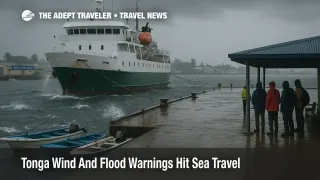
Tonga wind warnings sea travel risks are rising for mid December 2025, as strong wind, heavy rain, and flood alerts spread across key island groups and coastal waters. The Tonga Meteorological Service has issued overlapping strong wind warnings, heavy rain warnings, and flash flood advisories for land areas in Vavaʻu, Haʻapai, Tongatapu, and ʻEua, with matching strong wind and small craft advisories for surrounding coastal waters and extreme high tides around the archipelago. For visitors planning inter island ferries, open boat resort transfers, sailing, and dive trips, that mix points to rough seas, low visibility, and schedule changes, so island hops between Tongatapu, Vavaʻu, Haʻapai, the Niuas, and smaller outer islands need more slack and more conservative choices than printed timetables suggest.
The latest Tonga Meteorological Service bulletins turn the usual wet season caution into an active run of strong wind, heavy rain, and small craft warnings that can delay or cancel ferries and small boats around the main tourist routes.
What The Current Warnings Actually Say
Recent land area warnings keep strong wind alerts in force for all of Tonga, with heavy rain warnings and flash flood advisories focused on Vavaʻu, Haʻapai, Tongatapu, and ʻEua, where squally showers and embedded thunderstorms are expected. Parallel marine bulletins layer on strong wind warnings and small craft advisories for coastal waters off the same groups, along with an extreme high tide advisory for all Tongan coastal waters, a combination that routinely prompts ferry delays and cancellations.
Local coverage describes a developing low pressure system bringing persistent strong winds and heavy rain across much of the country, reinforcing official guidance that squally conditions will dominate for several days rather than a single stormy afternoon. In practice, that means whitecapped seas, gusty crosswinds around wharves, and reduced visibility in showers, exactly the conditions that boat captains and port authorities watch closely when deciding whether to sail.
The timing and intensity of individual showers and wind surges will vary by island group and day, but as long as these warnings stay in place, travelers should treat any printed ferry or small boat schedule as provisional. Operators may confirm departures only a few hours before sailing, or decide to hold vessels in port if local squalls line up poorly with crossing times.
Sea Travel: Ferries, Open Boats, And Resort Transfers
For most visitors, sea travel in Tonga falls into three broad buckets. First, larger inter island ferries connecting Tongatapu with Haʻapai and Vavaʻu, and sometimes on to the Niuas. Second, small open boats and day tour vessels running snorkel trips, whale watching style excursions in season, and day hops to nearby islets. Third, charter yachts and liveaboard style dive boats that use local ports as staging points.
Strong wind warnings and small craft advisories are primarily aimed at the second and third categories, because shorter, lighter boats are much more exposed to steep wind waves, confused chop, and poor visibility in squalls. Even when a captain feels technically able to operate, open boats landing passengers on beaches or small jetties may become unsafe if surf builds or cross swell starts hitting landing points. Operators who cancel under these conditions are doing exactly what they should do, and travelers should not push them to sail.
Larger ferries have more latitude, but they are not immune. Warnings about heavy rain and flash flooding are a signal that roads to and from wharves can be cut by swollen streams or ponding, and that loading areas may be slick and congested. On some runs, extreme high tides combined with wind driven waves can make docking maneuvers marginal, particularly on older infrastructure that lacks large fenders or enclosed terminals.
Official travel advisories already warn that maritime safety regulations in Tonga are not always followed, and that ferries can be overcrowded when demand is high, especially during holidays and festival periods. Add strong wind, heavy rain, and night crossings to that structural backdrop and it becomes even more important for travelers to choose daylight departures where possible, favor better maintained vessels when there is a choice, and be prepared to sit out a sailing if something feels off.
Domestic Flights And Island Hops
International links into Fua'amotu International Airport (TBU) on Tongatapu should mostly continue operating under wet season procedures, which are designed to handle showers, moderate crosswinds, and low cloud. However, heavy rain bands, turbulence around squall lines, and water on the runway can still trigger minor delays, particularly if visibility briefly drops below approach minima. Visitors should assume that tight self made connections between long haul arrivals and same day boats can fail if an inbound flight is held in a stack or diverted.
Domestic routes into Lupepauʻu, better known to travelers as Vava'u International Airport (VAV), and Lifuka Island Airport (HPA) in Haʻapai use smaller aircraft that are more sensitive to gusty crosswinds and short notice weather changes. These airports can see local showers and wind shifts that differ from Fua'amotu, so a flight may operate one leg but be delayed or canceled in the opposite direction as conditions change. In some cases, airlines will simply wait until weather passes rather than pushing the limits of wet, gusty strips.
Given that Tonga's cyclone and severe storm season runs roughly from November to April, regional advisories already recommend that visitors build weather slack into itineraries and know evacuation and shelter plans at hotels and on cruises. The current run of warnings is an example of why that guidance matters even when no named cyclone is on the chart.
Planning Tactics For Island Hoppers
For travelers already booked over the next week, the safest approach is to assume that at least one domestic leg may be moved or scrubbed. Concrete tactics include the following.
First, add buffer nights where it matters most. Anyone connecting from offshore islands or from Vavaʻu or Haʻapai back to Tongatapu should keep at least one full night in or near Nukuʻalofa before an onward long haul flight, rather than relying on a same day boat or domestic flight. If conditions improve and everything runs to time, that final day can be used for local touring or rest, but if a leg is lost to weather, you will not be stuck on the wrong island when your international flight leaves.
Second, avoid last sailings of the day when warnings are active. Morning crossings give more daylight to troubleshoot problems and rebook, and winds in the tropics sometimes ease slightly overnight before building again with daytime heating. Even if that pattern does not play out perfectly, it is usually better to discover a cancellation at 8 a.m. than at dusk.
Third, keep bookings as flexible as budget allows. The pattern seen elsewhere in the South Pacific during this cyclone season, where ferry and cruise passengers have leaned toward one night buffers and flexible fares rather than risky same day links, is a useful template for Tonga as well. Look for accommodation that allows date changes, and tickets that can be reissued or credited if a domestic leg fails.
Fourth, be realistic about road conditions. Heavy rain and flash flood advisories mean that low lying roads, causeways, and bridges can be impassable for hours at a time, even if skies clear briefly. Allow extra time for transfers to and from wharves and airports, and follow local advice if police or village authorities close a road or ask people to avoid certain low spots.
What To Do If Boats Or Flights Are Scrubbed
When a ferry, open boat, or domestic flight is canceled, low drama problem solving usually beats improvised heroics. Start with accommodation, and secure somewhere safe and dry to stay for at least the next night, even if that means extending your current booking. Next, contact any onward operators, such as dive shops, resorts, or tour companies on the next island, to let them know you are delayed and to adjust pickup plans or day trip schedules.
If a domestic flight from Vavaʻu or Haʻapai is canceled and you have a long haul ticket soon after, speak to the airline or your agent about bringing forward or pushing back the long haul leg. Airlines are often more flexible when delays are clearly weather related and backed by official warnings. For ferry cancellations, local practice varies, but operators may offer a later sailing when conditions improve, or, in more prolonged events, allow refunds or date changes.
Avoid hiring unlicensed small boats or pressing private skippers to run crossings in marginal conditions. Official advisories already flag structural weaknesses in Tonga's maritime safety regime, and recent tragedies in other Pacific nations have underlined the risks of overloaded, poorly equipped vessels pushing through bad weather. If the official ferry service is held, there is usually a good reason.
Finally, keep paperwork tidy. Good travel insurance that explicitly covers weather related delays and cancellations can make the difference between an expensive scramble and a manageable inconvenience, but insurers will expect documentation, such as airline notices, screenshots of meteorological warnings, and receipts for extra nights or reissued tickets.
How This Fits The Wider South Pacific Pattern
The Tonga warnings arrive in the middle of an already active regional season, where late year cyclones and extreme rainfall have disrupted travel across parts of the South Pacific and Southeast Asia, and where cruise and yacht itineraries have been reshaped by changing storm statistics. For Adept readers, the lesson is not that Tonga is uniquely risky, but that sea dependent itineraries anywhere under the cyclone belt now demand more buffers, more flexible routing, and a higher tolerance for last minute changes.
Anyone planning future Tonga trips for the 2025 to 2026 cyclone window can still enjoy inter island sailing, diving, and resort hopping, but the safest plans will treat published ferry and small boat schedules as guidance rather than guarantees, and will keep Nukuʻalofa, Vavaʻu, and Haʻapai destination guides close at hand for backup ideas if the sea closes in for a day or two.
Sources
- Tonga Meteorological Service, forecast and warning bulletins for land areas and coastal waters, December 2025
- Tonga Meteorological Services, official Facebook warnings for land areas and coastal waters, December 7 to 10, 2025
- Talanoa o Tonga, Strong winds and heavy rain bring warnings across Tonga
- SafeTravel New Zealand, Tonga travel advisory
- Smartraveller Australia, Tonga travel advice and safety
- Government of Canada, Travel advice and advisories for Tonga
- Adept Traveler, South Pacific Cyclone Season Puts Vanuatu Cruises At Risk