

Ecuador Curfews Keep Night Airport Transfers Risky
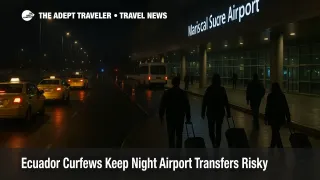
Ecuador curfew travel risk remains a live planning issue in Guayas and Quito after Australia's Smartraveller reaffirmed that a state of emergency spans multiple provinces and cantons, with 1000 p.m. to 500 a.m. curfews in some territories, in an update dated November 14, 2025. Travelers with late arrivals, early departures, and overland legs through coastal and border regions are the most exposed. The practical move is to design itineraries around daylight transfers, build extra slack into connections, and coordinate hotels and drivers so a sudden enforcement change does not strand you mid trip.
The Ecuador curfew travel risk is not just a safety headline, it is an operational constraint that can reshape how, and when, travelers can legally move between hotels, roads, and airports.
Smartraveller's language matters because it is specific about how quickly conditions can shift. It notes a separate state of emergency affecting Guayas, Los Ríos, Manabí, Orellana, Santa Elena, El Oro, Sucumbíos, Azuay (Ponce Enríquez canton), and Pichincha (the Metropolitan District of Quito), and it flags that several cantons have curfews from 1000 p.m. to 500 a.m., with travelers told to check local authorities for the exact local restrictions. In the same section, it warns that police and military can restrict movement, monitor communications, enter properties to conduct searches, and impose curfews on short notice.
For travelers, that combination produces a predictable set of pain points: airport transfers that fall into curfew hours, rideshare and taxi availability that thins after dark, highway segments that slow or close without much warning, and checkpoints where officers ask for identification and an explanation of where you are going. Even if you never encounter a formal curfew line, the behavior changes around it, with fewer transport options and more friction at the curb.
Why Airports Are Part of The Problem
Ecuador's two most common gateways for international travelers are Mariscal Sucre International Airport (UIO) near Quito, Ecuador, and José Joaquín de Olmedo International Airport (GYE) in Guayaquil, Ecuador. Both airports can operate normally while the trip to and from the terminal becomes the fragile link, especially late at night. If your flight lands after 10:00 p.m., the risk is not only a delay at baggage claim, it is the possibility that the last leg to your hotel crosses into a canton with active restrictions, or that enforcement tightens after an incident elsewhere.
This is where itinerary design beats improvisation. A traveler who lands late should treat the airport area hotel as a real option, not a defeat, because it preserves daylight movement the next morning. A traveler who must connect same night should rely on a pre arranged hotel transfer or a vetted transport provider, not a curbside scramble, because the driver is more likely to know which approaches are being controlled, and which routes are being waved through.
Background
A state of emergency or state of exception in Ecuador is typically implemented through executive decrees that define where measures apply, how long they last, and what rights or movements can be limited. For example, Executive Decree No. 202, issued in Quito on November 4, 2025, and entering into force November 5, 2025, declared a state of exception for Guayas, Los Ríos, Manabí, and Santa Elena, plus specific cantons, reflecting how geographically targeted these measures can be. The important travel takeaway is that the map can change, sometimes quickly, and travelers should treat any government advisory list of affected provinces or cantons as time sensitive, not a static rule set.
What This Means For Night Moves, Overland Transfers, And Tours
The U.S. State Department's Ecuador advisory provides useful context for why road and transfer planning is so central right now, warning that demonstrations can occur, and that demonstrators often block local roads and major highways without warning, disrupting access to important infrastructure. Even when a trip is purely touristic, this kind of unpredictability is what turns a two hour drive into a missed flight, or a missed check in window for a Galápagos connection.
So the right approach is conservative logistics. Travelers moving through Guayas, Los Ríos, Manabí, El Oro, Santa Elena, and Sucumbíos should avoid planning any critical arrival that depends on late evening road travel. If a tour requires an early morning departure, stay closer to the departure point the night before, rather than betting on a long predawn drive. If you are linking an overland leg to a flight, treat a same day buffer as mandatory, not optional, because a checkpoint delay can be invisible until it suddenly is not.
Hotels can do more than travelers often realize. A front desk that is used to curfew enforcement can advise whether your neighborhood is seeing active stops, whether a specific route is being redirected, and whether they recommend a licensed taxi stand, a known driver, or an internal transfer partner. That is why coordination matters, not as a luxury, but as a reliability tool.
A Practical Tourist Checklist, Without The Fear Mongering
Travelers do not need to catastrophize to be prepared. The basics are enough if you do them early: keep photo ID on you, and keep a screenshot or printed copy of your flight itinerary, your hotel reservation, and your next booking so you can explain your route quickly at a checkpoint. Save your hotel address offline, and share your arrival plan with the property so they know when to expect you. If you are arriving late, ask the hotel to confirm whether your pickup route crosses any canton with restrictions, and ask what they want you to do if your flight is delayed into deeper curfew hours. If you are driving between cities, check official road status before you leave, and again before you commit to the last long stretch, because the reality can change faster than a map app refresh.
Smartraveller specifically points travelers to Ecuador's ECU 911 road status portal for road conditions, which can be a useful cross check when demonstrations or security operations create roadblocks. When the goal is simply to make the flight, simple redundancy beats guesswork.
For related context on how these curfew and checkpoint dynamics have been affecting travelers on the ground, see Adept Traveler's recent coverage of Guayaquil stays and transfers, and the destination hub for Guayaquil, Ecuador, which tracks security and logistics updates over time: https://adept.travel/news/2025-12-08-ecuador-armed-conflict-guayaquil-stays-transfers and https://adept.travel/destinations/ecuador/guayaquil.
Sources
- Ecuador Travel Advice and Safety, Smartraveller
- Ecuador Travel Advisory, U.S. Department of State
- Executive Decree No. 202 (PDF), Daniel Noboa Azín
- Consulta de Vías, ECU 911
- Aeropuerto Internacional de Quito, Mariscal Sucre International Airport (UIO)
- TAGSA, José Joaquín de Olmedo International Airport (GYE)