

Tegucigalpa Election Protests Block Roads Near TGU
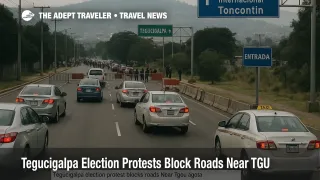
Tegucigalpa election protest roadblocks are disrupting traffic across Tegucigalpa, Honduras, and raising missed flight and missed bus risk for travelers trying to reach Toncontín International Airport (TGU) on December 12, 2025. The biggest hit is to airport transfers, hotel changes, and intercity bus departures that depend on a few bridges and choke points to move across the capital. Travelers should add significant buffer time, be ready to reroute at short notice, and avoid moving through protest corridors during peak daytime rally windows.
Tegucigalpa election protest roadblocks mean the "normal" drive time to Toncontín can become unreliable, even when flights operate as scheduled.
What Travelers Are Seeing In Tegucigalpa
The protest risk is being driven by a delayed and disputed tabulation process after the November 30, 2025 general election, which has prompted fraud claims and competing calls for recounts or annulment. International election observers are publicly urging political leaders to avoid disrupting the process, and to use the formal traceability and legal mechanisms rather than street pressure. The Organization of American States observation mission has explicitly rejected calls to disrupt public order while the legally mandated counts are underway, and it called for security forces to safeguard electoral materials and for the process to proceed without pressure.
On the ground, disruption has not been evenly spread across the city, it is concentrated where a small number of blockades can snarl the whole network. Reuters reported that demonstrators blocked a bridge linking Tegucigalpa and Comayagüela during the protests on December 10, 2025, a type of pinch point action that can rapidly cascade into gridlock well beyond the immediate crowd. Separate local traffic notices around political mobilizations have also flagged closures along Bulevar Suyapa toward the Miraflores area, which matters because it can force drivers onto fewer, slower alternates.
Why The December 30 Deadline Matters For Trip Planning
For travelers, the key is not picking a side, it is understanding the calendar that can drive flashpoints. Reuters has reported that the National Electoral Council has until December 30, 2025 to certify the results, and that the delay in final results has helped fuel protests and political escalation. Reuters also reported that a special recount of some votes is expected to begin around Saturday, December 13, 2025, although officials cautioned there was no confirmed start date at the time of reporting. The European Union election observation mission has likewise urged political actors to channel complaints through formal mechanisms and to avoid disrupting the process while tabulation continues.
That combination, an approaching certification deadline plus recount activity, is the pattern that often produces predictable spikes in street mobilization. Even if downtown looks calm at breakfast, the situation can change quickly if a march route shifts, a bridge is blocked, or security forces tighten perimeters around election related facilities.
Practical Playbook For Airport Runs, Hotels, And Buses
Start with the airport reality. Toncontín International Airport (TGU) is in the capital and sits behind city traffic constraints, so the weakest link is usually the drive, not the flight. If you have a flight out of Toncontín, the safest approach is to treat your transfer time as flexible and to plan for detours. In practice that means arranging pickup earlier than you normally would, confirming that your driver can change routes dynamically, and avoiding any itinerary that requires passing through the city center at the same time a demonstration is building.
If you are changing hotels inside Tegucigalpa, prioritize moves in the morning, and confirm whether your property can shift pickup points to a nearby main road if smaller streets are blocked. Keep screenshots or offline copies of your booking and boarding details in case mobile data slows or you lose signal in a congested area. If you rely on an intercity bus, call or message the operator before you leave the hotel, because terminals can delay departures, change boarding procedures, or ask passengers to arrive earlier when streets around the station are congested.
Consider alternatives when they genuinely fit your ticket. For some itineraries, flights may operate via Palmerola International Airport (XPL) near Comayagua instead of Tegucigalpa, and that can sometimes reduce exposure to inner city choke points, but only if your airline, and your onward ground transport, actually support the switch. Do not assume you can "just go there" without verifying transport conditions, because protests can also affect highways and access roads depending on where crowds concentrate that day.
Finally, keep your behavior simple around protests. Do not approach crowds to watch, do not try to cross blockades, and do not argue with demonstrators or security forces. If you encounter a roadblock, turn around and reroute, and let your driver choose the safest main road option rather than improvised side streets. Local reporting has quoted police emphasizing they will not allow blockades, a signal that enforcement posture can tighten with little warning, which can also slow traffic further as checkpoints appear.
Related Adept Traveler Coverage
For broader planning context on how protest roadblocks change airport transfer strategy, see Honduras Election Month: Expect Protest Roadblocks and the evergreen framing in Travel Advisory. For a practical "airport transfers under protest risk" template you can adapt, see Amman Protests And Airport Transfers Risk Guide.
Sources
- Protests in Honduras as president calls for election to be annulled amid further results delay, Reuters, December 10, 2025
- Recount of some votes in Honduras election expected to begin as deadlock drags on, Reuters, December 11, 2025
- OAS Mission in Honduras Categorically Rejects Any Call to Disrupt Public Order, OAS press release E 086 25, December 10, 2025
- EU Election Observation Mission to Honduras 2025 press release, December 10, 2025
- Cierres temporales en Tegucigalpa por movilización del Partido Liberal, Tiempo, December 9, 2025
- Policía Nacional advierte que no permitirá tomas, bloqueos ni cierres, El Heraldo, December 10, 2025
- Toncontín Airport overview (TGU), Skybrary
- Aeropuerto Internacional de Palmerola, Agencia Hondureña de Aeronáutica Civil