

U.S. Holiday Travel Forecast: Dec 20 To Jan 1
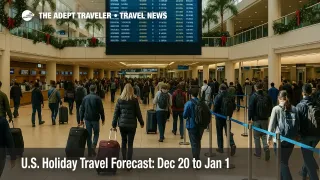
The U.S. holiday travel forecast for December 20, 2025, to January 1, 2026, points to a record 122.4 million Americans traveling at least 50 miles from home. That volume affects nearly every kind of traveler, from families driving to see relatives to flyers trying to connect through busy hubs, and vacationers heading for warm weather. The practical move is to shift departure times away from the busiest road windows, pad airport arrival and connection time, and treat weather as the wildcard that can turn "busy" into "stuck."
The U.S. holiday travel forecast matters because it signals when congestion and crowding are most likely, which helps travelers decide when to leave, what routes to take, and how much buffer time to build.
AAA says the 13 day year end holiday period, defined this year as Saturday, December 20, 2025, through Thursday, January 1, 2026, will top last year's record, rising 2.2% to 122.4 million travelers. By mode, AAA projects 109.5 million will travel by car, 8.03 million will take domestic flights, and 4.9 million will travel by bus, train, or cruise, with the "other modes" bucket up 9% year over year and up 25% compared with 2019. AAA also notes that national average gas prices fell below $3.00 (USD) per gallon in December, which can further reinforce driving's advantage on cost and flexibility.
Background AAA's holiday forecast is not a TSA checkpoint count, and it is not "air travel only." The estimate is built as a domestic leisure travel forecast of "person trips," and AAA says it is developed with S&P Global Market Intelligence using macroeconomic variables, plus historical travel behavior estimates from MMGY's Travel Performance Monitor. AAA also flags that TSA screening counts every time someone enters a secure area, while AAA's approach is built around a round trip travel itinerary concept, which is why the numbers will not line up one to one.
What the forecast says about driving
Driving remains the core story. AAA expects 89% of holiday travelers will take road trips, totaling 109.5 million people traveling by car over the period. That concentration means the highway system, and especially interstate approaches to major metros, is where travelers will feel the most friction.
AAA's INRIX based guidance points to a familiar rhythm. Christmas week is expected to be busier than New Year's week, with interstates most congested the weekend before Christmas, especially Saturday, December 20, and Sunday, December 21. In the days leading up to Christmas, the worst windows generally cluster in the early afternoon through early evening, while the best windows tend to be earlier in the morning, or later at night. AAA also calls out Friday, December 26, as a major post Christmas push day, with another broad band of congestion building from late morning into the evening in many metros. By contrast, AAA expects minimal traffic impacts on Christmas Eve and Christmas Day, and again on New Year's Eve and New Year's Day, although it cautions that crashes or severe weather can still create long delays even on "light" days.
For travelers planning long drives, the key is not "leave early" in the abstract, it is leaving outside the afternoon peak and having a fallback window. A one to two hour shift can be the difference between steady movement and stop and go conditions that add hours.
What the forecast says about flying
AAA's air travel projection is a record for the winter holiday period, 8.03 million domestic flyers, up 2.3% from last year. AAA also says its booking based pricing data shows round trip domestic flights averaging nearly $900.00 (USD), about 7% higher than last year, with the days leading up to Christmas typically the most expensive, and travel on the holiday itself often cheaper.
For travelers, that pricing pattern tends to align with operational reality. If more people are trying to fly in a narrower pre Christmas window, airports, security lines, and standby lists all tighten, and small disruptions can cascade. This is where following daily operational signals matters. If you want a working example of how fast conditions can change at hubs in winter, see our recent FAA based roundup, Flight Delays And Airport Impacts: December 11, 2025, which breaks down how weather pressure concentrates delays at a handful of airports, and then ripples outward.
A common traveler mistake during peak weeks is treating the airport trip as "fixed time." It is not. If your plan involves Orlando International Airport (MCO), Fort Lauderdale Hollywood International Airport (FLL), or Miami International Airport (MIA), which sit in the top tier of AAA's domestic destination list, build extra time for both the ground trip and the terminal process, because congestion often hits curbside, parking, bag drop, and security at once.
Where Americans are going
AAA's booking data suggests warm weather demand is again the dominant theme domestically. Orlando, Fort Lauderdale, and Miami lead the list, followed by Anaheim and Los Angeles, Honolulu, Tampa, New York City, Maui, Dallas and Fort Worth, and Las Vegas. Internationally and across the Caribbean, AAA's top destinations list is led by Cancun, Mexico, plus Punta Cana, Dominican Republic, and Cozumel, Mexico, followed by San Jose, Costa Rica, Puerto Vallarta, Mexico, San Juan, Puerto Rico, Nassau, Bahamas, Rome, Italy, Oranjestad, Aruba, and Sydney, Australia.
This destination mix matters because it explains where crowds concentrate, and why some routes feel "full" even if the national system is not weather constrained. Florida, Southern California, and Hawaii flows tend to load heavily into a smaller set of gateways, and that concentrates pressure at specific airports and highway approaches.
How to use the "best and worst times" guidance
AAA and INRIX point travelers toward a simple behavioral edge, do not drive into the mid day and afternoon peak when everyone else does. For this year end window, that means treating Saturday, December 20, through Tuesday, December 23, as the build up period where early mornings are usually safer than afternoons. It also means treating Friday, December 26, through Tuesday, December 30, as the return wave where morning departures are again the best hedge. If you can travel on December 24, December 25, December 31, or January 1, you are more likely to see lighter traffic, but only if winter weather is not actively degrading road conditions.
Travelers should also separate "traffic time" from "total trip time." A drive that is normally four hours can become six when you add holiday congestion, fuel stops, food stops, and slower movement near your destination, especially around theme park corridors and resort towns. For flyers, the analog is door to gate time, which includes parking, shuttles, bag checks, security, and long walks to gates in large terminals.
What to do now, if you are traveling in this window
The forecast is a planning tool, not a guarantee. AAA explicitly notes that severe weather and crashes can create delays on any day, including days that are usually light. The smartest approach is layered resilience, pick a lower congestion departure window, build time for the unexpected, and keep options open.
If your trip includes flights, keep an eye on hub performance and inbound aircraft positioning, especially in winter storm corridors. If your trip includes long drives, do vehicle basics early, plan rest stops, and do not let "a long day" turn into fatigued night driving. If your trip depends on a cruise embarkation or a paid tour start time, arriving the day before is still the strongest protection against a single disruption wiping out the first day of the trip.
For financial protection, a traveler should not assume every disruption becomes refundable. Trip interruption and delay benefits vary widely, and the fine print matters, so it is worth reviewing a policy that matches your exposure. See our evergreen explainer hub, Travel Insurance, for a starting point on how coverage commonly treats delays, cancellations, and missed connections.