

Dublin M50 Fire, Rail Suspension Delays Airport Runs
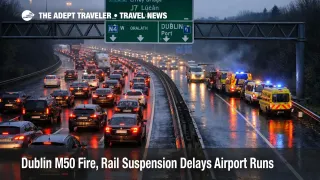
A bin lorry fire on Dublin's M50 near Junction 7 (Lucan) forced major lane closures and triggered heavy knock on congestion across the orbital and feeder routes on Tuesday evening, December 16, 2025. Travelers trying to cross the city for Dublin Airport (DUB), Dublin Port sailings, late hotel check ins, and evening rail connections were hit at the same time that Irish Rail suspended Phoenix Park Tunnel services due to a track fault. If you have a critical departure tonight, assume longer road times, confirm rail routing changes, and switch to the most direct, least transfer heavy option you can execute right now.
The Dublin M50 fire airport transfers problem is that a single point incident near a high leverage junction coincided with a cross city rail disruption, so travelers lost the usual ability to "mode shift" from road to rail when conditions deteriorated.
Transport Infrastructure Ireland traffic updates indicated disruption on the M50 northbound between Junction 7 Lucan and Junction 6 Blanchardstown, including a period of full closure, followed by partial reopening with lanes 2 and 3 reopened while heavy congestion persisted. Dublin Fire Brigade reported multiple appliances on scene, including foam support, which typically signals an incident that takes longer to fully stabilize and clear than a minor vehicle breakdown.
Who Is Affected
Travelers most exposed are anyone whose itinerary depends on crossing Dublin during the evening peak, especially airport bound passengers coming from the south, west, or southwest who would normally rely on the M50 to reach the M1 corridor to Dublin Airport. The risk is highest for passengers with checked bags, airline desk deadlines, or separate ticket connections, because even a modest late arrival can flip from "tight" to "not accepted" if bag drop or check in closes.
Rail passengers are also affected if they planned to use Phoenix Park Tunnel services as a cross city link, or if they were counting on specific stops and timings that change when services are rerouted. Irish Rail indicated Phoenix Park Tunnel services were suspended due to a track fault, and advised some passengers to route via Heuston Station instead, with knock on delays and some altered stopping patterns.
This is also the kind of evening disruption that breaks "stacked" plans, for example an arrival at Dublin Airport followed by a coach or taxi to a hotel, then an onward dinner reservation, or a same night transfer to the port. It follows closely on other Dublin ground access volatility earlier this month, including Dublin Taxi Protests Hit Airport Access December 8-13, which matters because repeated disruption conditions the market toward higher prices and lower availability in taxis, rideshares, and last minute hotel rooms.
What Travelers Should Do
If you are traveling tonight, treat every transfer as a "buffer first" problem. Before leaving, check live incident status and congestion maps, then add a large time cushion, because partial reopening does not mean normal speeds, it often means stop start queues for hours. If you are headed to Dublin Airport, prefer direct coaches or a prebooked transfer over multi step trips, and if you are rail dependent, verify whether your service is being rerouted via Heuston, or skipping stops you expected.
Use decision thresholds instead of hope. If your airport arrival is likely to be inside your airline's bag drop or check in cutoff, or your port arrival is likely to miss last vehicle boarding, shift to a later departure, rebook, or plan to overnight rather than gambling on "it might clear." If you are already within the city and you have flexibility, delaying departure until the network normalizes can be safer than joining a queue that is still propagating backward through junctions and slip roads.
Over the next 24 to 72 hours, monitor whether any residual lane restrictions, cleanup work, or rail fault follow ups persist into the next commute windows. Keep an eye on Transport Infrastructure Ireland traffic notices and Irish Rail service updates, and if your trip is also exposed to wider Ireland weather or transport shocks this week, factor in the compounding risk described in Storm Bram Hits Ireland Flights, Ferries, Coastal Roads.
How It Works
The M50 is a high leverage piece of Dublin's travel system because it concentrates cross city movement onto a limited set of junctions that also act as gateways to the national routes. When an incident hits near Junction 7 (Lucan), queues do not stay local, they propagate backward into upstream junctions and onto parallel surface roads as drivers divert, and that diversion traffic then slows buses, coaches, and airport shuttles that share the same approaches. Even after lanes reopen, the system can stay unstable because it takes time to drain stored demand, and because minor secondary incidents rise when stop start traffic increases.
The rail side matters because Phoenix Park Tunnel services effectively act as a pressure relief valve for certain cross city journeys that would otherwise require road transfers or multiple rail changes. When those services are suspended, passengers concentrate at alternate nodes such as Heuston or Connolly, and more travelers shift to taxis, rideshares, and private cars to bridge gaps. That shift pushes additional demand onto already stressed roads, which is why simultaneous road and rail problems create outsized disruption compared to either mode failing on its own.