

Dubuque-O'Hare Flights Ending, Rebooking Steps
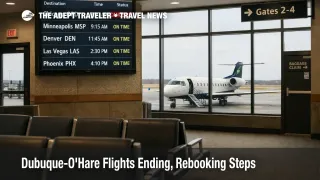
Denver Air Connection will end its daily commercial service between Dubuque Regional Airport (DBQ) and Chicago O'Hare International Airport (ORD) in early 2026, removing Dubuque's local link to a major hub connection point. The change primarily affects regional travelers in eastern Iowa and northwest Illinois who built winter and early 2026 trips around same day Chicago connections. Travelers should immediately check whether any booked segments fall after the cutoff date, then follow the airport's seller specific refund and rebooking instructions, and shift planning to alternate departure airports with extra winter driving buffer.
The Dubuque O'Hare flights ending update matters because the route has a confirmed end date, January 15, 2026, and the airport has published specific passenger action steps by booking channel.
Dubuque's airport says the Dubuque City Council voted on December 15, 2025, to direct the Dubuque Airport Commission to end the service agreement, effective January 15, 2026, and that Denver Air agreed to the termination date. The airport framed the decision as a funding and sustainability problem, saying federal and local contributions to the minimum revenue guarantee were exhausted, and that Denver Air could not operate the route at a loss. For travelers still flying before the shutdown, the airport also says Denver Air is adjusting the remaining schedule starting January 2, 2026, with a 600 a.m. departure from Dubuque arriving Chicago O'Hare at 650 a.m., and an evening departure from Chicago O'Hare at 745 p.m. arriving Dubuque at 840 p.m.
On refunds and rebooking, the airport's guidance is blunt about who to call. Passengers who booked travel after January 15, 2026, through American, Delta, United, or an online travel agency such as Expedia are directed to contact the airline or agency they booked through for rebooking or refund. Passengers who booked through Denver Air for flights to or from Chicago without an additional connection after the morning of January 15 are expected to receive refunds, or can contact Denver Air customer service at 866-373-8513, and the airport says its own staff can answer questions at 563-589-4128.
Who Is Affected
The most exposed travelers are anyone holding a DBQ to ORD itinerary dated after January 15, 2026, especially if Chicago O'Hare was being used as a same day bridge to a domestic or international connection. The practical pain point is not only the loss of the nonstop segment, it is the loss of a predictable, close to home uplift that made early departures and late returns possible without a long drive. That creates an immediate cascade into earlier wake ups, higher parking costs, and more vulnerability to Midwest winter weather when the "new connection" becomes a highway segment.
Business travelers and frequent flyers in the Dubuque area who used the route for day trips to Chicago, meetings, medical travel, or family visits are also directly affected, because driving becomes the default for short notice travel. Travel advisors should treat the change as a ticket ownership and fulfillment problem as much as a schedule problem, because the correct refund desk depends on where the itinerary was purchased, and misrouting a client to the wrong contact can cost days in peak rebooking periods.
Travelers who planned to use incentives tied to Dubuque's service push should also read the fine print. The airport says Dubuque Initiatives will honor its $100 round trip rebate pledge for tickets purchased between August 11 and December 31, 2025, and it points travelers to its incentives page for details.
What Travelers Should Do
Start by auditing every reservation that touches Dubuque, including return legs. If any DBQ segment falls after January 15, 2026, route your request to the seller of record, meaning the airline or online travel agency that issued the ticket, not the airport. If the booking was purchased directly from Denver Air for a simple Dubuque to Chicago trip after the morning cutoff, use the Denver Air customer service number the airport published, and document the call, the agent name, and any promised refund timeline.
Decide early whether the trip is worth preserving as a "drive to fly" itinerary. If your plan requires a tight same day connection in Chicago, and you would miss it if winter driving adds even 60 to 90 minutes, the safer move is to rebook from an alternate departure airport that offers a single ticket to your final destination, even if it adds a longer layover. If the trip is optional, or if fares are spiking, setting a threshold like "I will rebook if I cannot secure a single ticket itinerary by 72 hours before departure" can prevent last minute overpaying when inventory thins.
Over the next 24 to 72 hours after you rebook, monitor two things: whether your replacement airport has enough slack for your departure bank, and whether Chicago area operations are forcing additional buffer. Travelers still routing via Chicago O'Hare International Airport (ORD) should plan for variability during peak banks, and keep an eye on broader ATC driven flow programs that can compress connection windows, as explained in FAA staffing and shutdown: Rolling delay programs likely.
How It Works
Small market flights often survive their first year through a minimum revenue guarantee, which is effectively a backstop that shares early financial risk while travelers rebuild habits and load factors mature. Dubuque's airport described that structure directly, saying Denver Air estimated it would need load factors around 80 percent to be sustainable, and that local and federal contributions supported a minimum revenue guarantee while the service tried to reach that level. The airport also said the route's load factors climbed after a schedule change in May, reached 50 percent in August, stayed above that benchmark through October, and that reliability was strong through October 2025, but that the funding runway still ran out before the market reached self sustaining levels.
That is why the first order impact is immediate and personal, the last flight date forces rebooking, and the region loses a one stop on ramp into Chicago's hub system. The second order effects spread across multiple layers. Ground transportation demand rises as more travelers reposition to larger airports, and that can tighten long term parking, rentals, and one way inventory at nearby fields. Hotel demand can also shift, because travelers who used to leave home the morning of departure may now choose an overnight near Chicago to protect early flights, especially in winter weather.
For alternates, travelers commonly pivot to airports that are still within a manageable drive from the Dubuque area, then rebuild the itinerary from there. Travelmath estimates about 2 hours and 47 minutes driving time from Dubuque Regional to Chicago O'Hare, about 1 hour and 23 minutes from Dubuque to Eastern Iowa Airport (CID) in Cedar Rapids, about 2 hours from Dane County Regional Airport (MSN) in Madison to Dubuque Regional, about 3 hours and 17 minutes from Dubuque to Chicago Midway International Airport (MDW), and about 1 hour and 13 minutes from Moline, Illinois, to Dubuque, which is a useful proxy when considering the Quad Cities area as a reposition option.
Sources
- Denver Air Connection Flights at Dubuque Regional Airport to End in Early 2026
- Denver Air Connection to end Dubuque airport flights January 15
- Dubuque (DBQ) Dubuque Regional Airport, Denver Air Connection Airport Guide
- Driving time from DBQ to ORD
- Driving time from Dubuque, IA to CID
- Driving time from MSN to DBQ
- Driving time from Dubuque, IA to MDW
- Driving time from Moline, IL to Dubuque, IA