

Blizzard Hokkaido New Chitose Flights And Rail Suspended
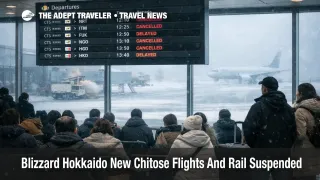
A rapidly deepening low pressure system brought blizzard conditions to Hokkaido, Japan, in mid December, driving heavy snowfall, violent winds, and rapid deterioration in visibility that disrupted both air and rail operations. Flight schedules around Sapporo New Chitose Airport (CTS) were hit hard, with widespread cancellations reported on December 14, 2025, and additional cancellations on December 15, 2025, as airlines tried to protect safety and reset aircraft and crew positioning. At the same time, JR Hokkaido curtailed service, including limited express impacts, which removed the main backup many travelers rely on when flights slip.
The practical traveler problem is not just a late arrival, it is the failure of the handoff that makes most Hokkaido itineraries work in winter. When an inbound flight arrives late or cancels, the next leg is usually a timed rail move toward Sapporo, then a bus, shuttle, or pre arranged pickup for ski towns and rural hotels. When rail headways break or services suspend, that entire chain becomes a same day coin flip, and the knock on effect is stranded passengers competing for the same small pool of replacement seats, taxis, rental cars, and rooms.
The Hokkaido blizzard New Chitose flights disruption matters beyond the airport perimeter because recovery often spills into the next morning bank. A canceled evening arrival can become a missing aircraft for the first departures the next day, and crews displaced overnight can trigger rolling downstream delays even after the weather eases.
Who Is Affected
Travelers flying into or out of Sapporo New Chitose are the most exposed, especially anyone connecting onward on a separate ticket, anyone trying to reach a ski resort the same day, and anyone with a last train cutoff risk into smaller towns. In this blizzard pattern, even travelers whose flights operate can lose their day if the arrival time shifts beyond workable ground transport windows, or if baggage delivery and de icing cycles create long gate holds that eat the transfer buffer.
Regional flyers within Hokkaido are also at elevated risk because winter lift is limited, and rebooking options compress quickly when multiple airports are constrained at once. Airline special handling notices around this event referenced disruption risk not only for New Chitose, but also for other Hokkaido airports such as Wakkanai Airport (WKJ), Okhotsk Monbetsu Airport (MBE), Memanbetsu Airport (MMB), Kushiro Airport (KUH), Nemuro Nakashibetsu Airport (SHB), Hakodate Airport (HKD), Sapporo Okadama Airport (OKD), and Tokachi Obihiro Airport (OBO). That matters because when regional airports lose a rotation, there may be no extra section flight to save the day, and the recovery path becomes next day, or a long surface reroute.
Rail travelers are affected even if they never step on a plane. JR Hokkaido service suspensions and significant delays can strand passengers mid corridor, collapse timed connections, and force unplanned overnights in hubs where hotels may already be tight due to weather diversions. For visitors combining Hokkaido with northern Honshu, the risk can compound, because winter operational measures elsewhere in the region can also reduce timetable reliability, as seen in JR East Winter Stop Skips On Senzan And Ou Lines.
What Travelers Should Do
Travelers already in Hokkaido should treat December 14 and 15, 2025, as a two mode disruption, and protect the overnight first. That means holding a room buffer in Sapporo when possible, pushing non refundable check in deadlines with hotels, and communicating early with ski lodges and transfer providers so they do not mark you a no show while you are still in an airport or station queue.
Travelers due to arrive the same day should use a simple threshold, if your arrival depends on a tight rail connection, a last bus, or a pre booked pickup you cannot easily reschedule, shifting to the next day is often the lower risk move once cancellations spread across multiple Hokkaido airports. If you do wait it out, aim for flights that arrive with enough daylight and margin to absorb de icing, baggage delays, and slower ground transport, because late evening recoveries can still fail when rail frequency drops and road conditions worsen.
Over the next 24 to 72 hours, monitor three signals together, airline rebooking waivers, JR Hokkaido operation updates, and the airport's current flight status. The blizzard may ease, but recovery can lag because aircraft and crews need to be repositioned, and rail can remain constrained by snowdrifts and wind even after visibility improves.
Background
Winter blizzards disrupt Hokkaido travel through a stack of operational choke points that amplify each other. At airports, heavy snow and wind reduce runway acceptance rates, slow de icing, and force longer taxi and gate cycles, which means the same airport can handle fewer movements per hour even if it never fully closes. When cancellations spike, aircraft end up out of position, crews time out or miss duty starts, and the next morning schedule inherits the gaps, which is why travelers often see lingering disruption even after conditions improve.
Rail is a separate system, but it fails in complementary ways during a blizzard. Snowdrifts, switch issues, and wind exposure can force precautionary suspensions, and once headways widen, the passenger load concentrates onto fewer trains, stressing station operations and last mile links. The key propagation effect for travelers is that airports and rail do not back each other up during a true blizzard, they both degrade, so the normal Hokkaido plan, fly into New Chitose, take rail toward Sapporo, then transfer onward, becomes fragile. That fragility ripples outward into tours, ski lessons, and hotel operations, because the whole regional winter economy is scheduled around predictable arrival banks that stop being predictable when both air and rail capacity are cut.
Sources
- Traffic Disrupted, Warning Issued After Blizzard Batters Japan's Hokkaido (Xinhua)
- Flights, New Chitose Airport (Hokkaido Airports)
- Train Operation Information, JR Hokkaido Railway Company
- ANA Implements Special Handling for Flights to Hokkaido Airports Due to Snowfall Forecast (TRAICY Global)
- JAL Implements Special Ticket Measures for December 15 Flights Due to Expected Snowfall in Hokkaido (TRAICY Global)