

Hualien Quake Rail Delays, Taiwan Metro Pauses
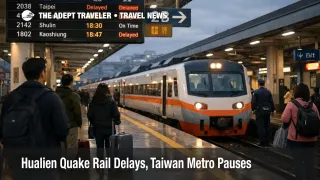
Hualien Quake Rail Delays affected eastern Taiwan after a magnitude 5.7 earthquake off Hualien County triggered standard safety checks and operating restrictions on December 8, 2025. Travelers were most likely to notice short notice slowdowns, because rail operators may reduce speeds after stronger shaking is recorded in specific areas, and metro operators may briefly pause service when control centers receive quake alerts. For most itineraries, the practical effect is not a day long shutdown, it is a small, uneven delay that can still break a tight chain of reservations.
According to Taiwan's Central Weather Administration, the earthquake's origin time was 7:24 p.m. local time, with a focal depth of 24.5 km and magnitude (ML) 5.7, centered south of Hualien County Hall. Intensity readings reached 4 in parts of Hualien County and Nantou County, which is the kind of threshold that often triggers cautious operating modes until checks are complete.
Who Is Affected
The most exposed travelers are those using Taiwan Railway's east coast corridor for Hualien stays, Taroko area access, and onward moves toward Yilan or Taipei, because speed restrictions concentrate where stronger shaking is recorded, and then ripple outward as trains bunch. Focus Taiwan reported that Taiwan Railway implemented speed restrictions on parts of the eastern line after stations including Chongde, Hualien, Nanao, and Yuli recorded intensity levels of 3 or 4.
In Taipei, the direct impact was smaller but still operationally meaningful for tight transfers. Focus Taiwan reported that Taipei Metro briefly halted trains on the Bannan [Blue] line for about one minute after its operations control center received an earthquake alert, and then returned service to normal after confirming intensity. A one minute stop can still translate into a longer platform delay if it hits a busy pulse of trains and passengers, especially near Taipei Main Station transfer flows.
Travel advisors and independent travelers should treat this as a reminder that moderate quakes can create "micro disruptions" that do not look dramatic on headlines, but still move enough pieces to change a day plan. The first order effect is slower rail running and brief metro pauses. The second order ripple is connection math: a late arrival can cause missed reserved seats, retimed private drivers, forfeited tour departure windows, and rebook pressure onto the next departures that still have capacity.
What Travelers Should Do
If traveling the same day as a quake alert, prioritize protecting the "hard edges" in the itinerary, such as a flight, a long distance reserved train, or a timed tour departure. Move nonrefundable items later in the day when possible, and assume taxis around major stations may be harder to secure for an hour or two if many travelers make the same pivot at once.
If delays appear to be staying localized and you still have at least 60 to 90 minutes of slack before your next commitment, waiting and staying on rail is usually the lowest friction option, because restrictions often ease once checks complete and train spacing normalizes. If you are down to less than 30 to 45 minutes before a hard cutoff, treat it as a decision threshold: switch to the next available departure, rebook to later timed entry, or convert the chain into an overnight plan rather than gambling on a perfect recovery.
Over the next 24 to 72 hours after any felt quake, monitor operator service notices, and watch for aftershock related advisories that can trigger repeat slowdowns. Focus Taiwan reported that Taiwan's weather agency warned on December 8 that aftershocks of magnitude 5 to 5.5 were possible within three days, which is exactly the kind of window where travelers should keep day trips flexible and avoid stacking multiple fixed time commitments back to back.
How It Works
Rail and metro systems are designed to fail safe, not fail fast. The normal pattern after a felt earthquake is an alert, a brief stop or speed reduction, then a staged return to normal speed once safety is confirmed. Taiwan High Speed Rail describes a "Disaster Warning System" that detects hazards including earthquakes, sends alerts to trains and the control center, assigns maintenance checks based on the situation, and then resumes operations with limited speed before gradually returning to normal. Even though this description is specific to the high speed rail system, it matches the broader logic travelers should expect across rail assets in Taiwan, safety checks first, schedule perfection second.
This is also why disruptions can propagate beyond the immediately affected line segment. When one section runs slower, trains arrive in clumps instead of evenly spaced intervals. That creates platform crowding at hubs, increases transfer friction for travelers hauling luggage, and pushes some passengers into taxis or private cars at the same time. Tours then adapt to the new arrival waves by delaying departures, consolidating groups, or reducing the number of stops, which can spill into restaurant reservations, attraction timed entries, and hotel check in timing at the destination.
For travelers who have been watching larger regional seismic stories, the operational takeaway is consistent. Rail inspection pauses and staged resumptions show up in other earthquake contexts too, including Japan Megaquake Advisory Puts Northern Travel On Watch and broader warning driven travel slowdowns covered in Pacific Tsunami Alerts Disrupt Trans-Pacific Travel. The common thread is that transportation systems will trade speed for confirmation, and that trade hits travelers hardest when itineraries are built with minimal buffers.