

India Winter Fog Flight Delays at North and East Airports
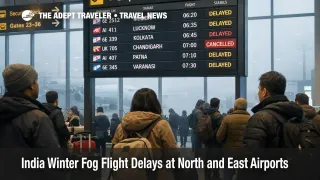
India Winter Fog Flight Delays are spreading across Delhi and other North and East hubs as low visibility slows morning departures on December 17, 2025. Passengers on early departures, tight domestic connections, and domestic to international transfers via Indira Gandhi International Airport (DEL) and Netaji Subhas Chandra Bose International Airport (CCU) face the highest misconnect risk. Check airline advisories before leaving, shift critical travel to later departures where possible, and add buffer for same day trains, road transfers, and hotel check ins.
IMD forecasts show the fog risk is now multi region, so India Winter Fog Flight Delays can recur for several mornings, and they can cascade into cancellations and rebooking congestion far beyond the first affected airport.
In its December 17 press release, the India Meteorological Department (IMD) said dense to very dense fog is very likely to continue during early morning hours across parts of Uttar Pradesh, Punjab, Haryana, and nearby regions on multiple days through December 22, with additional dense fog pockets flagged for Bihar, Jharkhand, Odisha, Himachal Pradesh, Uttarakhand, and Northeast India in the near term. The same release logged extremely low visibility readings in the morning, including 0 meter visibility at Lucknow Airport and Amritsar, alongside other sub 200 meter readings across several northern locations.
Airlines are also signaling higher predictability for disruption planning. IndiGo issued a travel advisory warning that fog is predicted across parts of North and East India, and that reduced visibility may slow operations, specifically calling out early morning December 17 travel as the most exposed period. Separately, the Airports Authority of India (AAI) has urged passengers to check flight status before leaving for the airport, to plan extra time, and to rely on airline apps and official channels for real time changes during fog disruption.
Even at airports with upgraded low visibility capability, the practical reality is that fog compresses capacity. When controllers and operators shift into low visibility procedures, arrival spacing grows, taxi speeds drop, runway occupancy times rise, and departure queues become harder to clear, which is why a morning backlog can continue to affect later rotations. For additional context on winter upgrades and why CAT III capability helps but does not eliminate disruption, see Delhi Airport Fog Delays, New Winter Upgrades.
Who Is Affected
Travelers booked on the first departure and arrival banks are the most exposed, especially flights scheduled around dawn through mid morning, when fog is typically thickest and operational limits are more likely to bind. This group includes business travelers chasing same day meetings, families trying to protect one connection to a holiday destination, and anyone holding a tight check in cutoff on a second ticket.
Connections are where this pattern becomes expensive. A domestic delay into Delhi can quickly become a missed international onward flight when gates change, boarding times slide, and the airline has to reseat passengers across limited inventory. Travelers on separate tickets face the highest financial risk because the second carrier may treat the miss as a no show, particularly on low fare classes that do not allow free changes.
The footprint is also wider than a single hub. IMD observations and warnings include multiple northern locations, and the operational knock on effects can spread into eastern schedules when aircraft and crews arrive late from the fog belt. For travelers whose plans combine air with onward rail in the capital region, the same low visibility conditions can add friction to train running times and station operations, which is covered in Delhi Smog, Fog Delay Flights And Trains Dec 15, 2025.
What Travelers Should Do
Start by treating every early morning departure as conditional. Recheck your flight status in the airline app before you leave for the airport, then again just before you head to security, because retimes and gate changes can stack quickly during fog mornings. Add extra road buffer for airport approaches in poor visibility, and assume bag drop and customer service lines will be longer if multiple flights slip at once.
Use decision thresholds, not hope. If you have a same day connection that is already tight on a clear day, or you are traveling on separate tickets, shifting to a later departure, or even moving travel to the following day, often beats waiting through rolling delays that can turn into a cancellation late in the morning. If you cannot tolerate arriving after a specific time, for example a long distance road transfer that cannot be safely driven late at night, prioritize rebooking into late morning or afternoon banks rather than the earliest available flight.
Monitor the next 24 to 72 hours with weather in mind. IMD's outlook supports the idea that fog risk will repeat across several mornings, so today's delay pattern can return even after an afternoon recovery. Watch IMD updates, airport advisories, and airline travel alerts, and be ready to accept protected reroutes that avoid the most fog prone first wave departures when your trip timing is critical.
How It Works
Fog disruption in North India is less about a single cancelled flight and more about throughput. Low visibility procedures reduce the number of safe movements per hour because aircraft need greater spacing, ground movements slow, and departures may require higher minimum runway visual range than landings, which can strand outbound flights even when some arrivals continue. The result is schedule compression, where the first bank does not clear on time, then pushes delays into later turns, and sometimes forces cancellations when aircraft and crews cannot be repositioned into the correct place for the next wave.
Operational limits also interact with equipment and staffing. CAT III equipped runways and aircraft help, but not every aircraft variant and cockpit crew pairing is cleared for the lowest visibility operations, which means an airline can have capacity on paper yet still have specific flights that cannot legally or safely operate at peak fog intensity. Airlines have been publishing fog season playbooks, including extra trained crews, aircraft positioning, proactive passenger communications, and change options, precisely because a localized fog window can ripple across the network.
Second order travel impacts tend to show up off airport. When arrival banks slip, hotel check ins move later, prepaid tours compress, and same day rail or road transfers become higher risk, especially when travelers were counting on a fixed arrival time. In Delhi, poor visibility has also coincided with broader winter air quality issues, and Reuters reported that shallow fog and smog conditions worsened visibility and affected flights and trains, reinforcing the need to plan curbside time and surface connections as part of the same risk window.
Sources
- IMD Press Release 17 December 2025
- Travel Advisory Post on X, IndiGo
- Airports Authority of India warns of flight disruptions amid dense fog in Northern India, ETInfra
- Air India activates customer-centric initiatives to minimise inconvenience during the fog season
- CAT III readiness put to test as dense fog grounds flights at Delhi airport
- Delhi restricts vehicles, office attendance in bid to curb pollution, Reuters