

Japan Megaquake Advisory Lifted After M7.5 Quake
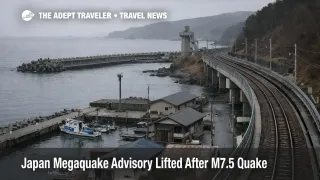
Japan's authorities ended a special megaquake caution period that followed a magnitude 7.5 earthquake offshore of northern Japan. Travelers in the designated coastal zones, including people moving through Aomori, Iwate, and parts of Hokkaido, should see fewer precaution driven interruptions, but they should still expect occasional aftershock jolts that can prompt inspections, slow rail running, and localized closures. The practical move is to keep your itinerary intact when services are running, but add buffers, confirm rail and ferry status before each leg, and keep an inland fallback base in mind for the next week.
The Japan megaquake advisory lifted shift reduces the likelihood of government requested extra precautions, but it does not remove earthquake risk, and it does not prevent a renewed disruption if stronger aftershocks trigger tsunami advisories or infrastructure checks.
Operationally, the biggest change for visitors is that the official special caution window is over, so municipalities and operators are less likely to maintain heightened precaution measures that can spill into event cancellations, delayed reopenings, or conservative service reductions. At the same time, the original quake was followed by notable aftershocks, including a later offshore tremor that prompted a tsunami advisory, which is the reminder travelers should take seriously: normalization can coexist with short, sharp disruption bursts.
Who Is Affected
Travelers sleeping, driving, or day tripping along Japan's northeastern Pacific coast are the most exposed to last minute changes, especially those with tight rail handoffs, fixed time tours, and prepaid ferries. That includes independent travelers hopping between smaller coastal towns, cruise or ferry passengers working around port cutoffs, and ski or onsen trips that rely on a single local line staying on time.
Long distance itineraries are indirectly affected because small regional slowdowns can break the entire chain. When a local line pauses for inspections, or runs under temporary speed restrictions, it can push you off a reserved Shinkansen connection, which then reshuffles seat availability across later departures and forces overnight choices in bigger nodes. If you are flying, irregular rail running can also shift airport arrival timing, and that is how a localized earthquake event becomes a missed flight problem, even when airports are operating. If you mention New Chitose Airport (CTS) or Misawa Airport (MSJ) in your plan, treat surface access and last mile transfers as the fragile parts, not the flight itself.
Tour operators and attractions in coastal zones can also behave more conservatively for a few days after a major quake, even after an advisory ends. The most common traveler pain point is not a total shutdown, it is a partial change, such as rerouted coastal drives, shortened boat tours, or a timed booking that becomes impractical when the transport layer runs slower than normal.
What Travelers Should Do
Start by building time slack into every coastal day. Confirm earthquake and tsunami updates before leaving your hotel each morning, then recheck rail status again before your first boarding of the day, because inspections can begin after an aftershock, not only after the main event. If you are chaining multiple legs, move any non refundable timed attraction to the later part of the day, and keep an inland alternative nearby so you can salvage the day without crossing coastal cutoffs.
Use simple thresholds for when to reroute versus wait. If your first leg slips and you lose the only workable connection to a remote coastal lodging, the safer choice is usually to pivot inland for the night rather than chase late arrivals into reduced evening service. If your plans depend on one ferry sailing, or a single last train, treat any disruption that pushes you inside a tight margin as a reason to rebook immediately, not as something to monitor passively.
Over the next 24 to 72 hours, watch for three signals: renewed tsunami advisories, rail inspection related service suspensions, and local road or coastal access restrictions that can appear even when the broader advisory has ended. Checking JR East service status before committing to a route is especially important in the wider region, and winter operations constraints can stack with earthquake checks, as shown in JR East Winter Stop Skips On Senzan And Ou Lines.
How It Works
Japan's "megaquake" caution framework in this case was tied to the elevated probability, however still low in absolute terms, of a larger quake after a magnitude 7 plus event in the same offshore system. The point is not to predict an exact quake, it is to push short term readiness, including extra attention to evacuation routes, emergency supplies, and fast decision making for coastal communities.
For travelers, the mechanism that matters is how warnings and inspections propagate. First order effects happen at the source: shaking can damage roads, bridges, station structures, and harbor equipment, and tsunami warnings can temporarily stop coastal activity. Second order ripples then spread into transport scheduling, where rail operators pause for track and overhead inspections, then restart with temporary speed limits that ripple across timed connections, reserved seats, and crew and rolling stock positioning. A third layer appears when travelers and operators react: tour groups shift departure times, hotels see unplanned one night stays in inland hubs, and inventory tightens quickly in winter because there is less spare capacity to absorb displaced demand.
The advisory ending helps because it reduces the likelihood of ongoing precautionary constraints, but it does not remove the underlying drivers that cause real world disruption: aftershocks, inspections, and localized access controls. That is why the best traveler posture after an advisory ends is not fear, it is operational readiness, with buffers, confirmations, and a clear fallback plan.
Sources
- 北海道・三陸沖後発地震注意情報に伴う特別な注意の呼び掛けの期間の終了について(第10報) | 気象庁
- 令和7年12月8日23時15分頃の青森県東方沖の地震について(第2報) | 気象庁 PDF
- Japan lifts megaquake advisory for northeastern coast | AP News
- Powerful 7.5-magnitude earthquake strikes Japan's northeast | Reuters
- Tsunami advisory lifted after magnitude 6.9 earthquake hits Japan's northeast region | Reuters
- Train Status Information, Tohoku Area | JR East
- Japan Issues 'Megaquake' Warning: What to Know | TIME