

Safi Floods Road Closures Disrupt Local Services
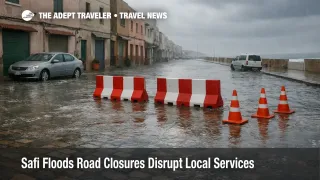
Safi floods road closures are disrupting road access across Safi, Morocco, after torrential rain triggered flash flooding on Sunday, December 14, 2025. Travelers arriving by car, taxi, or coach should expect detours and slower service as crews clear debris and pump water. If you are due to arrive or depart soon, build overnight flexibility, and be ready to route through Casablanca or Marrakech if your itinerary depends on tight connections. Authorities reported at least 37 deaths, and Morocco's weather service said unsettled conditions could persist in parts of the country through Wednesday, December 17, 2025.
The Safi floods road closures are a ground transport disruption that can break hotel checkouts, intercity coach plans, and self drive coastal itineraries even when airports elsewhere are operating normally.
Safi floods road closures: What Changed
Flash flooding hit Safi after intense rain pushed water through low lying streets and commercial areas, inundating homes and businesses and sweeping vehicles off roadways, according to Moroccan authorities and international reporting. The Interior Ministry said at least 37 people were killed, and it reported additional injuries requiring hospital care.
Authorities opened an investigation into why rainfall described as typical for the season produced catastrophic urban flooding, a signal that drainage constraints and localized intensity matter as much as daily totals. AP reported that Safi received 46 millimeters of rain over 24 hours, a level a meteorology official described as normal for the region.
Morocco's General Directorate of Meteorology said the broader pattern was driven by an upper level low, paired with humid inflow from the Atlantic and the Mediterranean, producing convective cells and uneven rainfall. In an outlook issued Monday, December 15, 2025, the agency said Safi recorded about 35 mm of rain in six hours, and warned that rainy, unsettled conditions could linger into midweek, which can delay cleanup and keep detours in place.
Who Is Affected
Travelers already in Safi are the most exposed, especially anyone staying in or near low lying districts where water concentrates, and where vehicle access can be restricted while crews clear debris. Visitors with fixed departure times, including tight hotel checkouts and onward coach tickets, face the highest risk if a key approach road is temporarily unusable.
Overland travelers using Safi as a stop on an Atlantic coast route are also at risk, including drivers moving between Casablanca, Safi, Essaouira, and Marrakech on a multi city loop. If you are flying into Mohammed V International Airport (CMN) or Marrakesh Menara Airport (RAK) and planning an immediate road transfer to Safi, treat that onward leg as the fragile link, and consider breaking the trip with an overnight in a larger hub.
More broadly, Morocco's winter weather is not confined to one city. Reuters reported alerts for heavy rain in wide areas, and significant snowfall in the High Atlas, which can disrupt alternates people use when they detour, including mountain roads and long distance coaches.
What Travelers Should Do
Start by assuming that navigation apps will lag reality. Check Morocco's official weather vigilance updates, then confirm road status through official motorway and travel tools before you move bags. For motorway travel, Autoroutes du Maroc publishes real time incident updates through its ADM Trafic service. Morocco's national tourism office also points travelers to official apps such as Météo Maroc, ONCF Trafic, and Autoroutes du Maroc to track conditions and alerts. If your accommodation is in a low lying area, ask the property for the safest vehicle approach point, and whether taxis are able to reach the entrance, or whether you should stage pickup on higher ground.
Decide whether to wait or reroute based on whether your plan has a single point of failure. If you cannot reach your departure point with at least two hours of margin, or if your onward segment is on a separate ticket that will not protect missed connections, moving the plan is usually cheaper than gambling on last minute access. The most reliable workaround is to shift your base to a larger hub city with multiple transport options, then rebuild your loop when the road network settles. For many itineraries, that means anchoring in Casablanca near Mohammed V International, or in Marrakech near Marrakesh Menara, then re entering the Atlantic coast when municipal access is stable and your driver can confirm routes in real time.
For the next 24 to 72 hours, monitor whether additional rain bands arrive, and whether authorities extend closures or advisories beyond Safi. Morocco's weather service said unsettled conditions could persist through Wednesday, December 17, 2025, which can slow cleanup and keep detours in place longer than travelers expect. Watch for signals that daily life is normalizing, including schools reopening, public transport running to schedule, and hotels resuming standard check in and checkout flows. If those indicators are not improving, assume a longer disruption window, and keep refundable ground transport and lodging until the risk of another downpour clearly drops.
Background
Urban flash flooding becomes a traveler problem because it cascades across systems that are normally independent. Water on roads and debris blocks taxis, hotel shuttles, and deliveries, then detours and closures propagate into missed coach departures, failed last mile transfers from rail stations, and tour cancellations. That is also how airports can feel secondary impacts, passengers may still fly, but they cannot reliably reach terminals on time.
Safi's case also shows why rainfall totals that look ordinary can still produce outsized disruption. Morocco's meteorology agency described a setup that favors intense, localized downpours, and sharp variability where one neighborhood floods while another sees far less rain. Add hardened soils after prolonged drought and drainage bottlenecks, and the result can be fast rising water that leaves little time to adjust.
If you want a broader road closure playbook that emphasizes official feeds, detour planning, and contingency lodging, see Flooding, Mudslides Close Washington, Oregon Roads Dec 15. For another Middle East and North Africa example of how to time transfers around short, high risk rainfall windows, see Oman Heavy Rain Alert, Flash Flood Risk Dec 16.
Sources
- Floods in Moroccan coastal city of Safi kill 37 | AP News
- At least 37 people killed in flash floods in Morocco | Reuters
- Morocco rolls out emergency aid during harsh winter weather | Arab News
- Situation météorologique de ce week end et prévisions pour les jours à venir | Maroc Météo
- Vigilance Météorologique | Maroc Météo
- ADM Trafic - L'information trafic en temps réel des Autoroutes du Maroc
- Useful apps for travelling in Morocco | Moroccan National Tourist Office
- Casablanca/Mohammed V International Airport | SKYbrary
- Marrakech-Menara Airport | SKYbrary