

Saudi Storm Alerts, Jeddah Airport Transfer Delays
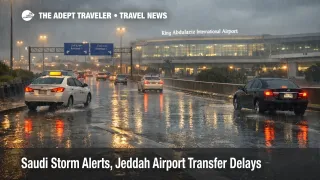
Thunderstorms and flood risk across western Saudi Arabia are driving an active run of official warnings that can disrupt road travel between Jeddah, Saudi Arabia, Makkah, Saudi Arabia, and Madinah, Saudi Arabia. Pilgrims on Umrah itineraries, business travelers with tight airport transfers, and anyone stacking rail or bus legs behind flights are the most exposed. The practical move is to treat transfers as weather dependent, add meaningful buffer, and avoid wadis, valleys, and low crossings that can become dangerous or impassable with little notice.
Saudi storm alerts Jeddah transfers now matter beyond a single storm cell because Civil Defense guidance and meteorology warnings extend the realistic risk window through Thursday, December 18, 2025, which changes how travelers should time airport runs and day trips.
The immediate disruption channel is on the ground. Heavy bursts of rain reduce visibility, increase crash risk, and create localized flooding in underpasses and low points, which slows highway flow and can force detours that drivers do not always anticipate. Once road movement degrades, the next layer is airport operations and passenger flow, because late arrivals compress check in, security, boarding, and baggage timelines even if flights continue operating. The third layer is the downstream stack, missed rail departures, missed bus departures, and late hotel arrivals that push check in into the late evening, when staffing and transport options are thinner.
For travelers using King Abdulaziz International Airport (JED), the key planning insight is that the airport can remain open while the city side becomes the constraint, especially when rain overlaps with peak arrivals and departures and when road incidents block the fastest routes. For travelers using Prince Mohammad bin Abdulaziz International Airport (MED), the same logic applies, with added sensitivity to highway visibility and fog or rain bands that slow the final approach into the city.
Who Is Affected
Travelers arriving into Jeddah for Umrah, or continuing onward to Makkah by private car, shared transfer, or coach, should expect higher variance in door to door times while the warning window remains active. The biggest risk is not only delay, it is being forced into last minute route changes when low lying stretches flood, which can break fixed booking times for hotel check in, permits, and timed visits.
Travelers moving between Jeddah and Madinah, including those using rail as part of an itinerary, should plan for knock on timing effects when road access to stations and terminals slows. Even a modest transfer delay can cascade into a missed departure when departure windows are fixed and rebooking queues build at the same time.
Travelers with day trips, outdoor excursions, desert drives, or any plan that involves valleys, wadis, or rural cut through roads are also exposed because runoff risk can be highest away from major urban drainage. Civil Defense guidance treats valley areas as avoid zones during active rain periods, and travelers should align their plans accordingly rather than testing conditions mid drive.
Finally, travelers connecting onward internationally out of Jeddah, or relying on separate tickets, should treat the next few days as a higher misconnect period. When weather friction pushes a departure by an hour, the ripple can extend into missed connections, rebooked hotel nights, and shift of ground transport demand that makes it harder to recover quickly.
What Travelers Should Do
Start with buffers and route discipline. Build extra time for any airport run, and choose main arterial routes even if they are longer, because shortcuts that dip into low points can become the failure point. If your driver proposes a valley or low crossing route to save time, decline it, and ask for a higher ground alternative, even if it adds minutes, because the downside risk is outsized when water moves quickly.
Use clear decision thresholds instead of hoping conditions will cooperate. If your itinerary depends on one critical transfer, for example Jeddah to Makkah on the same day as an international arrival, shift to an earlier flight, or add a refundable buffer night in Jeddah so you can move when conditions are stable. If your plan is a discretionary day trip, cancel or postpone it when warnings remain active, because the cost of a missed tour is lower than the cost of being stranded or rerouted late.
Monitor the right signals for the next 24 to 72 hours. Track National Center for Meteorology updates for your specific area, and follow Civil Defense instructions, especially guidance to avoid valleys and flood prone areas and to rely on official channels for updates. Watch your airline's app for departure time drift, and treat repeated small delays as an early indicator that airport flow is slowing, which is when you should adjust ground transport timing before roads clog.
How It Works
Saudi Arabia's rainfall patterns can be short and intense, and that is why official guidance emphasizes valleys and low terrain as danger zones. A wadi can be dry at the crossing point while rainfall upstream pushes a surge downstream, which turns an ordinary road segment into a closure or hazard quickly. Urban flooding behaves similarly in underpasses and low lying streets, where drainage can be overwhelmed during bursts, creating standing water and forcing detours.
In travel terms, the system ripple begins with slower driving speeds and incidents, which then causes late arrivals into airports and stations, which compresses passenger processing into fewer minutes, which then pushes flights and departures later and increases rebooking demand. Once rebooking demand rises, the second order effect shows up in hotel inventory and pricing, because stranded passengers extend stays near airports and in core districts, tightening availability for arriving travelers. A third order effect can hit tours and transfers, where operators shorten itineraries, cancel exposed segments, or shift departure times to avoid the worst windows, which is why travelers should keep plans flexible rather than chaining fixed timing commitments across multiple legs.
For travelers building broader Gulf region itineraries during this weather pattern, it is useful to compare how similar storm dynamics affect neighboring hubs and transfer planning in Saudi Storms Flood Jeddah And Threaten Makkah Trips and UAE Rain, Rough Seas Raise Dubai Airport Delay Risk.