

U.S. Travel Ban Expansion Starts January 1, 2026
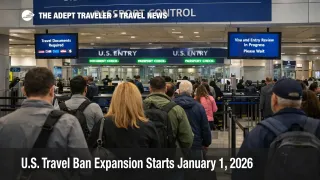
A new U.S. proclamation widens entry restrictions for travelers from additional countries, and for anyone traveling on Palestinian Authority issued or endorsed travel documents, with the new rules taking effect at 12:01 a.m. Eastern on January 1, 2026. Travelers from the newly listed countries, and anyone planning to connect through U.S. hubs en route to a third country, are the most exposed because airlines can deny boarding before departure when entry eligibility is not met. The practical move now is to confirm which passport and visa you will use, lock in a compliant routing that avoids U.S. transit if you might be in scope, and build buffer for rebooking before seats tighten.
The U.S. travel ban expansion adds seven full entry suspensions, fifteen partial suspensions, and a separate full suspension tied to Palestinian Authority travel documents, which raises denied boarding and last minute reroute risk for travel starting January 1, 2026.
In plain terms, the proclamation keeps earlier restrictions in place for a prior set of countries, then broadens the list and clarifies timing. It continues a full suspension for nationals of Afghanistan, Burma, Chad, Republic of the Congo, Equatorial Guinea, Eritrea, Haiti, Iran, Libya, Somalia, Sudan, and Yemen, and continues partial limits for Burundi, Cuba, Togo, and Venezuela. It also adds new full suspensions for Burkina Faso, Laos, Mali, Niger, Sierra Leone, Syria, and Uganda, while adding partial suspensions for Angola, Antigua and Barbuda, Benin, Cote d'Ivoire, Dominica, Malawi, Mauritania, Nigeria, Senegal, Tanzania, Tonga, Turkmenistan, Vanuatu, Zambia, and Zimbabwe.
For the 15 partially restricted countries, the text generally suspends entry for immigrants and for common visitor, student, vocational, and exchange categories, specifically B 1, B 2, B 1 and B 2, F, M, and J, while directing consular officers to reduce validity for other nonimmigrant visas to the extent permitted by law. Separately, it fully suspends entry for foreign nationals seeking to travel on Palestinian Authority issued or endorsed travel documents, both immigrants and nonimmigrants, because the proclamation states those documents cannot currently be properly vetted for entry decisions.
Who Is Affected
The highest risk group is travelers who will need to apply for a new U.S. visa on or after January 1, 2026 and whose nationality is on the fully or partially restricted lists, because the proclamation's scope is written to apply to foreign nationals who are outside the United States on the effective date and who do not have a valid visa on that date. That scope detail can create a hard planning cliff for people who assumed they could secure a visa closer to departure, or who are holding flexible tickets without firm documentation.
Travelers transiting the United States are also exposed, because many international connections require meeting U.S. entry rules even when the United States is not the final destination. That matters most at major gateways such as John F. Kennedy International Airport (JFK), Miami International Airport (MIA), and Los Angeles International Airport (LAX), where connecting itineraries are common, and where document checks can happen more than once before a traveler ever reaches a U.S. immigration booth. In practice, this is where airline document systems and gate agents become the enforcement point, and where denied boarding triggers immediate rebooking pressure on alternate hubs.
There are important listed exceptions, but they are narrower than many travelers assume. The proclamation states the suspensions do not apply to lawful permanent residents, to dual nationals traveling on a passport from a non designated country, and to travelers holding specific diplomatic and international organization visa classifications, along with certain athletes traveling for major events, specific Special Immigrant Visas for U.S. Government employees, and immigrant visas for ethnic and religious minorities facing persecution in Iran. It also allows case by case national interest exceptions by the Attorney General, the Secretary of State, or the Secretary of Homeland Security, depending on the circumstance.
A final group to watch is travelers who already hold a valid U.S. visa and are trying to understand whether it will be canceled. The proclamation explicitly says visas issued before the applicable effective date are not revoked pursuant to the proclamation, and it does not apply to individuals already granted asylum or to refugees already admitted. That said, travelers still need to match their itinerary, their passport, and their documentation exactly, because airline document checks and border inspections can still fail on mismatch, even when a visa exists.
To understand the pre boarding document enforcement pattern that tends to cause denied boarding surprises, travelers can compare similar mechanics in UK ETA Checks Enforced For Visa Free Travelers February 2026 and Israel ETA IL Now Required For Visa Exempt Visits.
What Travelers Should Do
First, travelers should treat eligibility as a document matching exercise, not a day of departure gamble. Confirm which passport you will present at check in, confirm whether you already hold a valid U.S. visa that remains valid through travel, and confirm whether any segment of your itinerary touches the United States, including overnight connections that look like simple transits. If Palestinian Authority travel documents are involved in any way, assume the highest risk category until an airline or the relevant U.S. authority confirms otherwise.
Second, use a clear decision threshold for rebooking versus waiting. If a traveler is from one of the newly listed countries and does not already have a valid U.S. visa in hand before January 1, 2026, the safest planning assumption is that a U.S. routed itinerary becomes a non starter, and the traveler should reroute via a non U.S. hub or postpone the trip rather than hoping for an airport day exception. If a traveler does have a valid visa already, the focus should shift to reducing operational risk, earlier flights, fewer tight connections, and avoiding separate tickets that turn one missed segment into a self funded rebook.
Third, monitor the right signals over the next 24 to 72 hours, and again as New Year travel peaks. Watch for airline travel advisory updates, embassy and consulate guidance, and any carrier specific requirements for pre travel document verification, because those often change faster than travelers expect when a policy effective date is close. For travelers considering U.S. transit, recheck whether a transit (C) visa, a visitor (B) visa, or another permission is required for your nationality and routing, because the United States treats transit as a visa category with limited exceptions.
How It Works
A U.S. entry proclamation affects travel in two separate places, and that is why disruption can start before a traveler reaches the border. The first enforcement layer is the airline, which must verify that a passenger is eligible to travel, because carriers can be penalized for transporting inadmissible passengers, and they rely on standardized document rules to decide whether to issue a boarding pass. That is why travelers can be denied boarding at online check in, at the airport desk, or at the gate, even when they never intended to stay in the United States.
The second enforcement layer is admission at the port of entry, where U.S. border officers decide whether to admit a traveler under the applicable rules. For many itineraries, especially those that include U.S. connections, travelers must be eligible to enter, or at minimum to transit under U.S. visa categories, which is why transit visa requirements matter when the United States is used as a hub. Operationally, this is also where second order ripples build, because denied boarding and long document reviews drive missed connections, and reroutes push travelers onto fewer remaining seats through Canada, Mexico, Europe, and other non U.S. gateways.
Those reroutes then propagate into the rest of a trip, even when the underlying disruption is a policy change, not a weather event. When flights shift, tight onward connections break, checked bag plans fail, and traveler behavior changes quickly, which tightens last seat inventory and raises same day fares on alternate routings. On the ground, hotels and car rentals see churn as arrival dates move, and tour tickets and timed entry bookings become harder to salvage when travelers are pushed to a different city or a different day.