Viti Levu Flash Flood Alert Raises Road Risks
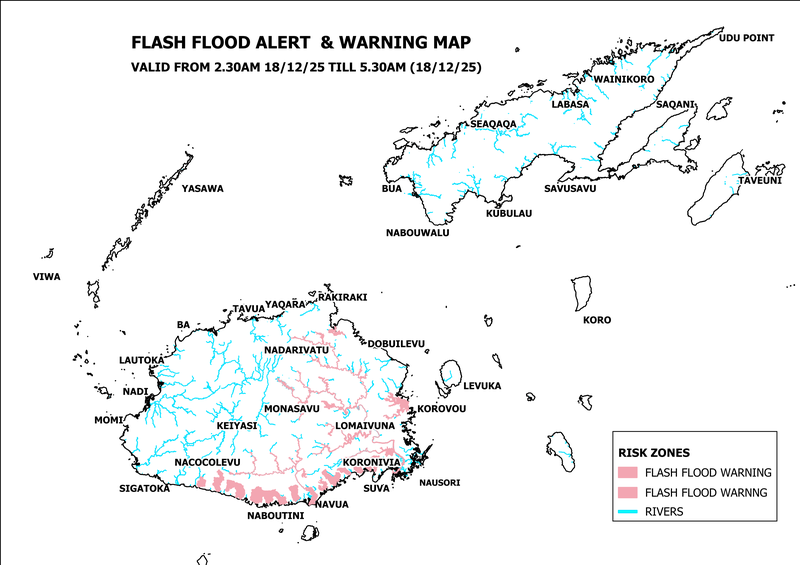
A Viti Levu flash flood alert remains in force in Fiji after the Fiji Meteorological Service said isolated heavy rain could trigger fast onset flooding across eastern and southern parts of the island. Travelers are most exposed on road segments where drainage, small streams, and low water crossings can turn a normal transfer into a stop and detour situation with little notice. The practical move is to treat resort transfers and intercity drives as flexible, add buffer, and watch for the next bulletin cycle before committing to interior or south coast plans.
The Viti Levu flash flood alert matters because it formalizes a higher risk window for road access, and it puts the most common visitor movements, airport transfers, and day trip drives into a higher variance category.
In its Special Weather Bulletin Number Sixty, Fiji Met said a slow moving trough of low pressure over Fiji is expected to keep cloud and showers in play over the next few days, with flash flooding possible from isolated heavy rain. The same bulletin canceled a flash flood warning that had been in force for Wainimala in the highlands of Naitasiri, while keeping the alert active for eastern and southern Viti Levu. Fiji Met also flagged the most practical impacts for travelers and residents, flooding in drainage systems, small streams, low water bridges, crossings, roads, and properties in low lying areas, and it scheduled the next flash flood bulletin for later the same morning.
For visitors, the map overlay matters as much as the text, because it aligns the risk with the corridors people actually use. Even if a hotel base is in the west near Nadi, Fiji, many itineraries rely on the south coast drive toward the Coral Coast, Pacific Harbour, and Navua, or the longer cross island push toward Suva, Fiji. Those are exactly the kinds of routes where one flooded low point can force long holds, reroutes, or a turn back that breaks a timed check in, a prepaid tour start, or a flight plan built around a tight airport arrival window.
Who Is Affected
Travelers moving between Nadi International Airport (NAN) and resorts along southern Viti Levu are the most likely to feel disruption first, because transfers stack multiple failure points, rain bursts, roadside flooding, and the simple fact that drivers cannot safely judge water depth over a crossing at speed. Visitors headed toward Suva, Fiji, including those using Nausori International Airport (SUV), should also plan for variability, because eastern access routes are within the alert footprint and because localized flooding tends to produce stop start traffic that looks minor until it cascades into missed time slots.
Self drive visitors and rental car users face a different risk profile than coach transfers. A private driver can often reroute or pause more easily, but self drive travelers are more likely to commit to interior shortcuts, scenic loops, or late day departures that leave limited daylight to recover if a road becomes impassable. This is when an itinerary that seems simple on a map, a two hour reposition between bases, can turn into an unplanned overnight if a crossing is closed and the nearest workable detour adds significant distance.
Tour operators and activity providers are also in the blast radius of an alert like this, even when the rain is not falling at the exact beach resort. When access roads become unreliable, operators will cancel or retime departures to keep vehicles and guests out of flood prone segments. That can create second order crowding on safer, shorter excursions near Nadi and Denarau, and it can raise last minute demand for taxis, private transfers, and hotel extensions when a planned move day stops being dependable.
What Travelers Should Do
Travelers should treat airport runs and resort transfers as the priority problem, not the weather itself. Build extra time into any movement that must happen on a schedule, especially hotel change days, tours with fixed start times, and flights that do not have later backups. If a transfer provider offers an earlier pickup, taking it is usually the cheapest form of insurance, because the downside is waiting under cover, and the upside is avoiding a missed flight or a forfeited booking.
Rebook or reshuffle plans when your route depends on low water crossings or low lying road segments, and conditions are actively deteriorating. The clearest decision triggers are an upgraded warning from Fiji Met for your area, confirmed road closure updates affecting your corridor, or persistent heavy downpours that reduce visibility and water clearance on the road. Waiting can be reasonable when showers are intermittent and your schedule has slack, but it stops being reasonable when the plan requires arriving at a specific time and there is no alternate route that avoids the vulnerable low points.
Over the next 24 to 72 hours, travelers should monitor Fiji Met bulletins for any expansion beyond eastern and southern Viti Levu, and for any shift from alert language into warning language that implies higher confidence of dangerous impacts. It is also worth watching road status updates before departing, because the travel system lag is real, water can recede while debris and congestion remain, and drivers and vehicles may be repositioned to cover disrupted routes. When in doubt, shifting to a staging plan near Nadi, Fiji, or Suva, Fiji, and moving between bases only when conditions stabilize is usually less costly than forcing a drive during the active risk window.
Background
Flash flooding in Fiji is a travel system problem because it is fast, localized, and route dependent. A trough pattern can keep showers regenerating over the same catchments, which saturates soil and increases runoff, and then a single heavier cell can push water into a small stream or roadside channel that crosses a main road. The traveler does not need to be driving in heavy rain to be affected, because water can move downstream into a crossing after rainfall upstream, and that is why low water bridges and crossings become the trip breaking points.
Once those points fail, disruption propagates beyond the road itself. At the source, vehicles slow, queues build, and drivers reroute, which immediately stretches transfer times and can strand day trip schedules. The second order effects show up as missed flight check ins, pushed hotel check in times, and reduced transport capacity as operators consolidate vehicles onto fewer safe routes. If travelers want a broader sense of how flood risk converts into practical reroute decisions, the same logic is laid out in Oman Heavy Rain Alert, Flash Flood Risk Dec 16 and in the road closure playbook from Flooding, Mudslides Close Washington, Oregon Roads Dec 15.