

France Farmer Roadblocks Hit Motorways And Toll Exits
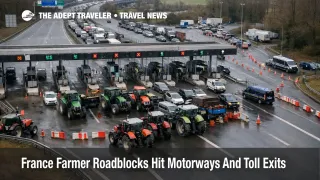
Farmer protests are disrupting motorway travel across France, with recurring tractor roadblocks and closures that are also hitting toll entrances and exits, particularly across the southwest motorway network. Travelers driving themselves, riding intercity coaches, or trying to time same day airport and rail transfers are the most exposed because even a short closure at an interchange can turn into long standstills and forced detours. Treat any tight connection today as fragile, then prioritize live traffic checks, earlier departures, and a mode switch to rail or air for longer hops if your route overlaps the most affected corridors.
The France farmer roadblocks toll exits pattern matters for travelers because it turns predictable motorway segments into stop and reroute zones, with closures reported on key routes including the A64, A63, A20, A89, A61, A10, plus additional disruption points that can expand during the day.
Operationally, the highest risk footprint has clustered around the southwest and south corridors that feed major cities and borders. Reporting and motorway operator updates have described extended disruption on the A64 between Bayonne and Toulouse, including shutdowns that span multiple exits, plus closures and restrictions on the A63 near Bordeaux area access. Authorities have also cited toll entrance and exit impacts in the southwest tied to the protest actions, which is the detail that most directly breaks airport runs and coach reliability because drivers can be pushed off the motorway with limited clean reentry options.
Who Is Affected
Self drive travelers in the southwest, the Pyrenees, and along major north to south corridors face the most immediate risk, especially anyone aiming to reach an airport, a long distance station, or a timed ticket commitment on the same day. If a route uses the A64 or A63 corridors, or it depends on a specific toll interchange for on and off access, the practical problem is not just slower traffic, it is that your planned motorway entry or exit may not function when you reach it.
Intercity coach passengers are also exposed because coaches cannot improvise detours as easily as private cars, and they can lose their recovery buffers quickly once a motorway closure forces a secondary road diversion. If you are relying on a coach to make a rail connection, assume the connection is not protected unless it is on a single ticket, then build a wider margin than you would on a normal day.
Airport and rail transfer risk is highest for travelers heading to Toulouse-Blagnac Airport (TLS), Bordeaux-Mérignac Airport (BOD), Biarritz Pays Basque Airport (BIQ), or other southwest gateways where motorway approaches and ring road links can be part of the default drive plan. The second order ripple is predictable, missed check in windows, missed trains, and same day rebooking pressure that can spike prices and force an unplanned hotel night when the disruption hits late in the day.
What Travelers Should Do
If you are on the ground today, check live conditions immediately before departure, and again right before you commit to the motorway, using the Bison Futé real time map and motorway operator traffic pages. Leave earlier than your normal buffer would suggest, and if you must arrive by a fixed time, treat any forecast that depends on one specific toll exit as unreliable, then route to an alternate access point while you still have flexibility.
If your drive is longer than about two hours, or it is designed to feed a flight, a last train of the day, or a nonrefundable booking, set a decision threshold now. If live updates show closures on your primary corridor, or if your estimated time jumps sharply and stays elevated for more than one refresh cycle, switch modes rather than hoping it clears, for example, reposition by regional rail, or rebook to a later departure. As a reference point for making that switch in France when ground conditions go uneven, see France December 2 Strike Spares Most Trains And Metro.
Over the next 24 to 72 hours, monitor whether closures spread beyond the southwest footprint, and whether authorities announce changes tied to the cattle disease response that is driving the protests. Watch for new closure clusters on the A7 and A9 valley routes, and on key north to south approaches, and if you are picking up a rental car or planning a one way drop, document the disruption with screenshots and receipts so you have a clean record for claims, charge disputes, or goodwill requests.
How It Works
Roadblock disruptions propagate through the travel system faster than many travelers expect because the motorway network is built around a small number of high capacity corridors and interchanges. When a protest closes an access ramp or toll barrier, traffic does not just slow, it can be forced off the motorway entirely, and secondary roads then become saturated by diverted cars, coaches, and freight. That is why an airport run that looks fine on a map can fail in the last miles, the interchange you planned to use may be closed, and the backup surface route may already be gridlocked by diverted traffic.
The second order ripple shows up at rail stations, airports, hotels, and tours, even when those assets are operating normally. A delayed drive can break an onward train, and missed trains push demand into later departures that may be full, especially on holiday dates. Missed flights can trigger rebooking cascades and unplanned overnight stays near airports, while rental car operations can get messy when drop off windows, staff hours, or one way inventory assumptions do not match a day of forced detours.
The underlying trigger for the current wave is tied to farmer anger over cattle disease measures, including culling policies, and the government response has included accelerated vaccination logistics intended to defuse tensions ahead of year end travel. That context matters mainly because it suggests the disruption can persist or flare with little notice, and because travel impacts are being treated as a serious holiday period risk, which is a clue that travelers should plan for continued instability on affected corridors rather than assuming a quick return to normal.
Sources
- France drafts in army for cattle vaccination to defuse farmer protests, Reuters
- France boosts cattle vaccination as farmers protest and block highways, Reuters
- Manifestations ce jeudi midi: A7 and A9 touched after A10, A20, A89, A61, A62, A63 and A64, Radio VINCI Autoroutes
- Manifestations agriculteurs: le point sur les blocages, APRR AREA Autoroute INFO
- Trafic maintenant, conditions de circulation en temps réel, Bison Futé
- Dermatose nodulaire contagieuse: démêler le vrai du faux, Ministère de l'Agriculture