

Isle of Wight Hovercraft Suspended, Solent Crossing
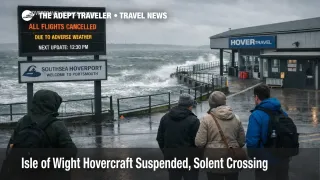
Hovertravel has suspended hovercraft operations across the Solent, leaving the Ryde to Southsea route vulnerable to last minute cancellations when weather turns. The impact is highest for foot passengers and anyone timing tight rail or coach connections on the mainland, plus day trippers trying to return the same evening. The practical move is to treat the crossing as an unstable link, check status before you travel, and commit early to a ferry backup route rather than waiting at the terminal for a restart window.
Hovertravel's live service status on December 18, 2025 stated that services were cancelled due to adverse weather conditions, and that tickets would be accepted on the Wightlink FastCat service, with a timed next update published on the same status banner. That guidance matters because when the hovercraft is down, a "wait and see" approach can quietly turn into a missed connection on the other side, especially if you are counting on a specific train, a coach departure, or a fixed check in time later the same day.
What makes this disruption different from a normal delay is that the hovercraft is often the shortest crossing for foot passengers, so the moment it is suspended, the itinerary typically gains at least one extra step. Even if an alternative ferry is operating, travelers may need to move between terminals, adapt to different boarding cutoffs, and accept longer or less predictable end to end travel time.
Who Is Affected
Foot passengers moving between Ryde, Isle of Wight, and Southsea, England are the most exposed, because a hovercraft suspension forces an immediate switch to conventional ferries and, in some cases, a terminal change. Travelers who planned to connect directly into rail at Portsmouth Harbour, England, or to meet timed coaches from Portsmouth and Southampton, England, should assume higher misconnect risk because a single cancellation can compress demand into fewer sailings and longer queues.
Day trip itineraries break more often than overnight trips, because a same day return depends on two successful crossings, and the return leg is usually the one that fails first when conditions worsen later in the day. Hotel check in timing on the Isle of Wight also becomes fragile when the crossing runs late, because late arrivals cascade into shorter restaurant hours, missed pre booked activities, and a narrower window to pick up rental cars or collect keys.
Travelers pairing the Solent crossing with flights should be conservative about buffers, especially if they are traveling to London Gatwick Airport (LGW), London Heathrow Airport (LHR), or Southampton Airport (SOU) on separate tickets. A hovercraft suspension can turn a normally tight connection into a multi step transfer, and any additional ferry delay can push you into peak rail crowding or disruption on the mainland network.
What Travelers Should Do
Act immediately by checking Hovertravel's service status before you leave for the terminal, and plan your alternate route while you still have time to reposition between ports. If Hovertravel directs ticket acceptance on Wightlink FastCat, treat Portsmouth Harbour to Ryde Pier Head as the primary foot passenger fallback, and build extra margin for the terminal walk, boarding cutoff, and the rail connection on either side. Wightlink also advises foot passengers to book in advance on some sailings and to allow time for rail connections, which matters most when demand surges after a hovercraft cancellation.
Use a clear decision threshold for whether to wait or reroute. If your mainland train or coach departure is fixed, or if you need to protect a flight same day, switch to a ferry fallback as soon as the hovercraft is shown as cancelled, rather than waiting for a possible later restart. If your plans are flexible and you can tolerate a multi hour slip, waiting can make sense, but only if you are prepared for conditions to worsen again and for a second cancellation cycle to reset the queue.
Over the next 24 to 72 hours, monitor three signals rather than just the next departure time. First, watch Hovertravel's next update time and the nominated alternative operator, because its contingency rules limit which service you can choose and when scanning is required. Second, watch Wightlink and Red Funnel service status because conventional ferries can also be disrupted by wind and sea state, and operators note that predictions can be better or worse than expected on the day. Third, protect your return plan, and if the afternoon starts to look unstable, abandon the same day return and book an overnight on the side where your onward obligations are least costly to miss, which is often the mainland if you have a morning departure the next day.
Background
Hovertravel's Ryde to Southsea hovercraft is a high speed passenger link across the Solent, and it is often used as the shortest foot passenger corridor between the Isle of Wight and the Portsmouth rail hub. When weather forces a suspension, the travel system does not simply slow down, it re routes. Travelers shift to conventional ferries, which changes where they board, how early they must arrive, and how their onward rail and road transfers line up.
Hovertravel's published disruption contingency plan explains the mechanics that shape real world outcomes during weather cancellations. Ticket acceptance can be offered on Wightlink services, and if those are not operating, the plan outlines acceptance on Red Funnel services, but it also sets practical limits, including that passengers should follow the nominated alternative service in the status update, that some routes require Hovertravel staff scanning, and that travel is constrained to Hovertravel's normal operating hours. That framework is why some passengers feel stranded even when "a ferry is running," because the alternative must match the acceptance arrangement, and it may require getting to a different terminal on your own.
Second order ripples show up quickly. On the mainland side, Portsmouth rail connections become less reliable because arrival times spread out, and missed trains push passengers into later, busier departures. On the island side, late arrivals can miss Island Line connections, shorten the usable day for tours, and trigger cascading changes such as taxis being redeployed to other terminals. Meanwhile, the same weather that stops the hovercraft can also stress conventional ferries, and both Wightlink and Red Funnel describe how wind, wave height, tidal conditions, and visibility can drive delays or cancellations that are difficult to predict far in advance.
For travelers who want a broader decision framework for disruption days, two recent ferry case studies on Adept Traveler show how quickly a single corridor failure can spread into missed connections and overnight demand, Terminal 5 Closure In Holyhead Delays Dublin Ferries and Tarifa Tangier Ferries Canceled in Gibraltar Winds. For financial protection, the fine print matters on missed connections and delay benefits, and the site's Travel Insurance hub is a starting point for how coverage commonly treats weather driven cancellations and reroutes.