

Southwest Turkish Airlines Interline Tickets January 2026
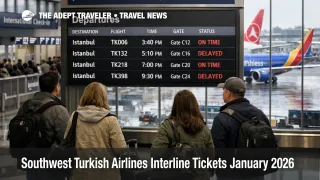
Southwest Airlines and Turkish Airlines say they will begin selling new interline itineraries that combine both carriers on a single ticket, opening a new path for U.S. travelers to connect to Istanbul, Turkey, and onward across Turkish's network. The change matters most for passengers who start in a Southwest served U.S. city and want one purchase that covers both the domestic positioning flight and the transatlantic segment. For now, travelers should plan to shop and book through Turkish Airlines and major third party channels, then build extra time into gateway connections until schedules, minimum connect times, and service routines settle after sales begin in January 2026.
The partnership was announced on December 17, 2025, with Southwest framing it as a January 2026 start for booking access via Turkish and third party booking channels. Southwest also positions Turkish as a major reach extension, since Turkish says it serves more than 350 destinations in 132 countries from its Istanbul hub.
Who Is Affected
Travelers are most affected when their trip naturally flows through one of the shared gateways that both carriers will use for international itineraries. Southwest lists the initial gateway set as Hartsfield Jackson Atlanta International Airport (ATL), Boston Logan International Airport (BOS), Chicago O'Hare International Airport (ORD), Denver International Airport (DEN), Detroit Metropolitan Wayne County Airport (DTW), Los Angeles International Airport (LAX), Miami International Airport (MIA), San Francisco International Airport (SFO), Seattle Tacoma International Airport (SEA), and Washington Dulles International Airport (IAD).
The travelers who benefit most are those in smaller and mid sized U.S. markets where Southwest has strong frequency, but where nonstop international options are limited. Instead of building separate tickets to reach a long haul departure, the new setup aims to package the trip through one of the gateways above, then onto Turkish's long haul service to Istanbul Airport (IST), with onward connections sold within the same Turkish ticketing flow.
Travel advisors and corporate travel desks are also in the impact zone, because Southwest is explicit that partner bookings are flowing through airline and third party channels first, with Southwest direct booking evolving later as capabilities mature. That shifts early comparison shopping and traveler servicing toward Turkish channels and agency tooling, at least for the launch phase.
What Travelers Should Do
If you expect to travel soon after sales open in January 2026, start by pricing the itinerary through Turkish Airlines or your usual agency channel, then confirm which carrier issues the ticket and what happens if the Southwest segment runs late into the gateway. The practical value of an interline style itinerary is usually the single ticket structure, but the details that matter, reaccommodation responsibility, baggage handoffs, and minimum connection time rules, live in the fare and the ticketing carrier's conditions.
If you are choosing between a tight same day gateway connection and a safer buffer, treat this like a long haul trip even if your first hop is domestic. When the gateway airport is large and complex, such as Chicago O'Hare, Los Angeles, or Washington Dulles, a short connection can collapse quickly due to routine domestic delays, terminal changes, or long lines. If your planned connection is under about 2 hours for a domestic to international handoff, consider rebooking to a longer connection or an earlier positioning flight, especially if you have checked bags.
Over the next 24 to 72 hours around the first days you see these itineraries for sale, monitor three things before you commit to a nonrefundable plan. Watch for the first appearance of published itineraries in your preferred channel, any notes from Southwest about what is and is not supported on Southwest.com during the rollout, and whether Turkish's U.S. city list and gateway pairing still matches your intended airport. Turkish markets service to 14 U.S. cities, while Southwest's initial partnership scope focuses on 10 gateways, so your preferred departure airport may still require a different routing.
How It Works
An interline partnership is not the same thing as a deep codeshare or an alliance joint venture. In plain terms, it is a framework that lets an itinerary be sold across two carriers, typically anchored by a ticketing airline and a defined set of transfer points, so a traveler is not forced to stitch separate tickets together. Southwest's own partnerships page emphasizes phased rollouts, with partner bookings initially flowing through the partner airline and third party channels, and Southwest.com support arriving later as the airline expands its booking technology and customer experience stack.
This is where the travel system ripple shows up. At the source layer, the partnership concentrates demand into a handful of gateway airports, which can change where travelers choose to connect and when peak check in and security periods hit in those terminals. One layer out, tighter load factors on specific gateway departures can push travelers into earlier domestic positioning flights, or into overnighting near the gateway to reduce misconnect risk, which shifts hotel demand patterns around airports like Miami International and Seattle Tacoma during busy travel weeks. Another layer out, irregular operations at a gateway can now affect more onward itineraries because a delayed domestic feeder flight can impact a long haul departure, which in turn affects onward connections at Istanbul, where Turkish funnels traffic into multiple banks for Europe, the Middle East, Africa, and Asia.
Southwest's addition of Turkish also fits into a visible strategy change. Southwest says it launched its first international partnership in February 2025 and has continued adding overseas partners, and its partner list now includes Icelandair, China Airlines, EVA Air, Philippine Airlines, Condor, and Turkish. Condor is a useful comparison for travelers because Southwest and Condor have already outlined how bookings can appear in partner channels ahead of Southwest.com, with eligible travel under that agreement tied to January 19, 2026. Travelers who want a preview of what the early booking experience can look like can review New Interline Links Frankfurt And Six U.S. Gateways and Southwest Adds Philippine Airlines Interline Partner.
Sources
- SOUTHWEST AIRLINES AND TURKISH AIRLINES TO PARTNER IN TRANSATLANTIC TRAVEL BEGINNING IN JANUARY 2026
- Airline Partnerships, Southwest Airlines
- Book Flights to United States, Turkish Airlines
- Southwest Airlines To Partner With Turkish In 2026, Aviation Week
- New Interline Links Frankfurt And Six U.S. Gateways
- Southwest Adds Philippine Airlines Interline Partner