

Tanzania Protest Roadblocks Disrupt Airport Transfers
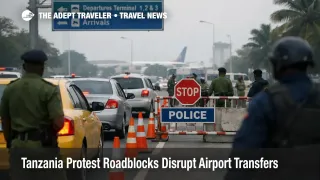
Tanzania's authorities increased movement controls in Dar es Salaam, Tanzania, and other key cities after calls for protests tied to post election tensions, with heavy police patrols, roadblocks near key government buildings, and ID checks on major corridors. Travelers heading to Julius Nyerere International Airport (DAR), those transiting through Dodoma, Tanzania, and Arusha, Tanzania, and anyone linking onward to domestic flights and safaris are the most exposed to sudden delays and route changes. The practical move is to treat city mobility as high variance, shift airport transfers earlier, and keep same day onward plans flexible until the security posture clearly relaxes.
The Tanzania protest roadblocks airport transfers risk matters because even when flights operate normally, roadblocks and transit shutdowns can prevent travelers from reaching terminals, tour departures, or ferries on time.
Reporting from Reuters described a largely deserted Dar es Salaam with security forces deployed in force, shops closed in the central business district, and checks on people moving around the city amid warnings that protests would be treated as an attempted coup. Associated Press reporting described roadblocks near government offices in Dar es Salaam and Dodoma, plus heavy patrols in Arusha, and it also reported that public transportation in Dar es Salaam was halted after drivers feared vandalism. Multiple foreign ministries and travel advisory services have warned that curfews and road closures can be announced at short notice, and that airport access and even flight schedules can be affected when unrest spikes.
For continuity on how this risk has been evolving, see Tanzania Unrest Roadblocks Slow Dar Airport Transfers and Tanzania December Protests Risk Travel Disruption.
Who Is Affected
Travelers are most exposed when their itinerary depends on predictable city movement, especially airport runs, hotel check ins tied to fixed cutoffs, and time bound tours that cannot wait. In Dar es Salaam, the risk concentrates on the road network linking hotels, government districts, and the airport, because a few checkpoints or closures can turn a routine transfer into a missed bag drop, a missed immigration cutoff, or a forfeited departure on a separate ticket.
Visitors connecting into the northern safari circuit should also treat Arusha area transfers as vulnerable, even if national parks remain quiet. Many itineraries route through Kilimanjaro International Airport (JRO) and onward road legs to Arusha hotels, staging points, and park gates, so a slowdown in city corridors can cascade into missed briefings, delayed departures, and costly re sequencing of camp nights.
Travelers with domestic connections, including flights to smaller airstrips and onward ground pickups, face a compounded risk because disruptions stack. If public transport or taxis thin out, staff and drivers can struggle to reach meeting points, and operators may push departures earlier to avoid afternoon uncertainty, which increases the penalty for being even slightly late. Advisories also flag potential communications issues, which can make it harder to receive rebooking notices or coordinate with drivers when conditions change quickly.
What Travelers Should Do
For the next 24 to 72 hours of uncertainty, travelers should build a larger buffer into every movement that touches a city center, and they should bias toward airport area lodging when departure timing is nonnegotiable. In Dar es Salaam, plan transfers as if one or two primary routes could be blocked, keep multiple ride options ready, and avoid passing near government buildings, police deployments, or visible gathering areas. If public transportation is limited, assume demand for taxis and private cars will spike, and confirm pickup plans in writing with your hotel or operator.
Decision thresholds should be strict. If you see expanding checkpoints, official stay home messaging, or evidence that buses and shared vans are not running, treat that as a signal to delay nonessential movement, and to rebook rather than attempt a tight same day plan. If your itinerary involves a same day international arrival plus a domestic hop, a safari road transfer, or a ferry connection, it is usually safer to add a buffer night than to gamble on a transfer that depends on normal city flow. Travelers on separate tickets should favor rerouting or date changes early, because a missed first leg can strand the entire chain.
Monitor official channels and operational signals, not social media clips without context. Watch your airline app for schedule changes, your government's travel advice for curfew or movement updates, and local hotel or tour operator messages about pickup timing. Also monitor whether card payments, mobile data, and messaging remain stable, and switch to offline backups if connectivity degrades. If the situation tightens, shelter in place, stay away from demonstrations, do not photograph security forces, and use your accommodation as a base until restrictions ease.
How It Works
Protest crackdowns disrupt travel less by closing runways than by breaking the last mile that connects travelers to transport assets. Roadblocks, ID checks, and sudden street closures compress traffic into a smaller set of routes, which lengthens transfer times and makes arrival times unpredictable, especially during commuting peaks. If public transport halts or drivers avoid certain corridors, the supply of vehicles drops while demand rises, which can create long waits even when roads are technically passable.
The second order ripple often shows up in aviation and tour operations. Airports can run with reduced staffing when employees cannot travel reliably, and airlines can face longer turn times when passengers arrive late and baggage processing becomes uneven. Those delays can propagate to later flights, and for travelers they show up as missed domestic connections, forced overnights near the airport, and compressed hotel inventory when many passengers rebook into the same window. On the safari side, tours and camp logistics may remain stable in remote areas, but most itineraries still funnel through city staging points, and a single delayed transfer can break a chain that includes park permits, timed flights to airstrips, and driver duty windows.
Sources
- Tanzania deploys police and army to prevent Independence Day protests, Reuters
- Tanzanian cities are empty as police patrol streets following calls for protests, AP News
- Tanzania protests, OHCHR press briefing note
- Tanzania: UN experts condemn post election lethal crackdown and digital repression, OHCHR
- Tanzania: Right to peaceful assembly and freedom of expression must be protected as more protests planned, Amnesty International
- Tanzania: multilateral engagement is key to preventing a further deterioration of the human rights situation, Human Rights Watch
- Travel advice and advisories for Tanzania, Government of Canada
- Tanzania travel advice, UK Foreign, Commonwealth and Development Office
- Tanzania travel advice, Australian Smartraveller
- Tanzania travel advice, SafeTravel New Zealand