

Uzbekistan Visa Free Entry For U.S. Travelers Jan 2026
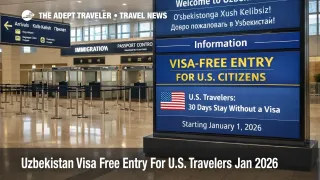
Uzbekistan is opening visa free entry for U.S. citizens for short visits, letting travelers enter without a visa and stay up to 30 days. The change affects Americans planning tourism, family visits, and short business or academic trips that fit inside a one month window. Travelers should still confirm passport and documentation basics, then design itineraries with realistic buffers for connections, and for any required on arrival formalities.
The practical meaning of Uzbekistan visa free entry is that a major pre trip hurdle disappears for most Americans, which tends to pull demand forward and compress availability for popular dates and classic Silk Road circuits.
Uzbekistan's government says the visa free regime begins January 1, 2026, and frames it as part of a broader push to deepen ties while expanding tourism and exchange travel. The policy is tied to a presidential decree, and it sets the stay limit at up to 30 days from the date of entry, which matters for travelers who like to enter, loop multiple cities, and exit overland or by air on the 29th or 30th day. If you were previously using an e visa, or avoiding Uzbekistan because you did not want paperwork risk, this is the type of change that makes a Central Asia trip feel bookable in a single planning sprint.
Operator commentary suggests the change is likely to accelerate a trend that was already underway. London based Wild Frontiers said it expects strong demand, and highlighted Uzbekistan as a gateway into Silk Road travel, while other tour brands have pointed to rising bookings tied to broader social exposure. Even if you are not taking a guided trip, those operator signals matter because group allocations can soak up hotel rooms, local guides, and train seats that independent travelers also rely on.
This also changes the way disruption spreads through an Uzbekistan itinerary. The first order effect is at the border and the airline check in desk, where you may no longer need to present a visa, but you still need to satisfy the carrier and border officer that your trip is legitimate, and time bounded. The second order ripple shows up in flight banks and on the ground, where tighter arrival waves can stress immigration processing, shift domestic flight and rail demand on the same day, and push more travelers into the same hotel check in windows in Tashkent, Samarkand, and Bukhara, especially during spring and fall shoulder season peaks.
For wider context on how easier entry has been reshaping multi country itineraries, see Central Asia tours surge as visas get easier. For a risk focused companion read that can inform routing choices and border region planning, see Uzbekistan High Caution Advisory For Silk Road Trips.
Who Is Affected
U.S. passport holders visiting Uzbekistan for trips that fit within a 30 day stay window are the direct winners, particularly first time visitors who were previously uncertain about e visa timelines, printing requirements, or approval edge cases. Last minute bookers also benefit, because the critical path shifts away from visa issuance and toward flights, lodging, insurance, and ground transport availability.
Travel advisors and tour operators are affected because demand can arrive faster than supply can scale. Uzbekistan's classic city circuit is tourism ready, but high quality guides, boutique properties, and comfortable train options are not infinite, and peak dates can sell out quickly once friction drops. Airlines and airports serving Uzbekistan are also affected at the margin, because more arrivals can mean more variability in processing times and more travelers needing help if a tight connection fails.
Independent travelers planning multi country routes across Central Asia are affected in a different way. When one country becomes easier, travelers often rebalance time across the region, which can change border crossing plans, the sequence of city stays, and the number of same day transfers. That can be good for flexibility, but it can also increase your exposure to missed connections if you stack too many legs without slack.
What Travelers Should Do
If you are traveling in January 2026 or early spring 2026, recheck your itinerary constraints right now, especially hotel cancellation windows, rail availability, and any nonrefundable domestic flight segments inside the region. Book the pieces that are capacity constrained first, then keep your entry documentation plan simple, with a valid passport, printed and offline copies of key confirmations, and conservative transfer times on arrival days.
If you already applied for an e visa, treat the decision as a math problem. If your trip starts after January 1, 2026, and you are eligible for visa free entry, it may be rational to stop chasing the visa and focus on airline and hotel flexibility instead, but if you are traveling before the change, or you need to stay beyond 30 days, you still need the appropriate visa pathway. The rebook threshold is usually whether your plan depends on a long stay, work or study activities, or repeated entries, because visa free entry is designed for short stays, and does not automatically solve those cases.
Over the next 24 to 72 hours, monitor the sources that actually move your trip. Watch for airline check in guidance for documentation, any updated embassy or government FAQs, and operator advisories if you are on a guided departure. If you are building a Silk Road route with border regions or overland crossings, keep an eye on travel advisories and on the on the ground constraints that can change quickly, then adjust routing to favor daylight travel and simpler city to city links.
Background
Uzbekistan's government announcement ties the change to a broader set of economic, cultural, humanitarian, and tourism goals, and anchors it in a presidential decree that sets the effective date and the 30 day stay limit. In practical travel terms, this shifts Uzbekistan closer to the low friction end of Central Asia for Americans, which is exactly how multi country itineraries go mainstream, because travelers can stitch together Kazakhstan, Kyrgyzstan, Tajikistan, and Uzbekistan with fewer pre trip steps and fewer points of failure.
It is also important to separate visa free entry from the rest of the compliance layer. The U.S. State Department's Uzbekistan page has long emphasized that travelers may use an e visa for short tourism visits, that certain categories still require physical visas, and that Uzbekistan requires foreign nationals to register with local authorities within a short window after arrival, with hotels often handling registration for guests. Those operational realities remain relevant even if the visa requirement drops for most American visitors, because they are the kinds of details that can derail a trip when you move between cities, stay in small properties, or travel independently.
Finally, a visa change can amplify both good and bad travel dynamics. Easier entry tends to increase demand, which can improve flight options over time and increase tour variety, but it can also raise prices and reduce last minute availability in the most visited cities and on the most popular train departures. Travelers who plan buffers, keep documents organized, and avoid overly tight connection chains are the ones who benefit most from the new flexibility.
Sources
- Uzbekistan introduces visa-free regime for U.S. citizens
- Uzbekistan introduces visa-free regime for U.S. citizens
- Uzbekistan International Travel Information
- Uzbekistan to Introduce Visa-Free Entry for US Citizens from January 1
- presidential decree of the republic of uzbekistan
- Uzbekistan permits visa-free travel for Americans