

American Adds 15 U.S. Routes From Chicago, Phoenix 2026
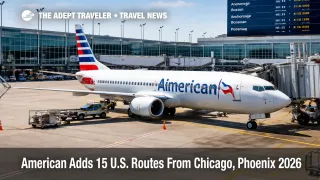
American Airlines says it will add 15 new domestic routes in 2026, with the biggest concentration tied to Chicago O'Hare International Airport (ORD) and Phoenix Sky Harbor International Airport (PHX). The changes are timed for late spring and early summer, which is when schedules harden for peak season travel planning and when travelers start locking in hotels, rental cars, and event weekends. For most travelers, the practical shift is simpler: more nonstop options for specific city pairs, and more one stop choices through hubs when nonstop seats sell out.
The new routes span six departure hubs, and the dates vary enough that travelers should not assume "summer" means the same thing everywhere. From Boston Logan International Airport (BOS), American will start daily Embraer 175 service to Dane County Regional Airport (MSN) on June 18, 2026, and it will also run seasonal daily BOS to Nantucket Memorial Airport (ACK) from June 18, 2026, through September 8, 2026. From Charlotte Douglas International Airport (CLT), daily Embraer 175 flights to Columbia Regional Airport (COU) start June 4, 2026.
Chicago O'Hare International Airport (ORD) gets three new year round spokes that matter for Midwest and Great Lakes travelers who prefer avoiding long drives to bigger airports. American plans to begin daily Bombardier CRJ 700 flights from Chicago O'Hare to Erie International Airport (ERI) on May 21, 2026, daily CRJ 700 service to Lincoln Airport (LNK) on June 4, 2026, and daily Embraer 170 flights to Tri Cities Airport (TRI) on May 21, 2026. Dallas Fort Worth International Airport (DFW) adds a second Lincoln option, with twice daily CRJ 700 service to Lincoln Airport (LNK) starting June 4, 2026, plus daily Bombardier CRJ 900 service to Roanoke Blacksburg Regional Airport (ROA) beginning the same day. Miami International Airport (MIA) adds a niche but useful link for spring and summer weekends, with once weekly Saturday flights to Jackson Medgar Wiley Evers International Airport (JAN) from March 14, 2026, through August 1, 2026.
Phoenix Sky Harbor International Airport (PHX) is the other center of gravity. American will add daily year round Embraer 175 service to Abilene Regional Airport (ABI) starting June 4, 2026, daily Airbus A321neo service to Ted Stevens Anchorage International Airport (ANC) from May 21, 2026, through September 8, 2026, and daily Embraer 175 flights to Bozeman Yellowstone International Airport (BZN) from June 4, 2026, through September 8, 2026. It also lists twice weekly CRJ 700 service to Glacier Park International Airport (FCA) from June 19, 2026, through September 6, 2026, plus daily Embraer 175 flights to McAllen Miller International Airport (MFE) starting June 4, 2026, and daily Embraer 175 service to Rapid City Regional Airport (RAP) from June 4, 2026, through October 4, 2026. Phoenix to Lincoln Airport (LNK) is also on the schedule as a seasonal daily route beginning in winter 2026, but without a published day specific start date in the announcement.
American also used the announcement to flag additional schedule changes at Chicago O'Hare. It will extend its winter only flying to Santa Fe Regional Airport (SAF) and Key West International Airport (EYW) into the summer window from May 21, 2026, through September 8, 2026. Separately, it will expand summer service from Chicago O'Hare to Hilton Head Island Airport (HHH), Pensacola International Airport (PNS), and Northwest Florida Beaches International Airport (ECP), shifting those markets from weekend only to daily service between February 12, 2026, and September 8, 2026.
Who Is Affected
Travelers who already rely on Chicago O'Hare International Airport (ORD) and Phoenix Sky Harbor International Airport (PHX) as connection hubs are the immediate winners, because more spoke flying generally means more itinerary combinations when a preferred nonstop is unavailable. American specifically framed Chicago as a growth hub for next summer, and said it expects to offer more than 500 daily departures from Chicago O'Hare, which can materially change same day connection options for business travelers and for families trying to avoid overnight layovers.
Smaller city travelers are also directly impacted, especially in Lincoln, Nebraska, where American is positioning new service as a one stop gateway to the broader network rather than as an isolated domestic add. For travelers in places like Erie, Tri Cities, Abilene, McAllen, and Columbia, Missouri, the main benefit is less backtracking by car to larger airports, and fewer two connection itineraries when traveling to the West, to Florida, or to major East Coast business markets.
Peak season leisure travelers are affected in a different way. Several of the routes are explicitly seasonal, ending in early September, which creates a real trap for late summer trips that slip past the cutoff date. That matters most for destinations linked to outdoor travel and national park demand, including Anchorage, Bozeman, Kalispell, and Rapid City, where hotel and car inventory can tighten quickly once nonstop options appear and more visitors commit to fixed arrival days.
What Travelers Should Do
If you are targeting any of these new city pairs, start by checking the exact start and end dates in your booking search, then build a buffer around the first two weeks of service. Early season routes are more exposed to schedule tweaks, aircraft swaps, and minor retimings as operations settle, so refundable hotels and a flexible first night plan are worth the premium if you are traveling on a fixed event weekend.
Use a simple threshold for whether to rebook or wait. If your preferred nonstop disappears, or prices spike beyond what a one stop itinerary would cost, shift to an earlier travel day or route through the hub that is adding the most capacity for your market, typically Chicago O'Hare or Phoenix. If you are traveling after September 8, 2026, on a route that ends earlier, stop waiting and reprice immediately, because that is when seasonal capacity drop offs can force inconvenient routings and higher fares.
Over the next 24 to 72 hours after you book, monitor three items: the listed operating days, the published aircraft type, and the seasonal end date for your route. American's announcement includes a mix of year round, summer seasonal, and winter seasonal flying, and those labels matter when you are coordinating rental car pickups, pre paid hotels, and onward tours that are hard to move.
Background
Route announcements like this are not just about adding seats, they reshape how a network moves people through connection banks. When American adds short haul regional flying into a hub, it can improve the "last mile" for smaller city travelers, but it also increases connecting passenger volume that competes for gates, ground crews, and departure slots at busy times of day. The first order effect is that you may see better schedule choices and fewer two stop itineraries. The second order effects show up in connection reliability, baggage flow, and the timing pressure on travelers who try to stack tight same day connections.
Seasonal flying adds another layer of complexity. Summer seasonal routes often align to predictable leisure demand patterns, but they can also concentrate travel on specific arrival days, which pushes hotel check in peaks, rental car shortages, and higher prices in smaller markets that do not have deep inventory. The same logic applies in the other direction when a seasonal route ends, because travelers who assumed a route was "daily all summer" can suddenly face a price jump or a two stop replacement once the calendar flips.
For Chicago specifically, American is also framing this as part of a broader build out that includes premium cabin positioning and additional destinations over time. If you are making longer haul plans that begin at Chicago O'Hare, it is worth pairing schedule changes with airport level planning, including connection time, terminal transfers, and ground transport options, using Chicago O'Hare International Airport (ORD). Travelers who are also tracking American's broader 2026 product and operational changes may want the context in American Flagship Suites Rollout On More Planes In 2026 and American Airlines pulls bag sizers from gates nationwide, because gate and cabin changes can compound peak season congestion when more regional flying is added.