

American Flagship Suites Rollout On More Planes In 2026
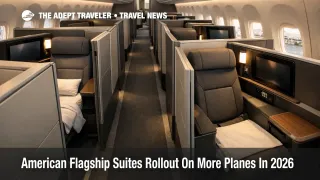
American Airlines is pushing a more premium onboard and airport experience across 2026, built around lie flat suites, better connectivity, and expanded lounge capacity. The first big inflection point for many travelers is domestic, not international, because American plans to debut its Airbus A321XLR with lie flat suites on the New York to Los Angeles route starting December 18, 2025. If you are booking for 2026, the practical takeaway is that American's most premium seats will be showing up on more aircraft types, but not evenly, and not always on the routes you expect, so you will need to verify the aircraft and seat map before you commit.
The core "suite" product is already flying on a subset of Boeing 787 9 aircraft with a higher premium seat count and privacy doors. American describes that 787 9 setup as having 51 Flagship Suite seats, along with updated premium economy and main cabin features. The airline's plan for 2026 is to grow that footprint through additional deliveries and by moving the suite concept onto more aircraft, including expanding to narrowbody long range flying with the A321XLR.
At the same time, American's retrofit plans for older Boeing 777 aircraft have real timing risk. American has acknowledged that supply chain bottlenecks, including seats and interior components, have slowed parts of the 777 conversion timeline. That matters for travelers because a "suites coming soon" story can translate into months of mixed cabins on the same route family, plus last minute aircraft substitutions that swap a suite seat map for an older configuration.
Beyond the seat itself, American is also attaching premium value to the rest of the journey. The airline has said free high speed Wi Fi for AAdvantage members is expected to begin in January 2026 on most equipped aircraft. On the ground, American continues to expand and refresh lounges in key hubs, which can materially change the value of a premium ticket, an eligible credit card, or oneworld status on a connection heavy itinerary.
Who Is Affected
Travelers most affected are those paying for business class, chasing upgrades, or using miles on long haul routes where the difference between a suite and an older lie flat seat changes the whole trip. If your 2026 plans include Europe, the South Pacific, or other long haul markets where American schedules its newest 787 9 premium configuration, you are in the highest probability bucket for seeing Flagship Suites, but only on flights actually operated by that specific aircraft subtype.
Premium transcontinental flyers are also squarely in scope. The A321XLR deployment on John F. Kennedy International Airport (JFK) to Los Angeles International Airport (LAX) is aimed at one of the most competitive domestic corridors, and it introduces an international style three class layout on a single aisle aircraft for that market. That can influence everything from upgrade inventory to how crowded the premium cabin feels, because the seat mix is different from the legacy transcon setup travelers are used to.
Loyalty members who care more about the total experience than the seat are also impacted, especially in 2026. Free Wi Fi for AAdvantage members changes the economics of staying connected in flight, but only on aircraft that have the supported connectivity installed, so the benefit can be uneven across routes and regions. Lounge projects are similarly uneven, meaning a premium connection through Philadelphia International Airport (PHL) can look very different from a connection through Miami International Airport (MIA), Charlotte Douglas International Airport (CLT), or Ronald Reagan Washington National Airport (DCA) during construction windows.
Finally, travelers on thinner routes, including secondary transatlantic flying, should pay attention because the A321XLR is designed to make smaller long range markets viable. That can create attractive new nonstop options, but it also concentrates product variability on a smaller fleet early on, which raises the odds that an aircraft swap changes your cabin experience at the last moment.
What Travelers Should Do
Start by treating the aircraft assignment as a booking criterion, not trivia. Before you buy, check the aircraft type in the booking flow, then confirm the seat map shows suites and a 1 2 1 style layout for business class where applicable. If your trip hinges on the suite experience, choose a fare that is changeable, or at least refundable with a manageable penalty, and avoid tight same day commitments on arrival until you have higher confidence the aircraft will hold.
Use a simple decision threshold once you are inside the final 72 hours. If the suite seat map disappears, or the aircraft type changes in the app, decide quickly whether you are willing to fly the older cabin, or whether you want to rebook to a flight that still shows the suite configuration, even if it means a different connection or departure time. The earlier you make that call, the more likely you are to find inventory in the same cabin or on a comparable routing.
Over the next 24 to 72 hours before departure, monitor three signals: the aircraft subtype shown in your reservation, the business class seat map, and any schedule change notifications. If you are flying through JFK or LAX, also keep an eye on systemwide delay risk that can disrupt carefully planned premium connections, and use FAA Dec 16 Flight Delays, JFK and LAX Weather Risks as a playbook for when to switch to earlier flights or protect a connection. For longer horizon planning, remember that aircraft delivery and certification delays can spill into cabin rollout schedules, so it helps to understand the broader capacity backdrop described in FAA Delays on Boeing 737 MAX 10 Hit Airline Capacity.
Background
Premium cabin rollouts do not land evenly across a network, they propagate through fleet assignment, maintenance cycles, crew training, and route economics. A new aircraft type like the A321XLR typically starts on a high visibility route where the airline can control the operation, build familiarity, and showcase the product, then expands outward once dispatch reliability and spare coverage mature. That is why the earliest "best bets" for American Flagship Suites 2026 will cluster on a small set of aircraft and routes, even if marketing implies a broader shift.
The second order effects show up in places travelers feel immediately. When an airline adds premium seats, it changes the upgrade and award landscape, sometimes creating new availability, and sometimes raising cash prices as demand concentrates on the newest cabins. It also changes boarding dynamics, carry on competition in premium heavy configurations, and the likelihood that an oversale in one cabin cascades into operational upgrades or downgrades.
Then there is the ground layer, which is where the experience can quietly win or lose for premium travelers. American opened new Flagship and Admirals Club lounges at PHL in 2025, and it has announced additional lounge projects at MIA, CLT, and DCA that extend into 2026 and beyond. That expansion can reduce crowding long term, but during renovation and build phases it can also push more passengers into fewer open lounges, shift walking times, and change how early you should arrive to reliably use the amenities you paid for.
Finally, supply chain reality matters. American has said seat and interior component shortages have delayed parts of its 777 retrofit program. Even if your route is on the "future suites" list, the operational truth is that airlines will swap aircraft to protect the schedule, and they will prioritize getting you there over protecting a specific cabin product. For travelers, that means the most reliable strategy is to book with flexibility, verify the aircraft repeatedly as departure nears, and have a rebooking plan that you can execute fast if the suite disappears.
Sources
- American Airlines ramps up premium upgrades to regain ground on Delta, United
- A suite sensation: American Airlines new premium Boeing 787-9 takes flight
- Get ready for free inflight Wi-Fi for AAdvantage members
- Introducing the newest airport oasis: American Airlines unveils Flagship and Admirals Club lounges at Philadelphia International Airport
- Tranquilo y tropical: American Airlines to elevate the premium travel experience at Miami International Airport with new Flagship lounge and expanded Admirals Club lounge
- American Airlines introduces first-of-its-kind Provisions by Admirals Club lounge at Charlotte Douglas International Airport
- A travel experience fit for a Queen City: American Airlines announces lounge investment at Charlotte Douglas International Airport
- American Airlines to renovate additional Admirals Club lounge in Washington, D.C.