

Eurostar Amsterdam Rotterdam Stops Suspended on Key Trains
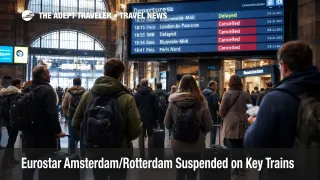
Eurostar has been running select Netherlands services without stops at Amsterdam Centraal and Rotterdam Centraal, forcing passengers to board in Brussels instead. Travelers booked on the affected Amsterdam and Rotterdam departures, plus anyone relying on late December Amsterdam and London rotations, are most likely to face last mile replanning and missed connections. The practical move is to check your train number now, then either reposition to Brussels with extra buffer, exchange to a different departure date, or pivot to a short haul flight if you cannot tolerate a same day miss.
Eurostar Amsterdam Rotterdam stop suspensions change where you board, and they raise the odds of late December reroutes via Brussels for London bound trips.
Eurostar's own travel updates say it has cancelled the Amsterdam Centraal and Rotterdam Centraal stops on Eurostar 9157 on December 15 to 19, 2025, plus December 22, 2025, and December 26, 2025. Rail Europe's disruption guidance adds that impacted passengers can keep their ticket and board the same Eurostar 9157 in Brussels Midi, with the published boarding time shown as 6:52 p.m. local time in Brussels, and that EuroCity and Eurocity Direct services can be used to reach Brussels at no extra cost.
Separate from the 9157 stop change, Rail Europe also lists forward dated cancellations that matter during the holiday peak because they remove full train options rather than just shifting the boarding station. The cancellations it lists include Amsterdam to London Eurostar 9167 on December 23, 2025, December 28, 2025, and December 30, 2025, and London to Amsterdam Eurostar 9106 on December 24, 2025, December 29, 2025, and December 31, 2025. Even if your own departure is not on that list, those removals can tighten seats on nearby departures and raise the odds that Eurostar reaccommodation pushes you to a different station, a different day, or a Brussels based connection.
Who Is Affected
The most exposed travelers are those holding tickets on Eurostar 9157 on December 15 to 19, 2025, plus December 22, 2025, and December 26, 2025, who planned to board at Amsterdam Centraal or Rotterdam Centraal. For these trips, the issue is not just delay risk, it is a boarding location change that turns a direct Netherlands departure into a two leg plan, usually involving Brussels Midi, and often involving local Dutch rail or metro steps to reach the recommended connection stations.
Passengers starting in Rotterdam have the cleanest repositioning path because Rail Europe's advisory includes specific EuroCity and Eurocity Direct options from Rotterdam Centraal to Brussels. Passengers starting in Amsterdam should watch the station detail closely because Rail Europe's advisory emphasizes Amsterdam Zuid and Schiphol Airport as connection points, and explicitly notes that the suggested Eurocity Direct train does not call at Amsterdam Centraal. That is a meaningful last mile change for travelers who booked hotels near Centraal, who planned to arrive on foot with luggage, or who were counting on minimal local transport.
Anyone traveling on the late December dates where Rail Europe lists outright cancellations should also treat onward plans as at risk, even if they can be reprotected, because a cancellation can push arrivals later into the evening bank, when fewer onward UK rail seats remain and when hotel check in policies get stricter. Travelers with separate tickets are the second group at risk, especially those chaining Eurostar to domestic UK rail, to ferries, or to short haul flights, because a single missed handoff can become a full day reset.
For related cross Channel instability context, see Eurostar Cancellations London Paris Trains Dec 18, since disruption clusters can reduce the network's ability to recover quickly during peak weeks.
What Travelers Should Do
Start with immediate actions and buffers. Verify your exact train number and date in Eurostar's travel updates and timetable tools before you leave for the station, then plan as if you will have to clear additional gate and border steps at Brussels. If you are on the affected 9157 dates, build time to reposition to Brussels, and do not treat a tight evening arrival in London as guaranteed, because one late local segment can collapse the whole chain.
Use clear decision thresholds for rebooking versus waiting. If missing your planned arrival would break a last train onward, a fixed event start, or a hotel check in cutoff you cannot waive, exchange proactively while seats exist, rather than showing up and hoping the day runs clean. If you can absorb a later arrival, keeping the ticket and boarding at Brussels can be rational, but only if you have a realistic local transport plan to reach the recommended departure station, and a backup lodging option if you end up pushed to the next departure.
Monitor the right signals over the next 24 to 72 hours. Watch whether Eurostar adds more stop level changes, whether additional Amsterdam and London rotations are removed, and whether Brussels Midi becomes a pinch point for evening departures as rerouted passengers converge. If your plan includes entering the United Kingdom by rail, recheck your documents and any new digital permission requirements well before travel using UK Entry Requirements For Tourists In 2026, since documentation problems become harder to solve when you are already rerouting.
For a practical city by city reroute plan, Rail Europe's published guidance points most affected 9157 passengers toward Brussels Midi boarding. From Rotterdam Centraal, it lists EuroCity 9240 departing at 210 p.m. and EuroCity 9244 departing at 310 p.m. as options to reach Brussels at no extra cost, and it separately notes updated Eurocity Direct options including 9544 at 239 p.m. and 9548 at 339 p.m. From Amsterdam, it advises using Amsterdam Zuid with Eurocity Direct 9544 at 204 p.m. or 9548 at 304 p.m., and from Schiphol Airport it lists Eurocity Direct 9544 at 212 p.m. or 9548 at 312 p.m., then boarding Eurostar 9157 in Brussels for the London leg. Travelers should treat those published times as a starting point, then confirm the day's platform and any short notice retimings before departure.
How It Works
Eurostar's London services are tightly coupled to fixed terminal processes, including ticket control, security, and border checks, plus limited high speed paths through the Channel Tunnel corridor. When a Netherlands stop is removed, the disruption is not only about one station, it changes where the system performs its passenger intake and where it must protect connections. The first order effect shows up immediately in the Netherlands, because travelers must reposition within the Dutch rail network, and any small delay on that feeder leg can become a missed international departure.
The second order ripple typically hits two layers at once. Brussels Midi can become a pressure point because rerouted passengers arrive in waves and compete for evening capacity, while the broader timetable loses slack as cancelled or retimed trains force more people onto fewer departures. That behavior change can spill into hotel demand near major stations, later check ins, and increased short haul air demand on Amsterdam and London city pairs when rail no longer looks like the lowest risk option. During late December, those effects can compound quickly, because holiday loads reduce spare seats, and reaccommodation options narrow the longer you wait.