

Geneva Airport EES Queues Up To 4 Hours
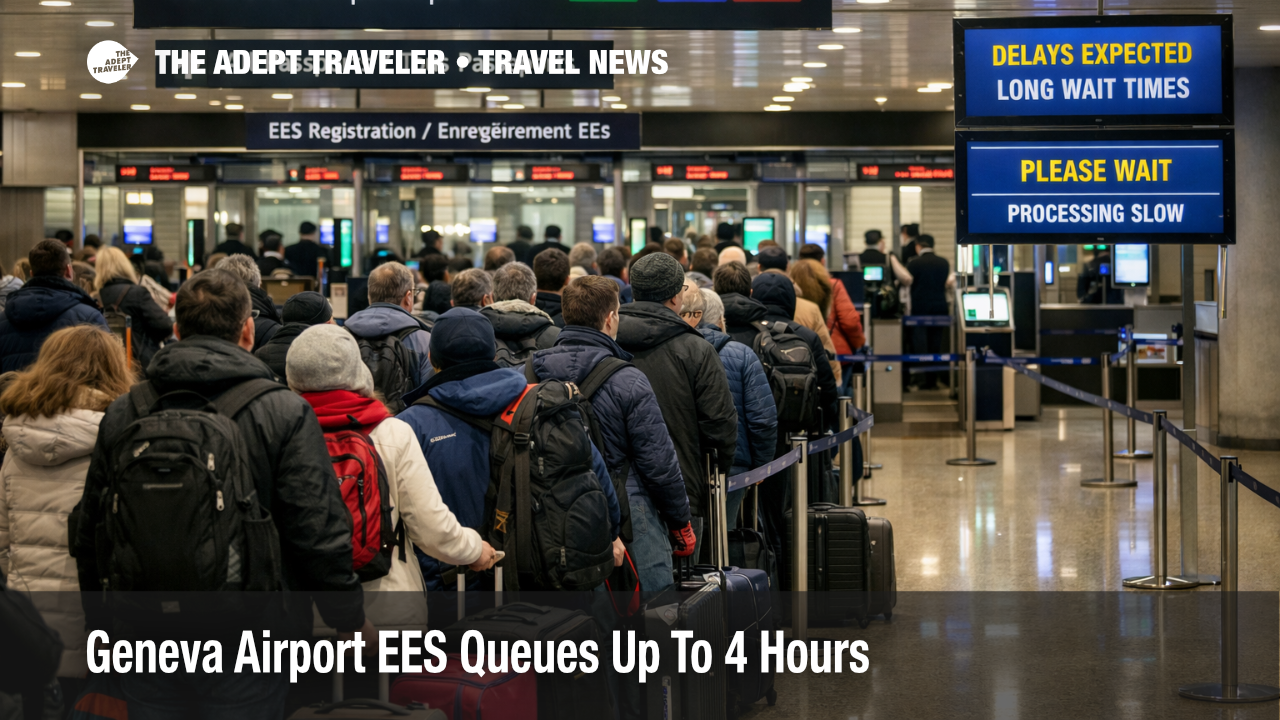
Passport control delays at Geneva Airport (GVA) have escalated sharply as the EU Entry Exit System, EES, adds biometric enrollment steps for many non EU arrivals. Travelers most exposed are visa exempt and short stay visitors entering Schengen for the first time since EES went live at this border point. The practical move is to protect arrival day plans by adding buffer after landing, loosening resort transfer timing, and avoiding tight onward connections that only start once immigration is cleared.
Geneva Airport EES queues now look like an arrivals hall capacity problem, not a minor inconvenience, because long lines can erase ground transfer windows and turn same day itineraries into involuntary overnights.
This Geneva escalation is a concrete example of the broader Schengen pattern flagged in Schengen EES Border Delays At Airports Into 2026, where small per passenger time increases and occasional outages can create nonlinear queues when arrivals bunch.
Who Is Affected
EES applies to non EU nationals traveling for a short stay each time they cross the external borders of participating Schengen countries, and it captures passport data plus biometric identifiers such as fingerprints and a facial image. Switzerland is part of Schengen and introduced EES at Geneva as an external Schengen border airport, so arriving non EU travelers can be processed under these new rules even though Geneva, Switzerland is not in the EU.
In traveler terms, three groups are most exposed at Geneva. First are ski season arrivals who must make a fixed coach, car, or rail connection to resorts in the Swiss and French Alps, because the delay happens after landing, and can push them into missed pickups and late check ins. Second are travelers connecting onward after clearing immigration, including same day flights, because the queue consumes the hidden part of a connection that many itineraries do not budget correctly. Third are families and groups arriving with mixed passports, where slower processing for first time biometric enrollment can keep the whole party together in line, even if some members are not subject to enrollment.
The second order effects follow quickly once the arrivals hall releases passengers in pulses rather than steadily. Airlines face a concentrated reaccommodation load if passengers miss onward flights, airport area hotels can tighten when misconnects become overnights, and transfer operators see bunching that can overflow vehicle capacity on popular changeover days. ACI EUROPE has also warned that operational issues, including outages and kiosk availability problems, amplify unpredictability, which is what turns a long line into a trip breaker.
What Travelers Should Do
Act as if your Geneva arrival time is the aircraft touchdown time plus a large, variable immigration margin. Keep the first day flexible, do not schedule hard start activities soon after landing, and if you are heading straight to the mountains, favor transfers you can shift without penalty, or add a buffer night in Geneva, Switzerland when the itinerary is tight.
Use a clear decision threshold for rebooking versus waiting. If your plan depends on making a fixed departure, such as an onward flight or a pre paid coach, and you cannot absorb a multi hour delay at passport control, moving to an earlier arrival day, or rerouting through a different first entry airport where you can build a longer layover, is often safer than gambling on the arrivals hall. If you are on separate tickets, treat the risk as yours to manage, and widen the gap until a missed connection does not create cascading losses.
Over the next 24 to 72 hours, monitor signals that predict whether Geneva will run smoothly on your travel day. Watch for airport or border authority messaging about congestion, airline advisories that hint at proactive rebooking options, and credible reporting of EES instability or local pauses in processing. The calendar risk increases on January 9, 2026, when the implementation schedule calls for a higher share of travelers to be registered, so instability that is tolerable at 10% can become unmanageable when enrollment volume rises.
Background
The Entry Exit System is the EU's digital replacement for manual passport stamping for short stay visits, and it records entries and exits across 29 participating European countries while storing traveler identity and biometric data. The European Commission describes the rollout as progressive from October 12, 2025, through April 2026, with countries introducing it gradually or in full at their external borders. Switzerland's federal guidance explicitly warned that travelers who are third country nationals could see longer waiting and control times during the introduction phase at airports, including at Geneva.
Why queues spike at airports like Geneva comes down to throughput math and system coupling. First order effects sit at the booths and kiosks, where first time biometric capture adds steps, retries happen when kiosks or networks fail, and border staffing must expand to keep the flow stable. When arrivals are banked, meaning several international flights arrive within a short window, a small increase in per person processing time becomes a large queue that can spill into circulation space, and that in turn can force operational throttling for safety and crowd management.
Second order ripples spread into at least two more layers of the travel system. Connections suffer because the delay happens after landing, which erases planned buffers, and drives missed flights and rebooking surges that reduce same day seat availability. Ground transport then sees late passenger waves that can overwhelm taxis, shuttles, and rail boarding, and in winter this can cascade into road transfer timing and resort check in disruptions across Alpine corridors. The pressure is likely to rise again as the registration threshold increases from 10% to 35% on January 9, 2026, per ACI EUROPE's warning about the rollout calendar.
Sources
- New EU entry system causes four-hour queues at Geneva airport
- Review of Schengen Entry-Exit System urgently needed to avoid systemic disruptions impacting passengers
- La Suisse introduit le système d'entrée et de sortie EES
- Entry/Exit System (EES), European Commission
- Information Campaign Launched on the Entry/Exit System, eu-LISA
- Why the EU's new entry-exit system is causing 'chaos' at airports