

U.S. Airport Delays, Ground Stops, December 22, 2025
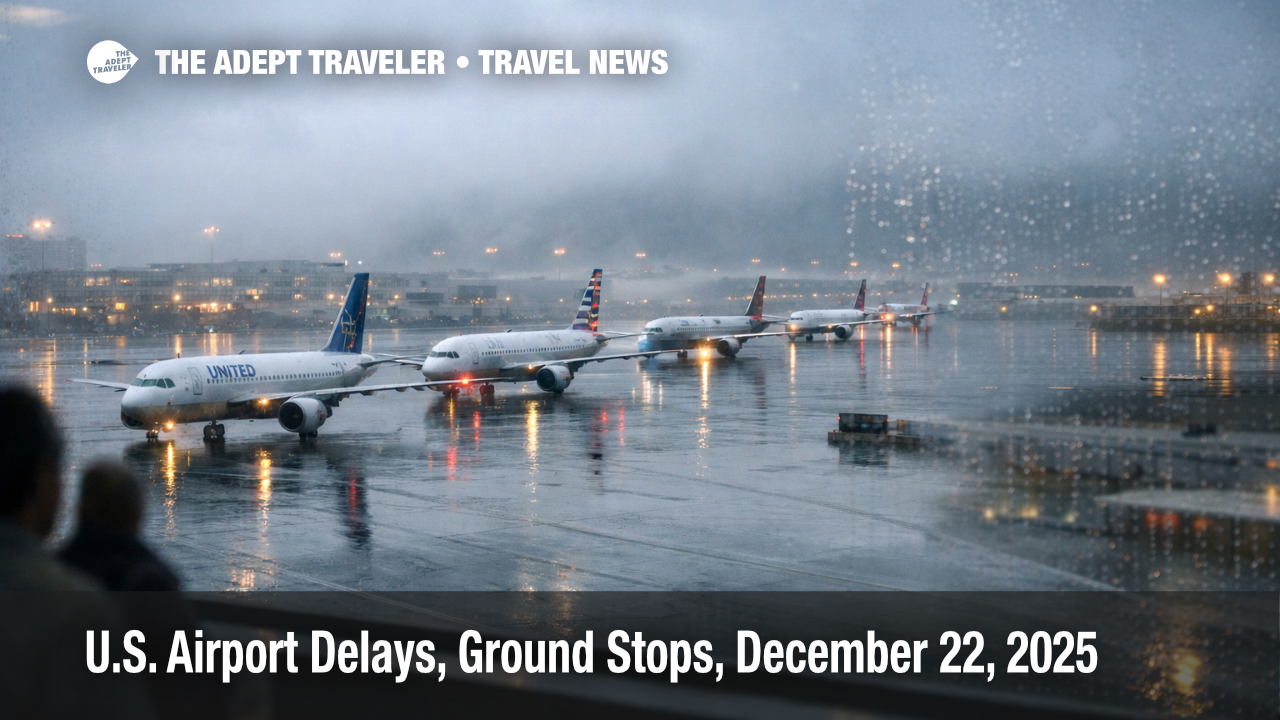
Targeted U.S. airport delays are on the table today as the FAA's system planning points to weather driven capacity cuts on the West Coast and wind related constraints in the Northeast corridor. Travelers are most exposed if they touch San Francisco International Airport (SFO), Seattle Tacoma International Airport (SEA), Boston Logan International Airport (BOS), or Newark Liberty International Airport (EWR), because those hubs amplify delays into missed connections and late aircraft. The practical move is to treat tight connections as optional, shift earlier where you can, and monitor FAA traffic management programs before you commit to airport transfers.
The FAA's operations plan for December 22 calls out low ceilings and rain affecting the San Francisco and Seattle areas, wind constraints tied to the Boston and New York area airspace, and a heavy volume window at Newark from 100 p.m. to 600 p.m. ET. The same plan lists a probable ground stop or delay program risk for San Francisco after 800 a.m. PT, and a possible program risk for Newark after 100 p.m. ET.
As of the most recent FAA status snapshot available at publication time, systemwide delays were generally low, which matters because it can lull travelers into booking short connections right before metering programs start. If today's planned constraints materialize, the pattern most travelers see is not a dramatic nationwide shutdown, it is uneven waves of gate holds that grow through the afternoon as aircraft and crews arrive out of position.
Who Is Affected
Travelers starting or connecting through San Francisco are exposed to arrival metering that can hold flights at the departure airport rather than in the air. That means your airline app may look fine until boarding time, then flip to a delayed departure once the metering slot is assigned.
Travelers touching Newark should treat the mid to late afternoon as the most fragile window, especially for itineraries that rely on a single specific connection bank. When volume pushes the airport close to capacity, even minor spacing changes can create long taxi out queues, gate holds, and rolling missed connections into the evening.
Northeast travelers using Boston and the wider New York area airspace complex are exposed to wind and low ceiling constraints that reduce arrival rates across multiple airports at once. When that happens, the disruption spreads beyond one airport because controllers meter traffic across the region, and airlines often need to protect crew legality by canceling later rotations.
Ski travelers routing into Aspen Pitkin County Sardy Field (ASE) are exposed to smaller airport fragility. When Aspen goes into a delay program or a ground stop, recovery can be slower because there are fewer substitute aircraft, fewer extra crews, and fewer same day alternate routings that still get you to the mountain on schedule.
What Travelers Should Do
If you are flying today, move your decision point earlier than you normally would. Check your inbound aircraft status and the FAA traffic management posture before you leave for the airport, and build more buffer for curb to gate time, because gate changes and long security lines compound quickly during holiday weeks.
Use a firm threshold for rebooking versus waiting. If a delay pushes you past your last realistic protected connection option at the hub, rebook immediately while seats still exist on later departures. If your flight is delayed but you still have multiple protected options later the same day, waiting can be rational, but only if you have time to absorb a surprise aircraft swap, a gate change, and a longer taxi out.
Over the next 24 to 72 hours, monitor whether today's "planned" programs become "active," and whether the West Coast rain and low ceiling pattern persists into the next morning bank. If the same airports stay constrained across multiple banks, delays tend to migrate from being mostly late departures into more cancellations, because airlines run out of slack in aircraft rotations and crew duty limits.
How It Works
A ground stop is a temporary pause on departures to an airport, used when the destination cannot safely accept more arrivals. A ground delay program meters arrivals by assigning controlled departure times, so the holding happens on the ground at origin airports rather than as airborne stacking.
These tools matter to travelers because the first order effect is not just your departure time, it is the whole downstream rotation. When an airport like San Francisco goes into arrival metering, inbound flights from across the country depart late, arrive late, and then push their next segments late, which can strand connecting travelers at a different airport than the one with the weather.
The second order effects are where the pain increases. Once delays compress into the afternoon and evening banks, crews can time out, aircraft can miss maintenance windows, and airlines lose rebooking inventory at exactly the moment passengers need flexibility. That spillover is why a West Coast low ceiling day can create missed connections at inland hubs, and why a Northeast wind day can turn into last flight of the day cancellations.
For continuity on how these programs show up in real traveler outcomes, see U.S. Airport Delays and Ground Stops: December 21, 2025 and New York Flight Delays, LGA and JFK Ground Stops, GDPs. For the broader structural context on why capacity and staffing debates keep resurfacing during peak travel weeks, reference U.S. Air Traffic Control Privatization: Reality Check.