

U.S. Airport Delays and Ground Stops: December 21, 2025
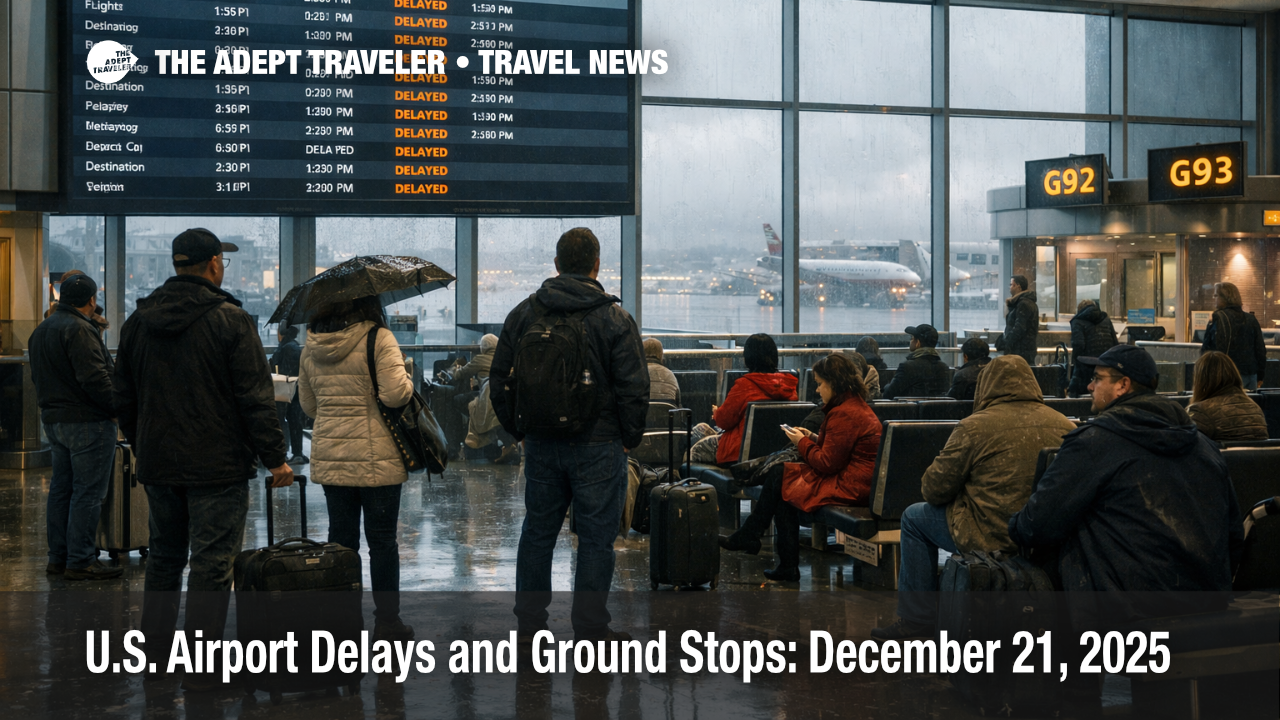
The FAA is managing targeted air traffic constraints on December 21, 2025, including ground delay programs tied to San Francisco International Airport (SFO) and Aspen Pitkin County Sardy Field (ASE). Travelers connecting through those airports, and travelers flying transcontinental routes that feed them, are the most exposed to late departures, missed connections, and last minute aircraft swaps. The practical move today is to treat tight connections as optional, build extra airport arrival time, and be ready to rebook proactively if your inbound aircraft is already running late.
U.S. airport delays December 21 are being driven by a mix of weather, wind, staffing initiatives in New York Center airspace, and holiday volume that reduces the system's ability to absorb small disruptions.
San Francisco is the clearest national ripple risk. The FAA's real time status page shows a traffic management program for arrivals into San Francisco that is delaying some inbound flights by an average of 1 hour and 48 minutes, even while general arrivals at the airport may look closer to normal in the moment. That pattern matters because it pushes delays backward to departure airports across the country, and it can turn into late aircraft and late crews for the rest of the day.
Aspen is also under a ground delay program, with the FAA listing average delays of 1 hour and 35 minutes attributed to airport volume. On peak winter weekends, that usually means demand and arrival sequencing are outpacing what the airport, and the surrounding airspace, can handle without metering.
Who Is Affected
Travelers flying into, or out of, San Francisco International Airport (SFO) should expect knock on impacts even if their specific flight is not immediately tagged as delayed in an airline app. Metering programs often hold flights at origin rather than in the air, so the disruption can show up first as a delayed departure from your starting airport, and only later as a delayed arrival into San Francisco.
Ski travelers using Aspen Pitkin County Sardy Field (ASE) face a similar pattern, plus a stronger misconnect risk because aircraft and crews are harder to substitute at small airports. When average delays run well over an hour, a same day car service, a shared shuttle, or a prebooked hotel check in window can become the next failure point.
Northeast travelers should watch the afternoon window. The FAA Command Center's operations plan flags wind constraints affecting the Boston, New York, Philadelphia, and Washington airspace complex, and it calls out possible programs after 1:00 p.m. ET for San Diego International Airport (SAN), LaGuardia Airport (LGA), and Newark Liberty International Airport (EWR) plus Teterboro Airport (TEB). If those become active, they can compress schedules late in the day, and increase misconnect risk into the evening banks at major hubs.
Florida, and certain Caribbean flows, are also worth monitoring because the same operations plan ties New York Center staffing triggers to partial routing initiatives toward Florida, plus additional en route constraints that reflect holiday patterns and volume. Even when a traveler never touches New York directly, those initiatives can lengthen flight times, create airborne spacing, and shift arrival banks at downstream hubs.
For continuity and traveler tactics that still apply today, see Flight Delays and Airport Impacts: December 20, 2025 and Flight Delays and Airport Impacts: December 19, 2025. For a standing playbook on rebooking posture and buffers, use Tips for Dealing with Flight Delays or Cancellations.
What Travelers Should Do
If you are traveling through San Francisco, or Aspen, treat any connection that is under 90 minutes as a risk trade, not a plan. Move to an earlier departure where possible, pick itineraries with a single protected ticket, and build extra ground time for rideshare lines, rental car shuttles, and hotel check in cutoffs, because the system tends to deliver delays in uneven waves when metering is active.
Use a clear decision threshold for rebooking versus waiting. If your inbound aircraft is delayed enough that you will arrive after your last reasonable connection option, rebook before you reach the airport, because peak holiday counters and gate lines slow everything down at the exact moment you need speed. If your delay is moderate, and you still have multiple protected rebooking options later, waiting can be rational, but only if you have enough time to absorb a surprise gate change, or a longer taxi in.
Over the next 24 to 72 hours, watch three inputs that tend to move before airline messaging catches up. Track the FAA Command Center operations plan for any upgrades from "possible" to "active" programs, check the real time airport status pages for your key hubs, and pay attention to runway, and construction constraints that shrink capacity, especially at LaGuardia and San Diego. Those constraints can keep delays elevated even after the primary weather, or staffing trigger improves.
Background
A ground delay program is the FAA's way of metering demand into an airport when the arrival rate has to be reduced, typically for weather, wind, staffing, or runway configuration limitations. For travelers, the key detail is that delays often get assigned at the departure airport, because holding an aircraft on the ground is safer and more predictable than stacking aircraft in the air. That is why a San Francisco constraint can show up as a late push from Chicago, Dallas, or Seattle, even if the weather at your origin is fine.
San Francisco is a classic example of how the system propagates disruption. The airport notes that low visibility can force single file arrivals because the parallel runways are closely spaced, which reduces how many aircraft can land per hour and triggers metering. Once that metering starts, airlines lose schedule elasticity, crews risk timing out, and aircraft rotations miss downstream departure slots, which then pushes delays into later banks, and increases the odds that travelers need overnight hotels or next day rebooking.
The same ripple logic applies to New York airspace staffing initiatives. Route programs and partial initiatives change how traffic flows through congested corridors, which can lengthen flights, re sequence arrivals, and create uneven peaks at hub airports. Add holiday volume and runway construction limits, and even small weather degradations, like gusty winds, can create longer recovery tails than travelers expect from the initial trigger alone.