

Heathrow SAS Cabin Crew Strike Dec 24 and 26
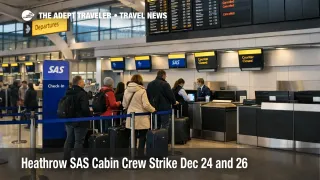
Scandinavian Airlines Services cabin crew based at London Heathrow Airport (LHR) are scheduled to take strike action over the Christmas period, with walkouts that include Wednesday, December 24, 2025, and Friday, December 26, 2025. SAS passengers are the most directly exposed, but itineraries that rely on tight Heathrow connections, separate tickets, or same day ground transfers can fail quickly when even a small number of flights cancel. Travelers should treat this as a time sensitive rebooking problem, check flight status frequently, and set a clear threshold for when to reroute versus when to wait.
The Heathrow SAS cabin crew strike affects plans because it increases the probability of short notice cancellations and thin recovery options on peak holiday load factors.
Industry reporting indicates the wider strike schedule includes Monday, December 22, Tuesday, December 23, Wednesday, December 24, and Friday, December 26, 2025, tied to a pay dispute involving more than 130 Heathrow based cabin crew. A SAS spokesperson has said the airline is in negotiations and has not provided detailed public commentary while talks continue.
For broader context on how overlapping London labor actions can compound Christmas week disruption, see London Airport Strikes Disrupt Christmas Flights.
Who Is Affected
The most exposed travelers are those booked on SAS services between Heathrow and Scandinavian gateways such as Copenhagen Airport (CPH), Stockholm Arlanda Airport (ARN), and Oslo Airport (OSL), because those routes are repeatedly flagged as likely pressure points if crew coverage drops. If your itinerary connects onward via those hubs, a single cancellation at Heathrow can cascade into missed connections across Nordic and European networks, and the next available protected itinerary may be one or more days later when holiday loads are high.
Travelers on separate tickets have an additional failure mode. If your SAS segment is delayed or canceled and your onward ticket is on a different carrier, you may be responsible for fixing the misconnect, paying walk up fares, and absorbing last minute hotel costs near Heathrow. The risk is highest when you have a same day transfer to another London airport, a long haul departure you cannot miss, or a time locked anchor such as a cruise embarkation or an event check in.
Even travelers not flying SAS can feel second order effects around Heathrow. When cancellations push passengers to rebook onto other carriers, demand spikes across the London market, and that can translate into sold out flights, longer service desk queues, and higher last minute room rates in the Heathrow corridor as displaced passengers wait for the next viable departure.
What Travelers Should Do
Start with actions that reduce fragility today. Confirm your operating status using SAS Flight Status and your booking in My Trips, and do not assume yesterday's schedule is still valid on December 24 or December 26. If you can travel carry on only, do it, because it limits exposure if you are rebooked onto a different aircraft, a partner carrier, or a different day, and it makes an involuntary overnight easier to manage.
Use decision thresholds that force an early choice. If your itinerary breaks when you arrive more than about 60 to 90 minutes late, or if you are on separate tickets with a short buffer, treat any schedule change, downgrade in connection time, or cancellation notice as a trigger to reroute immediately. In practice, that can mean moving to an earlier departure, shifting to a different day, or accepting a protected rebooking via a SkyTeam partner network if offered, rather than gambling on same day recovery inventory that may not exist.
Over the next 24 to 72 hours, monitor the signals that predict whether you will travel as planned. Watch for proactive rebooking options, fee free changes, and updated disruption instructions on SAS Flight Disruptions, and keep receipts for essential costs if you are delayed or stranded. If you are traveling for a fixed deadline, track your latest acceptable departure time, and act before the airport day begins, because once cancellations propagate, call centers and desks slow, and the best alternatives disappear first.
How It Works
A cabin crew walkout can translate into cancellations because airlines must staff each flight to minimum safety and service requirements, and gaps are difficult to patch on short notice when crews are position constrained. At a hub constrained airport like Heathrow, a single canceled rotation is not just one lost flight, it is also an aircraft and crew plan that must be rebuilt while the airport continues running near capacity. That is why disruption often shows up as last minute cancellations, merged flights, or late departures rather than a clean, evenly distributed delay pattern.
The second order ripple is usually larger than the first order event. When a flight is canceled on a peak day, the problem becomes seat inventory and partner capacity, not just staffing. SAS is a SkyTeam member, which can broaden rerouting options across partner networks, but those seats are still finite, and holiday demand can make even alliance based reaccommodation slow. Meanwhile, passengers who cannot be rebooked same day compete for hotels and ground transport near Heathrow, and that can tighten supply for travelers who are not even connected to the original SAS disruption.
From a traveler decision perspective, the key is that strikes create uncertainty that propagates through connections and timing. If you were relying on a tight transfer, a same day reposition to another London airport, or a separately ticketed long haul departure, the strike risk is less about the cancellation itself and more about how little slack the system has to recover during the Christmas and Boxing Day travel peaks. UK passenger rights still require airlines to offer rerouting or a refund in a cancellation scenario, and to provide duty of care while you wait, but compensation eligibility can depend on the specific cause and circumstances, so document your timeline and confirm what applies to your case.