

American Airlines DFW Schedule Change Adds 13 Banks
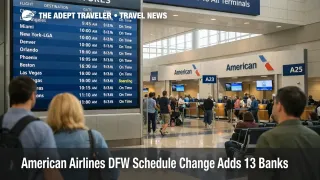
American Airlines says it will restructure how it banks flights at Dallas Fort Worth International Airport (DFW), shifting from nine large flight banks to 13 banks beginning in April 2026. The change affects both local departures and the large share of travelers who connect at DFW, because American says more than 30 percent of its daily connecting customers and connecting checked bags move through the hub. For travelers, the practical takeaway is that connection options should be less concentrated into a few surge periods, and schedules should offer more choices in the most in demand time windows.
American also says the 13 bank structure will be visible in published schedules starting December 27, 2025, and that the reflow is paired with broader operational work, including adjustments to scheduled block times that can influence on time performance. The airline frames this as a reliability move, not a network shrink or a destination pullback, with the intent to preserve breadth while making the peak waves less brittle when one arrival bank slides late.
Who Is Affected
Travelers connecting through Dallas Fort Worth are the most directly affected, especially those who routinely buy short connections to protect same day meeting times or to avoid overnight stops. Under a nine bank structure, a late inbound wave can create a chain reaction, gates fill, taxi times stretch, and the next outbound wave gets delayed while crews and bags try to catch up. A 13 bank structure spreads those peaks, which can reduce the number of moments when the airport is simultaneously trying to turn a very large volume of aircraft, people, and bags.
Local Dallas Fort Worth origin and destination travelers are also in the blast radius because banks drive curbside traffic, parking garage surges, check in line peaks, and security queue spikes. If fewer passengers arrive at the same time, the airport experience can feel less unpredictable even when the total daily flight count stays high. Local travelers should also expect that some departure times will shift earlier or later than what they are used to, because the goal is to distribute demand across more operating clusters instead of stacking it into fewer.
Travel advisors and corporate travel planners should treat this as a structural hub behavior change. It can alter which connection windows are realistically sellable without exposing clients to constant misconnect stress, and it can change when premium travelers want to arrive at the airport for lounge time versus rushing straight to the gate. It also matters for anyone planning tight ground transfers at the far end, such as last shuttles, limited hour rental car counters, or same day cruise and rail departures.
What Travelers Should Do
If you are booking now for travel from April 2026 onward, price itineraries across multiple departure windows rather than defaulting to the old DFW peaks. The point of the change is that there should be more workable options in desirable windows, and in many cases a slightly longer connection may become a small price trade for a large reliability gain. If you are traveling with checked bags, prioritize itineraries that keep connection time comfortably above your personal floor, because the bag transfer win comes from reducing the worst crunches, not from making every short connect magically safe.
Use clear decision thresholds for rebooking versus waiting when your trip date approaches. If your itinerary includes a connection that is under your comfort minimum, or if you are on separate tickets, treat the new structure as a reason to upgrade the connection buffer, not as permission to gamble. Conversely, if you can choose between two similar itineraries and one offers a mid length connection that still preserves your day, it is usually the better bet, because it protects you from a single late arrival bank turning into a missed last flight scenario.
Over the next 24 to 72 hours after your schedule opens for booking, monitor two things, your exact flight times as they settle into the timetable, and how American handles disruptions at DFW during busy weather periods. Bank structures show their value when thunderstorms or flow programs hit, because that is when peaks amplify gridlock. If you want a system level explainer on why airspace constraints and staffing issues can still create hub wide knock ons even when an airline improves its own schedule design, see U.S. Air Traffic Control Privatization: Reality Check. For a practical example of how delays propagate into connection risk across the U.S. network, see Flight Delays and Airport Impacts: December 26, 2025.
How It Works
A flight bank is a deliberately timed cluster of arrivals followed by a cluster of departures, built to maximize connect opportunities. The upside is convenience, more possible origin to destination pairs with one stop, and the ability to connect quickly when everything is on time. The downside is brittleness, when a disruption hits one arrival wave, the whole outbound wave can get trapped behind gate constraints, late bags, and crew timing, and the airport can feel like it goes from fine to overwhelmed in minutes.
Moving from nine banks to 13 banks is essentially a depeaking strategy. Instead of asking the airport, the airline, and the ground systems to handle very large pulses nine times a day, the airline is trying to distribute that demand into more frequent, smaller pulses. In theory, that creates more slack, so a late arrival wave does not collide as violently with the next departure wave, and recovery can start sooner because the system is not waiting for the next massive peak to hit. American also links the change to better checked bag connections and to improved efficiency in the surrounding airspace, which is where flow constraints and arrival metering can turn into traveler visible delays.
This operational shift sits alongside physical and process investments at DFW that can compound the benefit, if executed well. DFW's Terminal F program is underway, with the airport describing a $1.6 billion Terminal F build featuring a 400,000 square foot concourse, 15 gates, a modernized baggage system, and a new Skylink station, plus an expansion of Terminal E facilities dedicated to Terminal F customers. Separately, DFW's Terminal C project includes a pier style expansion that the airport says will add 115,000 square feet and nine gates through a mix of rebuilt and net new gates. American has also described a broader Terminal F plan with a larger total investment and phased delivery, tied to future international processing and premium facilities, which matters because gate supply and baggage systems are the hard constraints that either enable, or choke, a smoother bank strategy.
Sources
- Doubling down on DFW: American further strengthens its Flagship hub
- American Airlines announces significant changes to operations at DFW Airport to "improve passenger experience"
- Terminal F Construction
- Terminal C Construction & Improvement Project
- American Airlines and DFW Airport reveal plans for state-of-the-art new terminal for customers