

Flight Delays and Airport Impacts: December 26, 2025
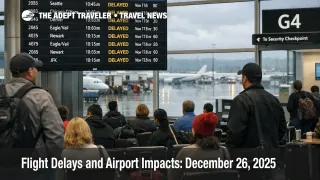
FAA traffic management planning is signaling a heavy volume day across the U.S. network, with active delay programs and a late day posture that could tighten further in the Northeast. The most traveler facing change is that multiple airports are already under ground delay programs, including San Francisco International Airport (SFO), and ski country airports Aspen Pitkin County Airport, Sardy Field (ASE), and Eagle County Regional Airport (EGE), which can turn normal holiday congestion into assigned gate holds at your departure airport. Chicago O'Hare International Airport (ORD) is also flagged for low ceilings and low visibility, which is the kind of constraint that often shows up as departure delays that then propagate into missed connection banks later in the day.
This matters because the FAA uses these programs to meter arrivals safely when an airport's acceptance rate drops due to weather, runway configuration, or demand. When a ground delay program is active, many flights to that airport get controlled departure times, so the delay may occur before you even push back, even if the destination weather looks only marginal on your app.
Who Is Affected
Travelers touching San Francisco are the most directly exposed because the SFO program is active into late evening on December 26, 2025, and SFO sits on a dense web of connections that moves crews and aircraft between the West Coast and inland hubs all day. Even if a traveler is not connecting at SFO, late inbound aircraft can still show up as delayed departures elsewhere, because the same plane is scheduled to operate multiple legs across different cities.
Ski trips are unusually sensitive today because both Aspen and Eagle County are under active metering, and those airports have fewer practical alternates. When a ski airport arrival gets metered, the failure mode is often not just a later arrival, it is a missed last shuttle, a missed hotel check in window, and higher cost ground transport when roads are busy and weather complicates mountain driving.
Late day travelers through the Northeast, especially those connecting through John F. Kennedy International Airport (JFK), LaGuardia Airport (LGA), Newark Liberty International Airport (EWR), and Philadelphia International Airport (PHL), face a different risk profile. FAA planning points to a probable ground stop or delay posture for the New York area airports and Philadelphia as the evening bank approaches, which is when snow, wind, and low visibility can collapse arrival rates and remove recovery slack. This intersects directly with the peak misconnect window described in Northeast Winter Storm Flight Delays Raise Misconnect Risk, where late evening and overnight banks are the most likely to turn delays into forced overnights.
What Travelers Should Do
Act as if your first workable itinerary is the one you will actually fly. If your routing touches San Francisco, Aspen, Eagle County, or any New York area hub late in the day, check for traffic management advisories before you leave for the airport, and build extra buffer for bag drop, deicing, and gate changes, because metering can convert an on time boarding plan into an assigned hold after you arrive.
Use clear decision thresholds for rebooking versus waiting. If your connection is under two hours through a constrained hub, or if an assigned delay pushes you past your last realistic protected connection bank, rebook immediately while same day inventory still exists. If you still have multiple protected options later the same day and your delay is modest, waiting can be reasonable, but only if you can absorb a second downstream delay after landing, which is common when the system is volume constrained and the late day weather risk is rising.
Over the next 24 to 72 hours, monitor whether today's constraints repeat into the next morning bank, which is when airlines run out of slack and start protecting the following day by trimming late evening flying. Watch for expansion of ground delay programs at hubs, and watch whether Northeast ground stop probabilities turn into active programs during the evening push. For deeper system context on why staffing, airspace structure, and modernization debates keep showing up as traveler visible reliability issues, see U.S. Air Traffic Control Privatization: Reality Check.
Background
The FAA Air Traffic Control System Command Center manages national demand through traffic management initiatives that keep arrival flows within safe limits when capacity drops. A ground delay program meters arrivals by assigning expected departure clearance times, so flights wait at their origin airports instead of stacking in airborne holding, and that is why a disruption at one destination can appear to a traveler as a late departure from somewhere else.
The ripple effect moves through the travel system in layers. First order impacts occur at the constrained airport, where arrival rates drop, gates stay occupied longer, and departures inherit late turns. Second order impacts spread across connections and crew flow because aircraft and crews rotate across multiple cities in a single day, so a late arrival into SFO, the New York area, or Chicago can degrade schedules at unrelated airports hours later. A third layer shows up off the aircraft, where late arrivals collide with limited late night ground transport, rental car counter hours, and hotel inventory, particularly in ski markets and major hubs during holiday loads.