

Brazil Azul and GOL Strike Risk for Domestic Flights
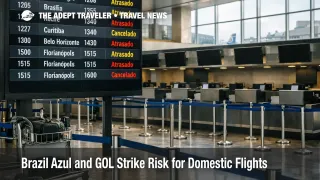
Brazil's main pilots and cabin crew union has moved into an "estado de greve" posture tied to labor negotiations covering Azul and GOL, a step that often signals readiness to escalate into targeted actions or a full stoppage. The National Union of Aeronauts has called an extraordinary assembly for the morning of December 29, 2025, in São Paulo to decide whether to deflagrate a strike and set the rules for any action. For travelers, the practical change is that end of year, and early January domestic schedules now carry a higher disruption premium, even if flights are still operating normally today.
The assembly timing matters because it lands in a peak demand period, when rebooking options are thinner and when a single canceled domestic leg can collapse an entire itinerary. If escalation happens, the most common failure modes are short notice cancellations, longer departure holds while crews and aircraft are reshuffled, and rolling delays that make "legal" connection times unrealistic in practice. Even without a formal strike, an elevated labor posture can coincide with tighter operational margins, because any local staffing friction, weather, or air traffic constraints are harder to absorb.
Who Is Affected
Travelers with domestic Brazil itineraries that rely on same day connections are the most exposed, especially those transiting the São Paulo system via São Paulo Congonhas Airport (CGH), São Paulo Guarulhos International Airport (GRU), or Viracopos Campinas International Airport (VCP). Rio de Janeiro connections through Rio de Janeiro Galeão International Airport (GIG) and Rio de Janeiro Santos Dumont Airport (SDU) are also vulnerable, because short hop shuttles are commonly used to position for international departures and cruise embarkations. Business travelers on day trips are at higher risk of forced overnight stays, since a late afternoon cancellation can eliminate viable same day alternatives.
Leisure travelers heading to beach and nature gateways, including routes with one or two flights per day, should assume longer recovery times if cancellations begin. When a thin route cancels, the next seat might be a day or two away, and the airline may prioritize re-accommodating passengers into major trunks first, then backfilling smaller markets. Group travel and tours are also exposed because rebooking a party across multiple flights can be impossible during peak windows, forcing splits that complicate transfers, lodging, and check in timing.
International visitors are affected in a specific way, domestic positioning is often the fragile link between a long haul arrival and an onward domestic hop. If you are arriving internationally and your itinerary might require an airport change, or an unplanned overnight that forces you to clear immigration, document readiness becomes part of disruption planning, not an afterthought. For that scenario, Brazil Entry Requirements For Tourists In 2026 can help you sanity check what you may need if a rebooking pushes you into a different entry, or transit pathway.
What Travelers Should Do
If you are traveling in Brazil from December 29, 2025, through the first days of January, treat your itinerary as "fragile" and add buffer where it is cheapest. Prioritize nonstop flights over connections, move critical meetings or tour starts at least a half day away from arrival when possible, and avoid last flight of the day routings into small airports where recovery options are limited. If you must connect, aim for longer layovers, and avoid airport changes across São Paulo unless you have a clear, time tested ground transfer plan.
Use a simple threshold for proactive rebooking versus waiting. If your trip depends on making a same day international departure, a cruise embarkation, or a non refundable tour start, rebook early into a nonstop, or into an earlier flight band, as soon as you see flight time shifts, rolling delays, or an airline issued flexibility policy tied to labor risk. If your trip is discretionary, and you have at least one full day of slack at the destination, you can often wait longer, because airlines may stabilize schedules, or protect key banks, to limit cascading disruptions.
Over the next 24 to 72 hours, monitor three decision signals in parallel: the union's December 29 assembly outcome and any announced action rules, airline travel advisories and waiver language (if issued), and real time completion rates at your specific departure airport. Also watch for early signs of mispositioning, such as repeated tail number swaps, unusual aircraft downgrades, and widening departure delays on short domestic sectors, since those are often the first indicators that the network is losing margin.
How It Works
In Brazilian labor practice, an "estado de greve" is not the same thing as a strike, but it is a formal posture that can precede escalation once workers have rejected proposals, or negotiations stall. In this case, the SNA has publicly tied the posture to the ongoing collective bargaining process, and it scheduled a December 29, 2025, extraordinary assembly to decide whether to deflagrate a strike and define the movement's rules.
If a strike is approved, the legal framework typically requires advance notice for essential activities and the maintenance of indispensable service to meet non deferrable community needs. Brazil's strike law identifies "transporte coletivo" as an essential activity, and it sets a 72 hour notice requirement for strikes in essential services, alongside obligations to protect indispensable services during the movement. (How air transport is operationalized under those rules can vary in practice, but the traveler takeaway is that disruption may be uneven, with some flights operating while others are canceled or delayed.)
Operationally, labor disruption propagates through aviation in layers. The first order effect is at the flight leg level, delayed departures, canceled segments, and crew availability constraints that force airlines to protect certain trunk routes while sacrificing others. The second order ripple shows up in aircraft and crew positioning, a canceled domestic hop can strand an aircraft away from its next rotation, and it can push crews into legality limits that trigger additional cancellations later in the day. By day two, the impact can leak into international banks, because widebody departures often rely on a web of feeder flights to deliver passengers, bags, and in some cases crews repositioning for duty.
On the ground, the spillover is usually predictable. When flights break in São Paulo and Rio, hotel inventory near key airports tightens, intercity coach demand rises for travelers trying to substitute road for air, and tour operators see more missed starts and late arrivals. For a broader traveler oriented monitoring playbook for strike driven disruption, even outside Brazil, see Europe December Strikes Hit Holiday Flights And Trains.
Finally, passenger protection rules still apply during irregular operations. In Brazil, ANAC guidance emphasizes that airlines must provide assistance at the airport based on waiting time, including communication after 1 hour, food after 2 hours, and hotel and transport in overnight scenarios after 4 hours, and that assistance is due regardless of the reason when the passenger is at the airport. Those rules do not eliminate disruption, but they do shape your decision making, because a long delay can become an involuntary overnight, and your best outcome often depends on acting early, before alternative seats disappear.
Sources
- SNA convoca aeronautas associados para AGE de deflagração de greve
- Pilotos e comissários declaram estado de greve e podem paralisar voos na próxima 2ª
- Atrasos, cancelamentos, preterição e assistência material, ANAC
- LEI Nº 7.783, DE 28 DE JUNHO DE 1989
- Presidência da República, Law No. 7.783 (NATLEX PDF)
- TST: Paralisações em transporte coletivo são consideradas abusivas por falta de comunicação prévia