

United Suspends Dakar, Stockholm Flights in 2026
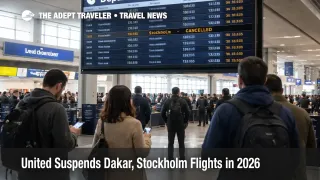
United Airlines has scheduled the end of its Washington Dulles to Dakar service and has also removed plans to bring back Newark to Stockholm next summer. Travelers booked on Washington Dulles International Airport (IAD) to Blaise Diagne International Airport (DSS) after the final operating date, or travelers who bought itineraries expecting United's Newark Liberty International Airport (EWR) to Stockholm Arlanda Airport (ARN) seasonal return, are the most exposed. The practical move is to pull up your reservation now, identify whether you are on one protected ticket or separate tickets, then decide whether you want United to reroute you, or whether you would rather take a refund and rebuild the trip.
The change is simple but disruptive, United suspends Dakar Stockholm flights, which removes a nonstop option to Senegal after March 5, 2026, and it also eliminates United's planned Stockholm seasonal service for summer 2026.
For Dakar, industry schedule reporting indicates the IAD to DSS route ends after the March 5, 2026, departure. That matters because the flight was a rare nonstop link for the Washington region into Francophone West Africa, and because the next best alternatives often require at least one connection, with longer elapsed travel times and more ways for a trip to break when something slips.
For Stockholm, the risk is more about expectation management. United's EWR to ARN service is described as seasonal and already ended for 2025, and United has said it will not return for the 2026 summer season as originally planned. If you booked Stockholm around a presumed June restart, you may see an automatic schedule change that replaces United metal with a partner, or it may push you onto a different hub, or it may cancel the segment entirely and force a choice.
This is also a capacity story, not just a route map story. When a long haul route disappears, the seats do not vanish from the system, they get redeployed, and that redeployment reshapes what is easy, what is expensive, and what is fragile. Dakar traffic that previously flowed through IAD now has to compete for space through New York connections or European banks, and that can spill into hotel nights when same day connections are no longer viable. Stockholm travelers lose a United nonstop option, which can tighten premium cabin inventory on the remaining nonstops and push more passengers into already busy transatlantic connecting complexes. For additional context on how aircraft availability pressure can drive these kinds of schedule decisions, see FAA Delays on Boeing 737 MAX 10 Hit Airline Capacity. For prior Adept Traveler coverage of the Dakar cutoff, see Washington Dakar Nonstop Flights End March 2026.
Who Is Affected
Travelers holding United tickets that include IAD to DSS for travel after March 5, 2026, are the clearest impacted group, because the nonstop segment itself is scheduled to end. This includes travelers connecting into IAD from smaller U.S. cities who specifically chose a one stop itinerary to Dakar, as well as travelers who built time sensitive trips around an overnight eastbound arrival and next day meetings, tours, or family events.
Travelers who booked Stockholm for summer 2026 expecting a United nonstop from EWR are the second major group. Even if the itinerary remains workable after automatic rebooking, the traveler experience changes, more connections, longer minimum connection time assumptions, and a higher chance that a small delay becomes a missed transatlantic departure with a full day slip.
Travelers on separate tickets face the highest financial risk. A schedule change that looks minor on paper can break the timing between an inbound domestic leg and the new long haul departure, or it can convert a same day arrival into an overnight that was not budgeted. This is especially common when a reroute shifts you from one hub bank to another, because bank structure drives where the connection options exist.
Travelers using miles and upgrades should assume the award picture will move. When capacity is removed, the remaining nonstop options can price higher, and the "easy" saver inventory can disappear quickly. If Stockholm demand concentrates into fewer nonstops, upgrade lists can get longer, and if Dakar demand consolidates into fewer routings, the remaining premium cabin space can become scarcer on peak days.
What Travelers Should Do
Start by auditing your booking, not the headlines. Check whether United has already pushed a schedule change into your reservation, then screenshot the current itinerary, and write down your must keep constraints, such as arriving by a certain day, needing a nonstop, or protecting a cruise embarkation. If you have separate tickets, add buffer immediately, because your new routing may raise misconnect probability, and you are effectively self insuring the handoff.
Rebook versus wait should hinge on two thresholds, how time sensitive the trip is, and how many acceptable alternates still have inventory. If you must arrive Dakar, Senegal, or Stockholm, Sweden, by a fixed date for an event, a tour start, or a work obligation, treat a forced connection as a reason to proactively move to a routing with a built in buffer or an overnight you control. If you have flexibility, waiting for United's reaccommodation offer can still be rational, because protected reroutes on partners can preserve your fare value, but only if the replacement itinerary is actually acceptable.
Over the next 24 to 72 hours after you see a formal schedule change, monitor three things, your reservation for additional changes, partner options United is willing to ticket you onto, and competitor nonstop pricing on your exact dates. For Stockholm, alternatives may include SAS and other carriers that already serve the market, and the broader alliance context is evolving, which can affect which "one ticket" combinations show up in search and agency tools, see Air France-KLM, SAS expand U.S. codeshare network. For Dakar, watch whether remaining nonstop capacity becomes constrained in the weeks you care about, because once seats tighten, the reroute that looks easy today can become a multi stop itinerary later.
How It Works
Airline schedules are built around aircraft availability, crew legalities, and connecting bank structures, and a route cancellation forces the system to rebalance in ways travelers feel downstream. When United pulls a long haul route, it frees an aircraft and crews that can be used on a different market, but it also forces every impacted passenger into fewer remaining paths. Those paths concentrate demand into specific hubs and departure waves, and that concentration is what turns a route change into a misconnect and hotel story.
For Dakar, losing the IAD nonstop shifts Washington area travelers into routings that often require New York connections or European connections. That introduces first order effects, longer travel times and more segments, and it also creates second order ripples, because missed connections can compress hotel inventory near key hubs during peak travel periods, and because fewer seats can push up last minute fares on remaining carriers. For Stockholm, the removal of a seasonal United option can push more travelers onto other nonstops or onto one stop itineraries through major European gateways, and those gateways can already be capacity constrained in summer, especially on weekends.
On passenger rights, United has publicly pointed impacted customers toward partner reaccommodation or refunds, and U.S. Department of Transportation guidance also frames refund eligibility around cancellations and significant schedule changes. In practice, the most important operational detail is whether your new itinerary stays on one protected ticket. If it does, the airline owns the disruption chain. If it does not, the traveler owns the disruption chain, including missed onward flights, lost hotel nights, and tour no show penalties.