

Polish Farmer Blockades Hit Poland Germany Border Roads
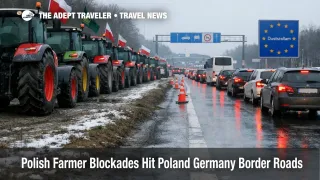
Polish farmer tractor actions tied to opposition over the EU Mercosur trade deal have added fresh disruption risk on roads that feed the Poland, Germany border. On December 30, 2025, reporting in Poland listed nearly 200 protest locations nationwide, including Sękowice on DK32 right at the Germany border, and the Zgorzelec area, with many actions set in a timed 1000 am to 300 pm window. For travelers on Wednesday, December 31, 2025, the practical takeaway is that even if the tractors are not continuously blocking lanes, the mere presence of slow moving convoys, shoulder parking, and police traffic management can choke approaches, trap drivers in static queues, and push crossing times far beyond what mapping apps predict.
The risk is amplified on high volume corridors that already operate close to capacity during holiday traffic. In Brandenburg, Germany, the Autobahn 12 corridor near Frankfurt (Oder) has faced long backups linked to stationary border controls, and recent reporting noted that a revised traffic pattern was put into operation on December 20, 2025 to reduce queues created by those controls. That context matters because a protest day does not have to fully close a crossing to create a failure mode, it only has to push the system past its tipping point, then the queue becomes the event.
Who Is Affected
Drivers crossing between western Poland and eastern Germany are the most exposed, especially anyone who must arrive by a fixed time, such as flight check in, a last train, a ferry departure, or a hotel desk that stops accepting late arrivals. Regional coach passengers are also high risk because buses cannot easily reverse course once they are committed to a congested approach road, and operator contingency plans can be limited when multiple crossings are affected at once.
Travelers transiting to Berlin Brandenburg Airport Willy Brandt (BER) by road from Poland, or from border area hotels, should assume that a seemingly modest border delay can cascade into a missed security time slot, a missed bag drop cutoff, or a forced same day rebooking. Rail passengers are not immune either, because when roads jam, replacement buses for engineering works can miss timed meets, and taxi supply tightens quickly in smaller border cities when many people abandon their original plans at once.
For broader context on why internal Europe crossings can still behave like choke points in 2025, see Schengen Internal Border Checks Widespread In Late 2025.
What Travelers Should Do
If you plan to cross the Poland, Germany border by car on December 31, carry your passport or national ID on your person, top up fuel before you enter the border approach zone, and add several hours of buffer if you have any fixed appointment on the far side. In practice, the safest move is to avoid arriving at a major crossing during the busiest late morning and early afternoon window, and to rely on live traffic and local authority updates rather than a single navigation ETA that may not understand a growing queue.
If your itinerary includes a flight, treat the border drive as a leg that can fail, not as a guaranteed transfer. When the required arrival time is non negotiable, such as an international departure or a last train, the decision threshold is simple, if the crossing corridor shows sustained slowdown and the delay eats into your minimum buffer, reroute to a less congested crossing immediately, or switch modes to rail, even if it costs more, because waiting in a static queue is usually the worst option for recovering the day.
Over the next 24 to 72 hours, monitor whether organizers announce new timed action windows, and watch for police traffic management changes that signal capacity reduction, such as lane closures, checkpoint metering, or heavy truck queuing that spills into passenger lanes. Also watch for secondary effects, including bus operators issuing detour notices, and rail operators adding capacity, because those are often the earliest signs that disruption is propagating beyond one road segment. For a comparable pattern in another European corridor, see Greece Farmers Blockades Disrupt Roads, Borders, Crete.
Background
Farmer protest actions create outsized travel disruption because they target the network's narrowest points, junctions, overpasses, and border approaches where there are few parallel routes and limited space to absorb stopped traffic. On December 30, Polish coverage described protests planned across more than 170 locations, generally in a 1000 am to 300 pm window, and organizers said the intent in many places was visibility, with tractors positioned along high traffic routes and at overpasses, rather than permanent full closures. Even with that posture, the travel system impact can be severe because once vehicles compress into a border approach queue, drivers lose the ability to detour, emergency access becomes harder, and clearing the backlog can take longer than the original action window.
At the Poland, Germany border, this interacts with an existing layer of friction: temporary Schengen internal border controls and, in some corridors, stationary checks that already slow movement at peak times. Recent German reporting around the A12 near Frankfurt (Oder) described long standing congestion tied to border controls, and an infrastructure change designed to improve traffic flow. When a protest concentrates vehicles near the same corridor, the first order effect is obvious, slower crossings and long waits. The second order ripple is where most travelers lose money, missed airport and rail cutoffs, missed hotel check ins, and cascading rebooking that pushes demand into later trains, later buses, and higher priced last minute rooms in gateway cities.
Sources
- Protesty rolników - blokady na drogach. [MAPA] (TVN24)
- Rolnicy zaprotestują w całej Polsce. Traktory wyjadą na drogi [MAPA] (Onet Wiadomości)
- Rolnicy wyjadą na drogi w całej Polsce. Mapa protestów 30.12.2025 (Wiadomości Rolnicze Polska)
- Umbau der A12 abgeschlossen: Neue Verkehrsführung soll Grenzkontroll Stau entlasten (Tagesspiegel)
- Temporary Reintroduction of Border Control (European Commission)
- Berlin Brandenburg Airport Willy Brandt (BER) corporate overview (BER)