

Schengen Internal Border Checks Widespread In Late 2025
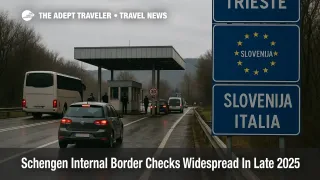
Schengen internal border checks across Europe remain common in December 2025, and they can slow cross border rail, bus, and road trips even when you never "leave" the Schengen Area. That matters most for travelers on multi country winter itineraries, especially anyone chaining trains, coaches, rental cars, or airport transfers near land borders. Use the European Commission notification list to spot where controls are active, then carry valid ID and pad connections so a short stop does not break the day.
Schengen internal border checks, in plain terms, means you should plan for occasional document checks and sporadic delays at certain internal borders, even if most crossings remain smooth and fast.
What Is Actually Happening
Schengen normally removes routine passport control at internal borders, but the Schengen Borders Code allows countries to temporarily reintroduce border control at internal borders for serious threats to public policy or internal security. The European Commission publishes a running list of current notifications, including the dates and the stated scope, such as specific land borders, ferry ports, or internal air borders.
As of the European Commission's list on December 13, 2025, France, Germany, Poland, the Netherlands, Italy, Slovenia, Austria, Denmark, Sweden, and Norway all have temporary internal border controls active for at least part of their internal borders, with many current periods running into March, April, May, or June 2026.
This does not mean every crossing will be stopped. Several authorities describe controls as targeted and risk based. But the traveler impact is still real because a short delay can break a tight connection, and a document request can become a bigger problem if your passport or ID is packed away.
Schengen Internal Border Checks Hit These Corridors Most
The Benelux corridor is high exposure because many itineraries treat it like one metro area. The Commission's notification for the Netherlands covers the land borders with Belgium and Germany, plus intra Schengen air borders, and the Royal Netherlands Marechaussee says checks may occur at any border crossing point and on international trains arriving from the Schengen Area. If your plan involves short transfers in Amsterdam, Brussels, or Cologne, booking a single through ticket, or choosing longer connections lowers the chance that a brief check ruins your day.
Germany's notification is broad, covering land borders with France, Luxembourg, Belgium, the Netherlands, Denmark, Austria, Switzerland, Czechia, and Poland. France's notification also covers multiple neighbors and applies to internal air and sea borders as well as land borders. Together, those two countries sit on many popular multi country rail and road routes, including Paris to Frankfurt, city hops in the Upper Rhine region, and overland trips that chain several countries in a single day, such as a rail itinerary that crosses the border more than once.
Central Europe and the northern Adriatic are another friction zone. Italy's current notification is limited to the land border with Slovenia, and Slovenia's notification covers its land borders with Croatia and Hungary. If you are combining Venice, Italy with Ljubljana, Slovenia, often via the Venice and Trieste corridor, or driving onward into Croatia, avoid building a day around a single must arrive by hour, especially in winter conditions when road travel is already less predictable.
In the Nordics, Denmark's notification focuses on land and sea borders with Germany, and Sweden's notification covers all internal borders, including land, air, and sea, with a specific callout to the land border with Denmark. That can add uncertainty to itineraries that mix Copenhagen, Denmark with southern Sweden, plus ferry and road trips that bounce between Denmark, Sweden, and Germany.
Poland's notification covers land borders with Germany and Lithuania, and Norway's focuses on ports with ferry connections to the Schengen Area. If you are traveling long distance by coach, or arriving by ferry and connecting onward, treat arrival times as estimates, not guarantees.
How To Plan Around It
Schengen internal border checks create three common failure modes, time risk, documentation risk, and downstream booking risk. Time risk is the small delay that breaks a connection. Documentation risk is being asked for ID and realizing it is in checked luggage or left behind. Downstream booking risk is missing a seat reservation, timed entry, or check in deadline because the border stop moved your whole day.
A conservative winter rule is to add buffer whenever your route crosses a border with active controls and your day has a hard constraint, such as a flight departure, a last train of the night, or a prepaid tour. For rail, that usually means choosing a longer transfer and avoiding self made connections on separate tickets. For road trips, it means not scheduling a cross border drive as the final step before a fixed appointment, and planning a backup route if a single crossing is congested.
What Documents To Carry
Dutch government guidance notes that even within Schengen, travelers should be able to show a valid travel document, and border units conduct random checks on roads and trains, among other settings. In practice, keep your passport or EU national ID card in your day bag on travel days, not packed at the bottom of a suitcase. If you are a non EU traveler legally resident in a Schengen country, carry your residence permit card with your passport so you can show both quickly.
For flights, remember that internal border controls can still touch intra Schengen routes. The Commission lists the Netherlands' controls as including intra Schengen air borders, and Dutch border authorities say they may check documents at arrival gates for selected Schengen flights based on risk analysis. The practical move is to keep your travel document on you, even for short hops that feel like domestic flying.
What To Do Before You Leave
Schengen internal border checks can end, shift, or extend on short notice. Before travel, check the European Commission notification list for the countries and borders on your route, then plan your crossing day as a buffer day with documents accessible and flexible downstream plans.
For related planning context, see Adept Traveler's coverage of Lisbon airport border queue pressure and the broader EU border systems overview.