

Popocatépetl Ash Mexico City Flights Delay Risk
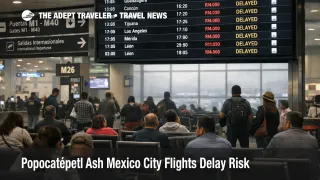
Volcanic ash advisories tied to Popocatépetl are keeping central Mexico's airspace in a posture where small changes can still produce real flight disruption. Travelers transiting Aeropuerto Internacional Benito Juárez de la Ciudad de México (MEX), Aeropuerto Internacional Felipe Ángeles (NLU), and Aeropuerto Internacional de Toluca (TLC) are the most exposed, because these airports sit inside a dense hub and spoke system with limited slack during peak domestic banks. The practical next step is to add buffer, watch each new advisory cycle, and avoid chaining separate tickets into fixed time plans until conditions stabilize across multiple bulletin updates.
The Popocatépetl ash Mexico City flights disruption risk is elevated because airlines and air navigation services typically treat any forecast ash polygon as a reason to reroute or slow traffic flows, even when observed ash is intermittent.
As of the Washington Volcanic Ash Advisory Center bulletin issued at 440 p.m. UTC on December 30, 2025, the advisory stated no volcanic ash was identifiable in satellite data and forecast no ash through 1030 a.m. UTC on December 31, 2025, with no further advisories planned unless conditions changed. That is a reassuring signal, but it does not remove the operational sensitivity, because the next observed pulse, wind shift, or model update can quickly reintroduce routing constraints.
Who Is Affected
Travelers flying into, out of, or connecting through the Mexico City airport system are most directly affected, especially those on late afternoon and evening arrivals where schedule recovery room is smallest. This includes passengers connecting onward to resort corridors, business travelers heading to meeting start times, and anyone depending on the last practical flight to reach Puebla, Mexico, Toluca, Mexico, or other central Mexico points before midnight check in windows.
The highest personal risk sits with tight connections and separate tickets. When a flight arrives late into Benito Juárez or Felipe Ángeles, the onward airline may not be obligated to protect the connection if it is on a separate booking, and the replacement options can be limited by aircraft, gate availability, and the next morning's first wave. That is how a few tactical reroutes can become an overnight, even when the original airport remains open.
Ripple exposure extends beyond aviation. If a cluster of flights is delayed or diverted, hotel inventory tightens in the catch basin city where passengers end up, and transfer providers miss pickup windows. In central Mexico, those second order effects can be expensive because ground transfers between airports, hotels, and nearby cities can be long, and rideshare and private transport rates tend to surge when large numbers of travelers self rescue at the same time.
What Travelers Should Do
In the next 12 hours, protect the parts of your itinerary that do not automatically flex. Confirm your flight's aircraft assignment and departure time in the airline app, check the airport's official flight status before leaving for the terminal, and build extra time for security and boarding because late gate changes are common on irregular operations days. If you have a prepaid transfer, message the provider now with a contingency that covers both a late arrival and a possible arrival at a different Mexico City area airport.
Use a decision threshold instead of waiting for the day of travel to collapse. If you must make a same day cruise embarkation, a wedding, a ticketed tour check in, or the last viable connection to a smaller city, rebook to an earlier flight, or add a buffer night near your critical endpoint. If your plans are flexible and you are traveling on a single ticket, waiting can be rational, but only if you still have realistic same day rebooking options when the schedule compresses.
Over the next 24 to 72 hours, monitor the inputs that actually change outcomes, Washington VAAC advisories for Popocatépetl, and the latest monitoring summaries from Mexico's civil protection volcano reporting. The pattern to watch is not a single calm bulletin, it is stability across multiple cycles without renewed forecast polygons. If advisories restart, expect the first visible symptoms to be longer routings, arrival metering, and rolling delays that worsen later in the day as aircraft rotations break.
How It Works
Volcanic ash is treated as an aviation hazard because fine particles can abrade windscreens, contaminate sensors, and damage engines, so operators generally plan to avoid ash clouds rather than attempt to thread through uncertain concentrations. The International Civil Aviation Organization's operational guidance frames this as a safety driven avoidance problem that can affect both en route airspace and airport operations when contamination is possible.
For Popocatépetl, the traveler visible layer is the Volcanic Ash Advisory issued by the Washington VAAC, which translates satellite observation, webcams, pilot reports when available, and model guidance into a time boxed statement about observed and forecast ash and the areas potentially affected. Even when a bulletin reports no ash observed, the existence of frequent monitoring cycles and the possibility of rapid updates is why airlines keep contingency routings ready for central Mexico.
The first order operational effect is usually not a dramatic shutdown. Instead, ash related routing or altitude constraints can reduce the number of arrivals per hour by forcing longer paths, wider spacing, or tactical holds, which shows up as delays rather than closures. Once arrivals slow, the system propagates the disruption, inbound aircraft arrive late and miss their next rotation, crews time out and require replacement, and the day's problems can spill into the next morning's bank even after advisories ease.
That pattern is similar to other ash driven airport risk stories where advisories, not surface weather, become the binding constraint on capacity and reliability, including Mount Etna Ash Catania Airport Disruption Risk. For travelers, the takeaway is to manage the connection and ground logistics exposure, not just the flight segment, because the cost and time pain often appears after landing, when diversions or late arrivals break transfers, hotel check ins, and fixed time plans.