

Delta Ends Binghamton Airport Flights Feb 2026
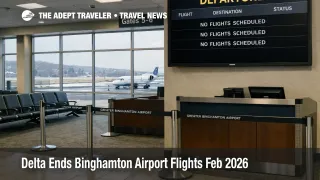
Delta is ending scheduled service at Greater Binghamton Airport (BGM) in the Southern Tier, with the final day of operations set for February 14, 2026. Local officials say Delta has committed to directly contacting customers who are currently booked after that date, and to re-accommodate those passengers onto alternatives. When that service stops, Binghamton area travelers who previously relied on a Delta Connection link into the domestic network will need to start trips with a drive to a different airport, which changes both total travel time and how much buffer is needed to keep connections intact.
The Delta ends Binghamton Airport flights change is not just a schedule tweak, it is a full loss of local commercial departures that forces a new airport choice for spring and summer bookings.
Who Is Affected
Travelers based in Binghamton, Johnson City, Endicott, Vestal, and nearby Southern Tier communities are the most directly affected, especially anyone who used BGM as a short hop into the Delta network. The most common downstream effect is that a previously simple one stop itinerary becomes a drive plus a flight, and the drive is now the segment most likely to break the day during winter weather.
Passengers already holding tickets that touch BGM after February 14, 2026 should expect an airline initiated itinerary change workflow. In many cases that means a re-accommodation offer that swaps the origin airport to a nearby alternative, or it can trigger a decision to take a refund and rebook from scratch if the new routing is not workable. The U.S. Department of Transportation makes clear that when an airline cancels a flight, a consumer is entitled to a refund if the consumer chooses not to travel and does not accept the alternative offered.
Secondary impacts show up in the alternates. When a small market loses service, demand concentrates into fewer departure points, and that can tighten peak day pricing, parking availability, and rental car inventory at the airports that absorb the displaced passengers. It also raises the odds of misconnects for travelers on separate tickets, because the drive segment has no airline protection if weather, traffic incidents, or road closures eat the buffer that used to be built into a single ticket connection.
What Travelers Should Do
If you are booked to fly out of Greater Binghamton Airport (BGM) after February 14, 2026, pull up your reservation now and watch for an airline schedule change notice, then contact Delta before you self cancel. The practical near term goal is to see what Delta is offering for re-accommodation, and to compare it against what you would book yourself from alternate airports, including the true door to door time once you add the drive, parking, and security lines.
Set a decision threshold that accounts for winter roads and connection structure, not just the ticket price. If your replacement plan requires a same day drive into a hub with a tight connection, or it relies on separate tickets, treat it as high risk and either shift to an earlier departure, add an overnight near the departure airport, or choose a routing with more slack. As a rule of thumb, plan your drive to arrive early enough that a slowdown still leaves you time to park, get inside, and clear screening without running. That matters more on early morning departures when a single delay can wipe out the day's remaining options.
Over the next 24 to 72 hours after you are re-accommodated, monitor three things: whether your replacement origin airport has weather or air traffic flow programs, whether your itinerary now depends on a single daily flight bank, and whether your ground plan is still realistic in poor conditions. Winter irregular operations can cascade through hubs that Southern Tier travelers commonly use, and when that happens, earlier flights and added buffers tend to outperform optimistic same day plans. For a recent example of how winter disruption propagates across hubs, see Storm Ezra US Flight Delays at Major Hubs Dec 30, 2025.
How It Works
Airlines decide to enter or exit small markets based on a mix of demand, revenue quality, aircraft and crew availability, and how well a route supports the wider network. At BGM, the remaining scheduled commercial service has been a Delta Connection operation, using regional aircraft, which is the kind of flying that can become difficult to sustain when the industry is short on crews, and when regional fleets are being redeployed toward higher performing markets.
The first order effect at the source is straightforward, once the last scheduled flight operates on February 14, 2026, travelers lose the ability to start trips locally, and the airport loses the reliability benefits of being inside an airline's protected connection system. The second order ripple appears immediately in surface transport and nearby airport operations. A drive that replaces a feeder flight shifts risk onto road conditions, and it increases exposure to parking and rental car constraints at alternates, which can raise missed flight risk and overnight costs during peaks. A third layer is network wide, when many passengers are funneled into fewer departure airports, carriers can run out of rebooking inventory faster during winter disruption, and that forces longer routings or unplanned hotel nights.
This exit also lands awkwardly against a backdrop where New York State has been investing in upstate airport facilities to improve passenger experience and to support regional connectivity. The Greater Binghamton Airport terminal revitalization was completed recently, with state funding highlighted as part of broader upstate airport upgrades, which makes the service loss feel sharper for local travelers even though route decisions are still driven by airline network economics. For additional context on why the U.S. system often runs with limited slack during staffing and capacity constraints, see U.S. Air Traffic Control Privatization: Reality Check.