

SFO Runway 1R Closure May Cause Summer 2026 Delays
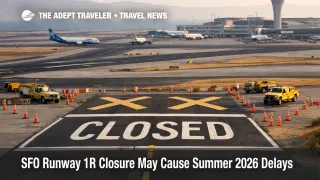
San Francisco International Airport (SFO) says it will close Runway 1 Right (1R) for about six months in 2026 to repave the runway surface and complete adjacent taxiway improvements. Summer 2026 travelers using SFO, especially those booking tight connections, should plan for less operational flexibility during peak banks when runway capacity is already tight. The practical move now is to build more buffer into connections, avoid last flight of day itineraries when you can, and keep an eye on schedule changes as airlines adjust to the new airfield setup.
The SFO Runway 1R closure runs from March 30, 2026, to October 2, 2026, and the airport says it expects some delays and changes to departure patterns during the work. In its announcement, SFO says it will operate arrivals and departures on Runways 28 Left and 28 Right during the closure window, and it plans to use Runway 1 Left as an additional taxiway to help reduce ground congestion rather than using it for takeoffs and landings. SFO's estimate is that fewer than 10% of flights will be delayed because of the closure, with delays averaging less than 30 minutes, and with the highest likelihood of delays in peak periods around 900 a.m. and 800 to 9:00 p.m.
From a traveler decision standpoint, the biggest change is that SFO is trading runway and taxiway redundancy for a simplified operating plan that concentrates traffic onto the two long 28 runways. That can work well on clear, windy days, but it also means there is less slack when anything else goes wrong, for example low ceilings, spacing increases, late inbound aircraft, gate holds, or a busy summer day when schedules are already packed. If you want a refresher on how small capacity drops turn into cascading delays across the national system, see Flight Delays and Airport Impacts: December 31, 2025 for the mechanics of flow programs and downstream ripple.
Who Is Affected
Travelers flying into, out of, or connecting through SFO between March 30, 2026, and October 2, 2026, are the primary exposure group, with the highest sensitivity for anyone whose plan depends on a narrow connection window. This is especially true for itineraries that combine separate tickets, long haul arrivals that connect onward domestically, and last flight of day departures where a modest delay can remove most same day recovery options. If your plan requires a car pickup, a cruise embarkation, a meeting start time, or a same night event, treat the runway closure as an added schedule friction layer rather than a guaranteed disruption, because the failure mode is often a cluster of short delays that becomes a missed threshold.
Airline operations teams, crew schedulers, and travelers on multi city routings will also feel second order effects when SFO congestion compounds broader West Coast air traffic management. Even when the average delay is modest, the network impact can be larger because late inbound aircraft arrive out of sequence, crews time out, and later turns degrade across multiple cities that were not part of the original problem. That is the same dynamic that drives hotel compression near hubs on irregular operations days, because missed connections push travelers into unplanned overnights, and pricing tightens fast when many passengers are rebooked at once.
People living under departure paths may notice the change, too. SFO has warned that concentrating takeoffs on Runways 28 Left and 28 Right can temporarily increase departing air traffic overhead for some communities. If you are staying in a Peninsula hotel and you are sensitive to aircraft noise, that is a small but real planning factor for summer stays near historic flight corridors.
What Travelers Should Do
Start with immediate actions and buffers. If you are booking now for April through September 2026 travel, pad your connection time at SFO, and avoid separate tickets where a missed connection becomes your problem rather than the airline's. If you must keep a tight same day plan, choose earlier departures that preserve more rebooking options, and avoid relying on the last flight of the day for anything you cannot miss.
Use decision thresholds for rebooking versus waiting. If your itinerary has a connection under 90 minutes, if you land close to the last viable onward flight, or if your arrival time is tied to a hard cutoff like a cruise boarding window, treat even a 30 minute average delay environment as enough to justify a more conservative routing. Waiting makes sense when you have multiple protected alternatives on the same ticket later that day, and when you can tolerate arriving late without paying for an overnight.
Over the next 24 to 72 hours before your travel day, monitor schedule change emails from your airline, SFO operational advisories, and any FAA traffic management initiatives that affect Bay Area flows. The most useful signal is not a single delay posting, it is whether the day develops a pattern of metering and gate holds in the peak banks that SFO flagged as most delay prone during the closure.
How It Works
SFO runway use is driven by wind, because aircraft typically take off and land into the wind for safety and performance. SFO describes its most common operating mode as the West Plan, where winds usually favor arrivals to the west on the 28 runways, while departures often use the north facing 01 runways. When winds shift, SFO can use different flows, but the common theme is that the airport's capacity and flight paths depend on which runway set is available, and on how arrivals and departures are paired at that moment.
The SFO Runway 1R closure matters because it removes one of the north south runways from service and, during the closure window, SFO says Runway 1 Left will not be used for takeoffs or landings and will instead function as an extra taxiway. Operationally, that pushes SFO toward a plan where Runways 28 Left and 28 Right handle both arrivals and departures, which the airport says is a common configuration and one that airlines and controllers prefer on clear, windy days. The traveler impact is that the airfield has fewer options to absorb peaks, and any additional constraint, for example tighter spacing in lower visibility, a late arrival bank, or a gate backlog, can translate into more frequent short delays and longer taxi out queues.
Those first order effects propagate. On the airfield, concentrated runway use can increase the chance that departures wait for arrival gaps, and that taxi flows bunch up when multiple pushes occur at once. In the terminal system, small arrival delays can break minimum connection times and trigger rebooking surges, which then increases curbside congestion, compresses airport hotel inventory, and pushes up last minute ground transport costs for stranded travelers. At the network level, SFO is a major connecting node for West Coast and transpacific schedules, so even moderate delay clusters can misposition aircraft and crews, and that can spill into next leg delays elsewhere on the same rotations.
If you want deeper context on the reliability debate around U.S. air traffic management, and why infrastructure and staffing constraints can magnify seemingly small capacity hits, U.S. Air Traffic Control Privatization: Reality Check is a useful explainer to keep the runway closure in the larger system frame.