

U.S. Entry Restrictions Jan 2026: Country List, Visas
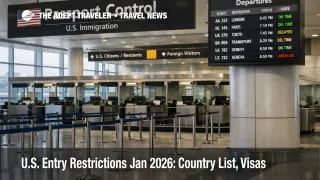
U.S. entry restrictions signed on December 16, 2025 are now live nationwide, with airlines and border officers applying the new rules in real time across check in systems and ports of entry. Travelers holding passports from newly restricted countries, plus anyone traveling on Palestinian Authority issued or endorsed travel documents, are the most exposed to immediate denied boarding, refused admission, and forced reroutes. The practical next step is to treat every U.S. touchpoint, including a connection, as a document eligibility checkpoint, and to switch routings away from U.S. transit if eligibility is uncertain.
The U.S. entry restrictions Jan 2026 policy change is a live screening and routing problem, because it splits affected travelers into full suspensions versus partial suspensions tied to specific visa classes and effective date scope.
The proclamation continues a full suspension of entry, for immigrants and nonimmigrants, for nationals of Afghanistan, Burma, Chad, Republic of the Congo, Equatorial Guinea, Eritrea, Haiti, Iran, Libya, Somalia, Sudan, and Yemen, and it adds full suspensions for Burkina Faso, Laos, Mali, Niger, Sierra Leone, South Sudan, and Syria. It also fully suspends entry for foreign nationals seeking to travel on travel documents issued or endorsed by the Palestinian Authority.
Separately, the proclamation expands partial suspensions that target immigrant travel and several high volume nonimmigrant categories. The partially restricted countries are Angola, Antigua and Barbuda, Benin, Burundi, Cote d'Ivoire, Cuba, Dominica, Gabon, The Gambia, Malawi, Mauritania, Nigeria, Senegal, Tanzania, Togo, Tonga, Turkmenistan, Venezuela, Zambia, and Zimbabwe. For most of those countries, entry is suspended for immigrants, and for nonimmigrants on B 1, B 2, B 1 and B 2, F, M, and J visas, while consular officers are directed to reduce validity for other nonimmigrant visas to the extent permitted by law. Turkmenistan is treated as an exception inside the partial framework, because the proclamation lifts the suspension for Turkmenistan nonimmigrants in those categories while keeping immigrant entry suspended.
For readers who tracked the earlier preview coverage, this story is the enforcement moment that turns policy language into check in outcomes. U.S. Travel Ban Expansion Starts January 1, 2026
Who Is Affected
The highest risk travelers are nationals of the fully suspended countries who are abroad and planning to travel as immigrants or nonimmigrants after the effective time, because the proclamation states the suspensions apply, subject to exceptions, to foreign nationals outside the United States on the applicable effective date who did not have a valid visa on that date. That detail matters operationally, because airline document checks often happen at online check in, at the airport counter, and again at the gate, and a single mismatch can stop travel before departure.
Travelers from the partially restricted countries are most exposed if they need a new immigrant visa, or if they are traveling on B, F, M, or J visas, which cover common visitor, student, vocational, and exchange patterns. Even when a traveler is not in one of those categories, the proclamation's direction to reduce validity for other nonimmigrant visas can change the practical usability of a visa for future trips, especially for travelers whose plans rely on longer validity or multiple entries.
Anyone traveling on travel documents issued or endorsed by the Palestinian Authority should assume the highest risk posture until a carrier and a primary U.S. source confirm eligibility for that specific itinerary, because the proclamation describes a full suspension tied to those documents, and the State Department also frames the change as a suspension of entry and visa issuance for individuals applying using those documents. This is the category most likely to create last minute airport outcomes, because carriers will treat document type as a hard gate in automated checks.
There are explicit exception buckets that travelers often misunderstand. The proclamation lists lawful permanent residents as exempt, and it also exempts dual nationals traveling on a passport issued by a country not designated under the restrictions. It further exempts certain diplomatic and international organization visa classifications, specific athlete travel tied to major events, certain Special Immigrant Visas for U.S. Government employees, and immigrant visas for ethnic and religious minorities facing persecution in Iran. It also states that visas issued before the applicable effective date are not revoked pursuant to the proclamation, and that the proclamation does not apply to people already granted asylum or refugees already admitted.
What Travelers Should Do
Travelers who might be in scope should take immediate steps that reduce airport day surprises. Confirm exactly which passport you will present at check in, confirm whether you already have a valid U.S. visa that remains valid for travel, and ask the airline, in writing when possible, to validate your specific itinerary and document set before you depart. If any segment connects through the United States, build buffer for rebooking and consider a backup routing that avoids U.S. transit entirely, because availability can tighten fast once denied boarding events start clustering.
Use a clear decision rule for rebooking versus waiting. If you are outside the United States and you do not have a valid U.S. visa that was valid as of 12:01 a.m. Eastern Standard Time on January 1, 2026, assume a U.S. routed itinerary is likely to fail if you are a national of a restricted country, or if your trip depends on visa classes named in the partial suspension. In that scenario, reroute via a non U.S. hub or postpone, rather than gambling on a counter decision at the airport. If you do have a valid visa and you fall into an exception bucket, the goal becomes operational resilience, meaning fewer tight connections, fewer separate tickets, and earlier departures that preserve same day recovery options.
Over the next 24 to 72 hours, monitor primary sources for implementation shifts and carrier level friction points. Watch for updates from the Department of State, and for airline advisories that describe document verification steps, because carriers translate proclamations into their own check in workflows faster than many travelers expect. Also watch for second order disruptions, including sudden demand on alternate connection airports outside the United States, and hotel compression near major gateways when travelers are forced into overnight holds while they pursue waivers, reroutes, or legal advice.
Background
A U.S. entry proclamation propagates through travel in two layers, and the first layer is often the one that breaks trips. Airlines act as the front line because they must validate that a passenger can lawfully travel, and automated document checks are designed to be conservative, which means an unclear case frequently turns into a refused boarding pass rather than a discretionary boarding decision.
The second layer is the port of entry decision, where U.S. border officers apply admissibility rules on arrival. Even when a traveler never planned to "visit" the United States, many itineraries that connect in the United States still require meeting U.S. entry and visa rules, and that is why a policy change can break third country travel that merely touches a U.S. hub.
Those two layers create predictable second order ripples. When travelers are denied boarding or routed into long document reviews, they misconnect, aircraft seats get reallocated, and rebooking demand concentrates onto fewer remaining routings through Canada, Mexico, Europe, and other non U.S. gateways. As those routings tighten, hotel nights near gateways compress, and separate ticket itineraries become especially fragile, because a missed first segment often voids later legs and forces self funded recovery.
Sources
- Restricting and Limiting the Entry of Foreign Nationals to Protect the Security of the United States
- Fact Sheet: President Donald J. Trump Further Restricts and Limits the Entry of Foreign Nationals
- Suspension of Visa Issuance to Foreign Nationals to Protect the Security of the United States
- Expanded "Travel Ban" to Take Effect January 1, 2026