

Eurostar Cancellations London Paris Trains Jan 2026
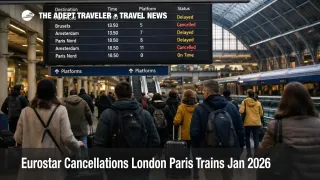
Eurostar service is still not back to a stable baseline on routes through the Channel Tunnel, and passengers should plan for more late changes on Friday, January 2, 2026. The highest exposure is for travelers moving between London, United Kingdom, and Paris, France, plus those using Brussels, Belgium, or Amsterdam, Netherlands as connection points on a single ticket itinerary. The practical move is to verify your exact train status shortly before leaving, build an overnight buffer if you are time locked, and decide early when to switch to a flight or ferry if you must arrive the same day.
Eurostar cancellations London Paris trains remain a traveler planning problem because Eurostar is publishing both day of disruption warnings and forward timetable removals that shrink seat supply across the first half of January and into early February.
Alongside the January 2 rolling disruption, Eurostar's published travel updates show planned cancellations on parts of the network from Monday, January 5, 2026 through Sunday, February 8, 2026, plus separate limited service periods tied to engineering works and operational restrictions. In practice, that combination means the timetable can look normal weeks out, then quietly lose specific trains, and the remaining departures fill faster and fail harder when anything slips.
Who Is Affected
The core group is any passenger booked on a Eurostar London route between London St Pancras International and Paris Gare du Nord, Brussels Midi, or Amsterdam Centraal during the active disruption window, especially travelers heading out for short breaks with little slack. Travelers are also exposed on non London Eurostar segments where engineering works cut capacity, including parts of the France, Belgium, Netherlands, and Germany corridors, because equipment and crews circulate across the broader network.
The next tier is travelers with chained plans that assume a precise arrival time. Separate ticket itineraries are the brittle ones, rail into a flight, a cruise embarkation, a timed tour, or a hotel check in cutoff where missing the window creates a new cost that can dwarf the rail fare. Even when your Eurostar train runs, the recovery phase can still break the chain through longer dwell times at terminals, longer boarding processes, and late arrivals that collapse connection margins.
A third group is anyone not riding Eurostar at all but sharing the same constrained alternatives. When Eurostar removes trains in advance, demand moves into fewer remaining rail departures, as well as ferries and short haul flights, and those options can sell out quickly. The knock on effect is hotel night compression in London, Paris, Lille, and Brussels when a late cancellation turns a day trip into an unplanned overnight, and when passengers are forced to wait for the next available departure.
What Travelers Should Do
Start with immediate risk control for Friday, January 2, 2026. Check Eurostar travel updates and your booking status shortly before you leave, then again if you are still at home within a few hours of departure, because late changes can appear after an earlier green status. If you are crossing the Channel, arrive earlier than usual for station processes, bring power, food, and warm layers, and avoid building a same day plan that depends on a tight arrival.
Set a decision threshold that forces action instead of hope. If you must arrive in Paris, Brussels, or Amsterdam by a fixed time, for example a non refundable hotel night, a separate ticket flight, or an event, switch to an alternate mode as soon as your first viable same day rebooking option disappears, or as soon as the remaining departures leave you with less than a realistic arrival buffer for your onward plan. In disruption recovery, the losing bet is waiting until late afternoon to make a new plan, when ferries, flights, and hotels have already repriced.
Over the next 24 to 72 hours, monitor two signals that matter more than headlines. First, watch whether Eurostar continues to publish operational restriction notices and day of disruption warnings, because that is a sign the network is still clearing backlog and mispositioned resources. Second, watch whether the planned cancellation windows shrink or expand, because schedule removals weeks ahead usually indicate capacity is still being managed proactively, not simply reacting to one bad day.
How It Works
The Channel Tunnel is a single, high throughput rail link, and when it suffers a power or infrastructure incident, the immediate stoppage is only the first problem. The second problem is recovery, trains and crews are out of place, the timetable has little spare capacity to absorb delays, and terminals are designed for smooth, timed flows, not for holding large crowds for long periods. Even after service restarts, the next day can still see cancellations because trains are not where they are supposed to be, crews hit work time limits, and platform and border processing becomes a chokepoint.
When Eurostar then publishes planned cancellations and limited service windows, the disruption propagates into the wider travel system in a different way. The reduced rail supply concentrates demand onto fewer departures, which raises load factors, reduces flexibility, and makes every marginal delay more consequential. That pushes travelers into flights and ferries, which can tighten inventory and raise prices quickly, particularly on short notice. It also changes hotel demand patterns, with more unplanned overnight stays near St Pancras and Gare du Nord, and more late arrivals that increase rebooking and no show disputes.
The operational timeframe is best thought of in layers. Friday, January 2, 2026 is about day of reliability and late change risk. Monday, January 5, 2026 through early February is about reduced seat supply and timetable removals, with several overlapping engineering related constraints that can affect different parts of the Eurostar network at different times. Even if day of stability improves, the planned cancellations mean travelers should expect tighter availability and less forgiving backup options until the published windows end.
For additional context on the original disruption trigger and the immediate recovery phase, see Channel Tunnel Power Failure Halts Eurostar December 30, 2025 and Channel Tunnel Disruption Hits Eurostar, LeShuttle Dec 31. If you end up needing an unplanned overnight near the Eurostar terminal, London Travel Guide: The Ultimate 7-10 Day Itinerary for First-Time Visitors has neighborhood and transit context around the King's Cross, Bloomsbury area.
Sources
- Disruptions, Travel News, Eurostar
- What happens if Eurostar cancels my train?
- Refunds and compensation for delays and cancellations
- Disruption to Eurostar services between London St Pancras International and Paris Nord, National Rail
- Channel Tunnel disruption affects Eurostar and vehicle shuttle between France and England, AP