

Landing System Outage at Milan Bergamo Delays BGY Flights
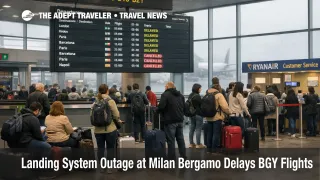
Flight operations at Milan Bergamo Airport Il Caravaggio International Airport (BGY) were suspended Saturday evening after technical issues with the instrument approach, or landing guidance, system coincided with poor visibility, forcing cancellations and diversions and leaving many passengers stuck overnight in the terminal. The disruption hit a major low cost gateway for Milan, Italy, with Ryanair traffic particularly exposed because of the airport's dense short haul schedule and fast turn requirements. Travelers should treat January 4, 2026 as a recovery day, expect uneven on time performance, and be ready to reroute via other northern Italy airports if seats reopen faster there.
The Milan Bergamo landing system outage matters for travelers because even after the technical fault is cleared, the airport and airlines still need to unwind diversions, reposition aircraft, and rebuild gate and crew plans, which keeps delays and cancellations in the system.
Reuters reported that the incident drove 26 canceled departing flights, six diversions to other airports, and seven rescheduled departures into Sunday, January 4, 2026, with thousands stranded overnight. The same reporting said the technical problem was resolved around midnight, local time, but airport messaging warned that flights could still be delayed or canceled as operations restarted.
Who Is Affected
Passengers departing from or arriving into Milan Bergamo are the obvious first group, especially anyone booked on early January 4 departures that rely on an aircraft arriving late from the prior day's disruption. Travelers on low cost itineraries are often more exposed because a cancellation can push them into limited same day seat inventory, and because many travelers using BGY are self connecting on separate tickets, which can turn a missed onward flight into a separate purchase.
Ryanair's network structure makes second order effects more likely. When a base airport pauses arrivals and departures, aircraft end up parked at alternates, crews hit duty limits, and rotations that were supposed to operate multiple legs in a day start failing downstream. That ripple can show up far from Milan as later day cancellations, late inbound aircraft, and reaccommodation pressure on competing flights across Europe.
Travelers trying to salvage time sensitive plans, including events, nonrefundable hotels, cruises, or prepaid tours, are also at higher risk because the most expensive failure mode is not the delay itself, it is the chain reaction, missed check in windows, missed boarding windows, and last minute overnight stays near whichever airport you end up using.
What Travelers Should Do
Start with immediate actions and buffers. Recheck your flight status close to departure, and do not assume a flight is safe because it is still listed, airlines may retime or cancel flights as they match schedules to available aircraft and crews. If you are still deciding whether to travel to the airport, prioritize any rebooking that keeps you on a protected itinerary, meaning one ticket, one airline or alliance, and confirmed reaccommodation, before you commit to a long ground transfer.
Use decision thresholds for switching airports versus waiting. If your flight is canceled, or if your departure is in the first bank after reopening and your trip cannot absorb a multi hour slip, it is usually rational to move fast to a different airport, even if it adds a ground leg, because alternate seats disappear quickly once stranded passengers compete for the same inventory. For Milan area reroutes, Milan Central Station to Bergamo Orio al Serio coach services are commonly marketed at about 50 to 60 minutes, with fares advertised from €7.00 (EUR), while the Malpensa Express between Malpensa and Milano Centrale is advertised at €15.00 (EUR), with travel time listed around 51 minutes, which is a typical tradeoff, cheaper bus to BGY versus a pricier but rail based option to MXP.
Over the next 24 to 72 hours, monitor the indicators that predict whether the recovery is real or fragile. Watch the Milan Bergamo Airport updates, your airline's disruption advisories, and whether delay boards shift from widespread late departures to a smaller number of isolated delays. If you can switch to Milan Linate Airport (LIN), the airport highlights M4 metro access as the backbone public transport option, and local guidance has described the existing M4 segment as a 12 minute ride with standard ATM ticketing, which can make LIN attractive for travelers who value predictable city access while schedules stabilize.
How It Works
Instrument approach systems matter most when visibility drops. When ceilings and visibility deteriorate, airports lean on precision approach procedures, and air navigation service providers manage arrival spacing and runway movement rates to keep operations safe. If a key element of the instrument approach environment is degraded, even temporarily, the practical effect for travelers is fewer arrivals and departures per hour, and in some cases a full pause, because the airport cannot safely sustain the previous acceptance rate.
Once flights divert, the disruption stops being local and becomes network wide. Diversions strand aircraft away from their planned next legs, crew duty clocks keep running, and gate plans at the diversion airports get stressed, which can cascade into additional cancellations even after the original constraint is removed. That is why Milan Bergamo's "back to normal" technical message can still coexist with messy recovery day outcomes for passengers, and why hotel demand and ground transport demand can spike across multiple airports in northern Italy as travelers scatter to find any workable route.
For a parallel example of how low visibility operations can cascade beyond the first affected bank, see Fog Delays Delhi Airport Flights, Cancellations Persist. For broader context on how constraints and downstream misconnect risk show up in day to day traveler decisions, reference Flight Delays and Airport Impacts: January 2, 2026.
Sources
- Comunicati stampa * SACBO S.p.A.
- Autobus * SACBO S.p.A.
- Thousands stranded overnight as Italy's Bergamo airport halts flights
- Milan Central Station - Bergamo Orio al Serio - Motorway
- Tickets and timetables for Milano Centrale - Malpensa Aeroporto T1 route
- Hot to get to Linate by underground | Milan Linate
- M4: From Linate airport to Milano centre in 12 minutes