

Storm Anna Stockholm Arlanda Flight Cancellations Weekend
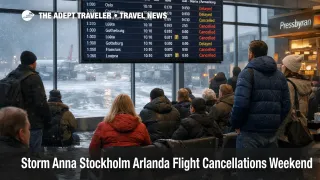
Storm Anna is disrupting operations at Stockholm Arlanda Airport (ARN), with delays and cancellations expected to extend through the weekend as heavy snow and wind move across central and eastern Sweden. Passengers connecting through Arlanda, and travelers on thinner domestic and Nordic frequencies, face the highest risk of missed connections and forced overnight stays. The practical next step is to check your airline for waivers, rebook early if your itinerary is tight, and add extra time for airport access because surface transport can slow even when terminals stay open.
The Storm Anna Arlanda cancellations pattern matters because it is not only the weather at the airport, it is the recovery cycle that follows as aircraft, crews, and gates drift out of position across Scandinavia.
Reports tied to airport operations described roughly 70 delayed flights and at least 17 cancelled departures as the storm intensified on January 2, 2026, with more knock on disruption expected as conditions persisted. Swedish media also cited Swedavia noting departure delays on the order of roughly 40 to 60 minutes during the disruption window, a sign that operations were running but constrained.
Who Is Affected
Travelers scheduled to depart Arlanda during the most active snowfall and wind periods are the most exposed, especially if they are booked on the last flight of the day to a smaller airport where there may not be another same day option. When airlines protect you on a single ticket, a missed connection can still mean a long wait if the next available seat is the following day, and those waits compound quickly when multiple flights cancel in the same bank.
Connecting itineraries are fragile because Arlanda sits at the center of several short haul "rotation chains," where the same aircraft might fly a morning out and back, then an afternoon sector to another Nordic city, then finish with an evening return. When snow slows turn times, or when crews time out, airlines often cancel selective legs to reset the next day schedule, and that can strand travelers far from the worst weather. This is why the "tail" of disruption frequently extends beyond the heaviest snowfall window.
Surface transport adds a second pressure point. Sweden's public warning information and SMHI advisories around Storm Anna emphasized difficult travel conditions in affected regions, and the practical effect for Arlanda passengers is slower road access, fewer reliable taxi or rideshare options, and bus schedules that may not match a newly rebooked flight time. Rail can help some travelers reposition, but it is not a guaranteed fallback when the storm impacts corridors north of Stockholm, including long distance services.
What Travelers Should Do
Start with immediate actions and buffers. If your flight is cancelled, rebook in the airline app or website before you go to the airport, because agent lines tend to spike after the first large wave of cancellations. If you must travel to the airport without a confirmed rebooking, bring essentials for an extended terminal stay, and plan extra time for ground access because winter road conditions can break tight curbside timing even when security and check in are running.
Use decision thresholds for rebooking versus waiting. If you are connecting with under about 2 hours in Arlanda, if your first leg is already delayed enough to erase your buffer, or if you are booked on the last flight of the day to your destination, rebooking proactively is usually the lower risk move. Waiting can make sense only when you have multiple later protected options the same day on the same ticket, and when arriving several hours late will not trigger a cruise embarkation miss, a nonrefundable hotel penalty, or a separate ticket misconnect.
Monitor specific indicators over the next 24 to 72 hours. Track SMHI warning updates for your corridor, and look for signs of a "reset," such as fewer cancellations in early morning departures, and shorter posted delays later in the day. Also watch rail advisories if you are planning to swap to trains, because cancellations on key northbound routes can remove the most common self rescue option for stranded travelers. If forecasts and warnings suggest conditions may linger into early week, assume hotel inventory near the airport tightens, and book an overnight buffer sooner rather than later if you cannot tolerate being stuck.
How It Works
Winter airport disruption is a capacity problem that becomes visible as long turns, gate holds, and missed connections. Snowfall and wind can reduce the effective departure rate even when runways remain open, because aircraft must be deiced, braking action and taxi speeds can be lower, and ramp work takes longer when visibility is reduced. The operational consequence is that departures leave late, arrivals stack up behind occupied gates, and airlines lose the "slack" they rely on to absorb small delays.
Once that first layer is constrained, the disruption spreads through at least two other layers of the travel system. First, network positioning breaks, because aircraft that should operate the next wave are not in place, and crews approach duty limits after repeated delays, which forces additional cancellations that are not directly tied to the weather at the moment. Second, traveler behavior shifts, and the system then strains off airport capacity, including hotels near Arlanda, long distance rail seats, and intercity buses, because many passengers try to rebook onto the same alternative departures and ground options.
For travelers, that means the best alternative is often not "the next flight," it is the next workable itinerary that includes enough buffer to survive a second round of delays. If your goal is to keep moving the same day, the most realistic reroute patterns are typically via larger nearby hubs with frequent frequencies, then continuing onward by a short connecting flight or ground transfer. When you plan this, build extra time for surface transport and terminal processes, and avoid self connecting on separate tickets unless you can absorb a misconnect.
For related winter disruption decision rules in other regions, see Winter Storm Delays Toronto Pearson, Montréal Trudeau and Scotland Amber Snow Warning Hits Flights, Ferries.
Sources
- Warnings and advisories, SMHI
- Ovädret Anna, Krisinformation.se
- Many flights cancelled at Arlanda due to Storm Anna, Sweden Herald
- Tiotalet förseningar på Arlanda på grund av Anna, Omni
- All train traffic north of Gävle canceled until Monday at 10 a.m., Sweden Herald
- Anna drar in, Aftonbladet
- Stockholm Arlanda Airport, Swedavia