

Winter Storm Delays Toronto Pearson, Montréal Trudeau
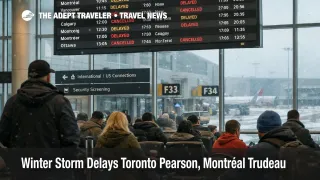
Winter weather disruption across Canada is still driving cancellations, long delays, and hard rebooking through Toronto Pearson International Airport (YYZ) and Montréal Pierre Elliott Trudeau International Airport (YUL), as airlines work through deicing limits and aircraft, plus crew displacement. Travelers connecting through these hubs, especially on transborder itineraries, are the most exposed group because a small reduction in departure rate can quickly erase connection buffers across the network. The practical next step is to assume same day plans are fragile, check whether your ticket qualifies for a waiver, and move to earlier or later flights, or alternate airports, before remaining inventory compresses.
The Toronto Pearson winter storm delays problem is not just the snow or wind in front of you, it is the recovery cycle that follows, when late arrivals, longer turns, and deicing queues propagate into later banks and strand passengers overnight.
Who Is Affected
Passengers routed through Toronto Pearson are seeing the highest operational risk because YYZ is a dense hub where international arrivals, domestic connections, and transborder departures compete for gates, crews, and deicing resources at the same time. On January 2, 2026, FlightStats flagged YYZ as being in significant delay status, which is the kind of signal that tends to show up when the airport is still clearing a backlog of late aircraft and extended turn times. Even when conditions improve at the field, the late aircraft that should operate later departures often arrives out of sequence, and that mismatch is what turns a localized storm day into a multi bank disruption.
Travelers using Montréal Trudeau should treat YUL as a secondary failure point in this pattern, especially when their itinerary involves an inbound connection from Toronto, Ottawa, or a smaller regional station. Environment Canada showed no active alerts for the Montréal Island area at late morning on January 2, 2026, but cold conditions and periodic flurries still matter operationally because deicing demand does not need a formal warning to slow the system. When carriers cancel selectively to reset the network, Montréal becomes a common reroute and reaccommodation node, which can tighten seats, hotels, and ground transport even if the worst conditions are concentrated elsewhere.
Cross border itineraries are where the ripple becomes most visible. A missed connection at Toronto Pearson can break onward travel into U.S. hubs, then strand travelers far from the original problem, and it can also disrupt the return direction when aircraft and crews that should fly back to Canada are no longer in position. That second order effect tends to persist into the following day schedule because duty time limits and maintenance routings reduce the number of spare aircraft available to plug holes.
What Travelers Should Do
Start with immediate actions and buffers. If your itinerary routes through Toronto Pearson or Montréal Trudeau between December 31, 2025, and January 4, 2026, check whether your ticket qualifies for Air Canada's flexible rebooking policy, and make changes while seat inventory still exists in your original cabin. Add ground buffer as well, because snow cleared on the runway does not guarantee normal road access, rideshare availability, or short security lines once large numbers of passengers are rebooked into the same waves.
Use decision thresholds for rebooking versus waiting. If your connection is under 90 minutes, if you are on the last flight of the day, or if your first flight is already delayed enough to put your onward segment at risk, move your itinerary instead of hoping the bank recovers at the gate. If you have multiple later protected options on the same ticket, waiting can make sense, but only when you can tolerate arriving several hours late without triggering hotel penalties, missed cruise embarkation, or a separate ticket misconnect.
Monitor specific indicators over the next 24 to 72 hours. Watch whether light snow and renewed periods of snow in the Toronto forecast for Saturday, January 3, 2026, and Monday, January 5, 2026, materialize, because repeated deicing cycles are what keep the system from resetting cleanly. Keep an eye on YYZ delay status, plus your airline's waiver updates, and if you are rerouted through alternates like Ottawa Macdonald-Cartier International Airport (YOW), John C. Munro Hamilton International Airport (YHM), or Billy Bishop Toronto City Airport (YTZ), confirm ground transfer times and last mile options before you commit to the swap.
How It Works
Winter disruption at major Canadian hubs is largely a capacity math problem that becomes visible as missed departures and long gate holds. When snow, freezing precipitation, or blowing snow increases contamination risk, aircraft must be deiced and anti iced before departure, and those fluids have limited holdover time that can force repeat treatment if queues are long or if precipitation intensity changes. That extra step stretches turn times, reduces the number of departures the airport can push per hour, and makes schedule timing less reliable even after visibility improves.
Toronto Pearson has additional winter specific flow constraints that matter to travelers because they shape runway usage and taxi patterns. NAV CANADA's winter operations plan notes that during the winter operations period, the landing distance available for Runway 15L is temporarily reduced to support traffic flow to the Central Deicing Facility during certain runway configurations, and that kind of procedural change is part of why arrival and departure rates can change quickly in winter operations. When arrival rates are metered and gates stay occupied, departures inherit delays, crews approach duty limits, and airlines may cancel later flights to preserve the next morning schedule, which is why disruption often persists after the headline weather event.
Those airport mechanics ripple through at least two additional layers of the travel system. First, connections compress, and travelers miss onward flights into U.S. hubs, or miss international departures that operate in tighter banks with fewer same day alternatives. Second, off airport capacity becomes the constraint, because irregular operations concentrate passengers into fewer hotels near the terminals, then strain taxis, rideshares, and rental car counters as people try to reposition to alternate airports. For a broader read on how delay programs and bank fragility cascade through hub networks, see Flight Delays and Airport Impacts: January 1, 2026 and Flight Delays and Airport Impacts: December 31, 2025.
Sources
- Flexible Rebooking Policy
- Flexible rebooking policy during peak holiday travel period
- YYZ - Toronto Pearson International Airport Current Conditions
- YUL - Montréal Trudeau International Airport Current Conditions
- Toronto, ON - 7 Day Forecast
- Montréal, QC - 7 Day Forecast
- Weather Alerts for: City of Toronto
- Weather Alerts for: Montréal Island area
- AIP CANADA SUPPLEMENT 129/2025, 15L WINTER OPERATIONS PLAN, TORONTO PEARSON INTERNATIONAL AIRPORT
- Holdover time (HOT) guidelines for de-icing and anti-icing aircraft
- Toronto Pearson Int'l Airport Live Status