

Venezuela Action Delays Caribbean Cruise Embarkation
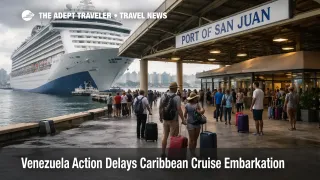
A U.S. military operation in Venezuela triggered emergency aviation restrictions across parts of the Caribbean, and that shock rolled straight into cruise turnarounds and port day logistics. Cruise guests were affected in two directions, some could not reach ships to start their vacations, while others could not fly home after disembarking. The practical next step is to treat January 4, 2026 through January 6, 2026 as a recovery window, verify flights before moving toward the port, and use cruise line guidance to decide whether to reroute, delay, or rebook.
The Venezuela action Caribbean cruise embarkation disruption is mainly an air access problem that forced cruise lines to slow departures, modify guest handling, and protect the week ahead of itineraries.
On Saturday, January 3, 2026, the Federal Aviation Administration imposed temporary airspace limits tied to safety concerns after the U.S. action in Venezuela, and airlines canceled large numbers of flights across Puerto Rico and the Eastern Caribbean. For cruises, that removed the normal flow of same day arrivals into key ports and cut off the same day flight options that many disembarking travelers depend on.
Cruise lines then had to make an operational choice that looks simple but is not. Either hold the ship and protect more guests at the pier, or sail on time to protect the rest of the itinerary, including downstream ports, crew scheduling, bunker plans, provisioning, and the next week's embarkation. The industry response over the weekend shows both approaches, plus a growing emphasis on credits, clear cutoffs, and documentation so travelers can claim trip delay benefits when they have coverage.
Two concrete examples capture the playbook. Windstar said airport closures in St. Maarten and Bridgetown disrupted turnaround operations for Wind Surf and Wind Spirit, it secured a berth delay, and it planned both ships to sail on January 5, 2026 at 11:59 p.m., with itineraries resuming as scheduled effective January 6, 2026. Virgin Voyages published guidance tied to San Juan flight disruption, and later communicated that sailors unable to embark due to the situation would receive a future voyage credit.
For the broader air disruption context that set up the cruise impacts, see Venezuela Airspace Curbs Disrupt Caribbean Flights and Windstar Caribbean Cruise Embarkation Delays After Closures.
Who Is Affected
The core affected group is any traveler whose cruise plan depended on U.S. airline lift into, or out of, Puerto Rico and the Eastern Caribbean during the Saturday disruption and the Sunday restart. That includes guests embarking in San Juan, where Luis Muñoz Marín International Airport (SJU) saw a large share of cancellations reported by multiple outlets, and anyone using the city as a connection point to reach ships sailing from nearby islands.
Travelers embarking via St. Maarten and Barbados also faced elevated risk because Princess Juliana International Airport (SXM) and Grantley Adams International Airport (BGI) are common flight gateways for smaller ship and yacht style itineraries, and for guests stitching together inter island routings. In Windstar's case, the company explicitly linked the guest turnaround problem to disruptions in St. Maarten and Bridgetown, which is the kind of brittle dependency that makes boutique cruise operations feel airline turbulence faster than mega ships sailing from Florida.
Disembarking guests were also hit, and their risk often looks worse than embarkation risk. When you miss embarkation, there is sometimes a path to join later, depending on immigration rules, the ship's schedule, and the line's willingness to coordinate. When you miss your flight home after disembarkation, you are immediately in a high demand hotel market, often during a weekend, and you can lose prepaid onward travel such as domestic connections or ground transfers.
Cruise lines, port agents, and hotels in the homeport layer felt the second order ripple quickly. When hundreds of flights cancel, demand for same day rooms spikes, and the best located inventory sells first. Transfer providers then face a mismatch, some vehicles are staged for passengers who never arrive, while other passengers arrive in a sudden wave on recovery flights. That is why cruise operators lean toward simple, scalable remedies under stress, such as a clear late boarding policy, a delayed sail time when the berth is available, or credits when guests cannot join.
What Travelers Should Do
If you are not yet at the port, stop treating your itinerary as linear. Confirm your specific flight is operating before you start any long ground transfer, then secure a written rebooking from the airline, and only then coordinate with the cruise line so both sides agree on the same arrival plan. If you are within 24 hours of sailing, prioritize an earlier flight bank, a routing through a less affected gateway, or an overnight buffer near the port rather than gambling on a last flight of the day.
Decide quickly whether you are in the "must sail" bucket or the "can wait" bucket. If your sailing is the main trip and you have limited future flexibility, rebook aggressively and accept added hotel cost to protect embarkation, because the value of the cruise week usually dwarfs one or two nights on land. If your sailing is discretionary and seats are scarce, waiting for the network to stabilize can be rational, but only if the cruise line confirms what happens if you arrive late, including whether you can join later, or whether you should pivot to a future sailing.
Over the next 24 to 72 hours, monitor three signals, airline schedule reliability into your port, cruise line updates that change sail time or boarding windows, and port level advisories that affect air access or security posture. A recovery day can still produce rolling cancellations even after a formal restriction ends, so you are looking for clean midday and afternoon banks, not just one early departure that happens to operate. If you see repeated cancellations into the same gateway, assume your cruise line will protect the sailing schedule first, and switch tactics toward rebooking, credits, or a controlled rejoin plan rather than hoping for a last minute miracle.
How It Works
Cruises depend on aviation more than most travelers realize because the "turnaround" is a tightly timed handoff. The first order disruption starts with airspace restrictions and mass flight cancellations that strand embarking guests at origin airports and disembarking guests at the destination gateway. When that happens at a cruise homeport, the ship can end up with a partial manifest at sail time, baggage that arrives without owners, and transfer schedules that no longer match arrivals.
The second order ripple spreads across at least two other layers of the travel system. Hotel inventory tightens near ports and near major airports as stranded travelers extend stays, and prices move quickly because supply is limited on short notice. Ground transport then becomes unreliable because drivers, coaches, and rideshare availability do not scale instantly, and cruise arranged transfers can only wait so long before port security timelines and pilotage windows force a hard cutoff.
A third layer is itinerary integrity. Even when a ship delays departure to absorb late guests, it still has to protect downstream commitments, including berth windows, customs processes, crew duty and rest rules, and the next week's embarkation. That is why many lines prefer tools that preserve the rest of the sailing, such as a single delayed departure, a revised port sequence, or a credit that moves affected guests to a future voyage, rather than open ended waiting that risks turning one weekend problem into a multi week schedule breakdown.
Sources
- US lifts Caribbean airspace curbs after attack on Venezuela | Reuters
- US operation in Venezuela disrupts regional travel | AP News
- Important Travel Update for San Juan Disembarkation | Virgin Voyages
- Virgin to Issue Voyage Credits Due to Airspace Issues in Caribbean - Cruise Industry News | Cruise News
- 2025, 2026, 2027 Transatlantic Cruise | Windstar Cruises