

Delta One Check In Expands At Eight U.S. Hubs
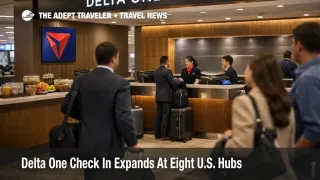
Delta Air Lines has expanded Delta One Check-In to all eight of its U.S. hub airports, creating dedicated, pre-security lobbies where eligible premium travelers can check in, drop bags, and get help in a quieter space. The perk applies to same-day Delta One tickets, select partner airline business class customers, and invite-only Delta 360 Members, and it can change which curb, door, or terminal you should use to start your trip. Travelers flying Delta One in 2026 should plan arrivals around the published entry points, especially at airports where the Delta One entrance sits on an arrivals level or in a different terminal zone than the one most travelers default to.
The Delta One Check In Hubs rollout matters because it shifts the first bottleneck of the airport journey, document checks, bag acceptance, and irregular-operations problem solving, into a separate intake. Delta says each location is designed to deliver high-touch service with Premium Service ambassadors, faster bag drop, seating, and light refreshments, and at two hubs it also shortens the path to premium security and lounge access.
Delta previewed the expansion on its October 9, 2025 earnings call, when Ed Bastian said Delta One check-in would be available across all hubs by year-end as part of broader airport infrastructure upgrades. For the earlier timeline and what Delta originally signaled for the last two hubs, see our prior coverage, Delta One check-in expands to every Delta hub.
Who Is Affected
This change affects travelers who originate at Hartsfield-Jackson Atlanta International Airport (ATL), Boston Logan International Airport (BOS), Detroit Metropolitan Wayne County Airport (DTW), Los Angeles International Airport (LAX), Minneapolis-St. Paul International Airport (MSP), John F. Kennedy International Airport (JFK), Salt Lake City International Airport (SLC), and Seattle-Tacoma International Airport (SEA) with an eligible premium ticket and, critically, anyone checking bags or needing agent assistance before screening. Connecting passengers already airside will usually see little benefit unless they must exit and re-enter security, while travelers flying carry-on only may see a smaller time difference depending on how crowded the standard lobby is.
Delta's wayfinding details are specific enough that they can change your curbside plan. In Atlanta, the entrance is in the International Terminal at Door 2, which can be a meaningful detour if you are dropped at the Domestic Terminal out of habit. In Boston, it is in Terminal E on Level 2 Departures at Door E205, and in Detroit it is in the McNamara Terminal on the Departures Level, entering Door 4, then using the Delta One sliding doors left of TSA and CLEAR. In JFK Terminal 4, the entry is on the Departures Level at Door B, and in LAX Terminal 3 it is on the lower arrivals level near pillars 3F and 3G. In Minneapolis-St. Paul it is across the road from the terminal entrance, accessible via the Flex Lane for departures at Door 8, in Seattle it is in the Main Terminal on the ground floor near the departures drop-off at Door 13, and in Salt Lake City it is in the Main Terminal on Level 1, arrivals, entering Door L2 adjacent to TSA.
Two hubs add an extra advantage that can materially reduce uncertainty in peak periods. Delta says JFK and LAX offer private Delta One security that leads directly to each airport's Delta One Lounge, creating a more controlled path from curb to airside for eligible travelers. Boston and Seattle also have Delta One Lounges, though Delta does not describe them as connected to a private screening corridor in the same way.
What Travelers Should Do
Before travel day, confirm that your itinerary qualifies, then save the correct door and terminal approach for your departure airport, and share it with your driver or ride-share so you are not dropped at a different terminal entrance. If you are checking bags, build a buffer for curb congestion and for the walk from the Delta One entry point to your specific gate area, because faster check-in does not remove the need to clear the Transportation Security Administration (TSA) checkpoint.
If you arrive and the Delta One entry is temporarily constrained by curb backups, construction, or access confusion, use a simple threshold. If reaching the published door will take longer than the estimated wait at the standard premium line, pivot to the main lobby, and keep moving toward a predictable security queue, rather than losing time on a last-minute terminal switch. At airports where the Delta One entrance is on an arrivals level, confirm you are in the correct roadway and level early, because backtracking between levels can erase the time savings.
Over the next 24 to 72 hours before departure, monitor Delta's airport pages and the Delta One Lounge information for operating-hour changes, and for any updates to eligibility language for partner business class travelers. Delta's product pages describe Delta One as a curb-to-cloud experience with dedicated check-in, security, and Delta One Lounge access at specific airports, so updates often appear there before they show up in third-party summaries.
How It Works
Delta One Check-In is a pre-security intake designed to pull premium travelers out of the main lobby flow, so document checks, baggage handling, and high-touch service happen in a controlled space before passengers join the broader security system. The concept complements Delta One, Delta's flagship international and premium transcontinental cabin, and it is meant to standardize the ground experience across hubs, not just at a few marquee gateways.
The ripple effects are mainly about passenger flow and staffing, not just comfort. At the source, separating premium transactions can reduce crowding at conventional counters, and it can also improve problem resolution during disruptions because experienced staff can handle complex cases without the noise and line pressure of the main hall. The second-order effects show up downstream, premium travelers often reach security in tighter waves tied to flight banks, which can shift TSA queue dynamics, and at airports where the Delta One security corridor feeds directly into a lounge, it can change where premium foot traffic concentrates airside.
Delta is framing this as part of a broader premium push. In its September quarter 2025 results, Delta said premium revenue grew 9% year over year, and on the October 9, 2025 earnings call it pointed to airport infrastructure and premium products, including Delta One lounges and hub-wide Delta One check-in, as a growth lever. For how this strategy has played out at one of the newest lounge airports, see our earlier report, Delta One Lounge Seattle Debuts With New Europe Flights.