

UK Snow Hits Scotland Rail, Airports January 5, 2026
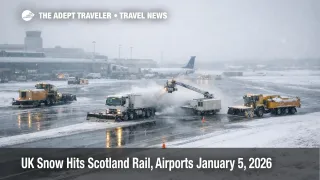
Snow and ice are disrupting travel across Scotland, Northern Ireland, and parts of northern England on Monday, January 5, 2026, with rail line closures in north and northeast Scotland and widespread flight delays and cancellations at regional airports. Network Rail Scotland said several routes in the north and northeast will not reopen until at least midday while snowploughs clear tracks and teams confirm it is safe to run passenger services. Airlines and airports are also dealing with reduced departure rates from de icing constraints and, in some cases, temporary runway closures.
For rail, the biggest immediate hit is on corridors that feed the Highlands and the northeast, where suspended segments can strand travelers mid journey and break same day connections into airports, ferries, and onward rail. For air, the disruption is concentrating at Aberdeen International Airport (ABZ), Inverness Airport (INV), Belfast International Airport (BFS), George Best Belfast City Airport (BHD), and Liverpool John Lennon Airport (LPL), where travelers should expect rolling delays, cancellations, and long rebooking queues.
Who Is Affected
Travelers using rail in northern Scotland are the most exposed, especially anyone relying on the Aberdeen to Dundee corridor, the Aberdeen to Inverness corridor, and the Inverness routes toward Wick, Thurso, and Kyle of Lochalsh, because a mid day restart target still leaves limited time to recover the rest of the day's timetable. If your itinerary depends on reaching an airport by rail for an afternoon departure, treat the connection as fragile even if the flight still shows as on time, because rail recovery often lags and road conditions can slow last mile transfers.
Air travelers are affected in two different ways, and it matters which one applies to you. Origin and destination passengers can often switch to a later departure or alternate airport if seats exist, but connecting passengers can be forced into overnight delays when a feeder flight cancels and the onward bank has already departed. That risk is higher on thin regional schedules, where one cancelled aircraft rotation can remove most remaining options for the day.
Travelers with cruise embarkations, ski transfers, and pre booked tours are also in the blast radius because surface conditions and limited standby capacity can turn a manageable delay into a missed check in window. If your plan includes a fixed time commitment that cannot slide, like a ship departure, a guided transfer, or a non refundable activity start, the correct posture on January 5, 2026, is disruption probable, not disruption possible.
What Travelers Should Do
If you are traveling on January 5, 2026, start by protecting the first break point in your chain, which is usually airport and station access. Add buffer time for icy roads, check rail status before you leave for the station, and check flight status before you leave for the airport, then again after you arrive. If you have checked baggage, remember that rebooking is often easier before bags are accepted, so decide early whether you are going to travel or pivot.
Use decision thresholds that match how many backup options your route actually has. If you have one or two flights a day, or you are on a rail corridor that is suspended into the afternoon, it is often smarter to shift to an earlier departure from an alternate hub, or move travel to Tuesday, January 6, 2026, rather than waiting for recovery that may not materialize before evening. If you have multiple daily options and you are still at home or in a flexible hotel, waiting can make sense, but only if you can absorb an overnight without breaking something downstream.
Over the next 24 to 72 hours, monitor three official signals and act when they change. First, watch Met Office warnings for updates on where ice risk remains high overnight. Second, watch rail operator updates and National Rail service disruption pages for line reopenings and timetable recovery. Third, watch airport and airline advisories for runway status, de icing constraints, and fee free change policies, because those policies can disappear once operations stabilise and the waiver window closes.
How It Works
Severe winter disruption propagates through the travel system in layers, and January 5, 2026, is a textbook day for cascading impacts. At the source layer, snow and drifting affect rail first because tracks, points, and exposed cuttings can become unsafe, and operators often need snowplough runs and inspections before restarting passenger services. Network Rail Scotland has highlighted that these constraints can keep lines closed into the day, which then compresses the remaining timetable and limits recovery capacity even after services restart.
At the aviation layer, airports can technically remain open while still losing departure rate, because de icing, reduced visibility, and slower ground operations stretch turn times. When a morning arrival cancels into a regional airport, the aircraft and crew that should have operated the next legs may be out of position, and duty time limits can force additional cancellations later. Airlines may publish disruption policies that allow fee free changes, but seats can vanish quickly when multiple airports in a region are disrupted at once.
The second order ripple is where traveler plans break. When rail segments are suspended, replacement coaches are finite, and road conditions can prevent buses from operating on time or at all, which leaves rental cars and taxis competing for the same limited safe corridors. Hotels then absorb the overflow, especially near airports and city centres that still have some operating departures, and that compression can make it harder and more expensive to wait for the system to recover. This is also why rerouting is not always a clean fix on January 5, 2026, because nearby hubs may be dealing with their own winter capacity cuts, including broader European knock on disruption such as KLM Cancellations Amsterdam Schiphol Flights January 5.
For travelers who have been tracking the cold snap since earlier warnings, this is the shift from forecast risk to confirmed operational impact. If you need background on how quickly Scottish winter warnings can tighten island, ferry, and regional flight links, the earlier disruption window is covered in Scotland Amber Snow Warning Hits Flights, Ferries.
Sources
- Snow closes schools and disrupts travel in parts of UK and Ireland
- Cold spell continues with further snow and ice warnings
- UK weather warnings
- Monday morning line closures expected following heavy snowfall in north and north-east
- Incident: Scotland weather, National Rail
- Wintry weather to affect services across England, Scotland and Wales until Tuesday 6 January
- Weather Disruption, Sunday, 4 January to Monday, 5 January 2026
- Liverpool airport runway closed due to snow and icy conditions
- Belfast International Airport update on cancellations and delays
- Belfast City Airport travel information update
- Translink service incidents and disruptions
- TrafficWatchNI travel and road conditions updates