

Flight Delays and Airport Impacts: January 5, 2026
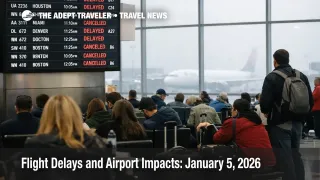
U.S. flight delays January 5 are being pushed higher by low ceilings across several major hubs, plus winter weather in New England, based on FAA planning for Monday, January 5, 2026. Travelers connecting through Hartsfield-Jackson Atlanta International Airport (ATL), Boston Logan International Airport (BOS), and San Francisco International Airport (SFO) face the highest misconnect risk if morning constraints spill into the mid day and evening departure banks. Check your airline status first, then check FAA constraints, and lock in a rebooking cutoff before seats disappear on later banks.
The FAA's daily outlook flagged low clouds as the primary operational risk for ATL, Charlotte Douglas International Airport (CLT), George Bush Intercontinental Airport (IAH), William P. Hobby Airport (HOU), Austin-Bergstrom International Airport (AUS), San Antonio International Airport (SAT), Seattle-Tacoma International Airport (SEA), Los Angeles International Airport (LAX), San Diego International Airport (SAN), and Orlando International Airport (MCO), while BOS reported snow, low clouds, and low visibility, and wind was noted around Denver International Airport (DEN) and SFO.
In the Command Center operations plan effective 1500Z and later, ATL was listed under an active ground stop due to low ceilings through 1500Z [about 10:00 a.m. ET], and ground delay programs were noted for Aspen Pitkin County Airport (ASE) and SFO due to weather in their respective areas.
Local reporting around Atlanta also described a weather driven ground stop tied to fog and low ceilings on the morning of January 5, 2026, which matters because even a short stop at the nation's busiest hub can create a long delay tail across the network.
Who Is Affected
Atlanta is the biggest nationwide trigger point today because it is a high frequency connector, and it anchors a large share of domestic aircraft and crew rotations. When Atlanta is under a ground stop or reduced arrival rate, flights bound for the airport are held at their departure airports, and that turns into delayed inbound aircraft for later flights. FlightAware's airport status page showed Atlanta experiencing substantial average departure delays tied to low clouds, plus airborne arrival delays, a pattern that often translates into missed connections once banks stack up.
Northeast travelers are exposed in a different way. Snow and low visibility in Boston can reduce arrival rates and increase spacing, which then shows up as longer taxi times and gate occupancy pressure. If your itinerary relies on a short connection at Boston Logan, or on the last bank of departures, a modest early delay can turn into a missed connection because reaccommodation queues build quickly in weather constrained corridors.
West Coast flyers, and anyone trying to reach mountain markets, are dealing with an uneven mix of weather and capacity tools. A ground delay program at San Francisco can spill into missed long haul connections because West Coast banks often run full, and same day recovery inventory is thin late. Mountain markets such as Aspen are fragile in winter, a delay program into Aspen can force diversions, missed ground transfers, and rebookings that push to the next day because frequencies are limited.
Florida and leisure volume flows are another pressure point. The operations plan referenced low ceilings for central Florida and listed an Orlando escape routing window, and FAA reroutes and flow constrained areas can meter traffic in ways that shift delay time backward to origin gates even when the departure airport looks clear.
Finally, travelers in South Florida should watch for arrival metering into Palm Beach International Airport (PBI). The most recent ATCSCC advisory warned of arrival delays and possible airborne holding of up to 30 minutes due to compacted demand through 2200Z [about 5:00 p.m. ET].
What Travelers Should Do
Start with immediate buffers and a clean decision plan. If you are connecting through Atlanta, Boston Logan, San Francisco, or Orlando on a single ticket, treat any connection under 60 minutes as fragile on January 5, 2026, and plan for a two to three hour cushion if you have a cruise departure, a same day event, or a last train. If you are on separate tickets, assume your onward flight will not be protected, and move flights earlier or switch routings while alternatives still exist.
Use clear thresholds for rebooking versus waiting. Rebook early if your departure or destination airport moves into a ground stop or ground delay program, if your inbound aircraft is running late enough to cut your connection under 45 minutes, or if you are holding a last flight of the day. Waiting makes sense only when you have multiple later protected options on the same ticket, and you can absorb a late arrival without paying for a new hotel night or losing nonrefundable ground arrangements.
Monitor the signals that matter over the next 24 to 72 hours. Watch whether the Atlanta ground stop clears on schedule and whether low ceiling conditions expand into Charlotte, Orlando, and the Houston airports during peak banks. Track whether the San Francisco program persists into the evening, which is when missed connections create the fastest hotel compression around airport districts. If you are flying to mountain airports such as Aspen, watch for diversion patterns and tightening arrival rates, because those are early indicators that tomorrow's rebooking backlog is about to form.
How It Works
The FAA Air Traffic Control System Command Center manages demand when airport capacity drops, using tools such as ground stops, ground delay programs, reroutes, and flow constrained areas. A ground stop is the most visible tool to travelers because departures to a destination are held at origin airports, while a ground delay program assigns expected delay to flights so arrivals can be spaced safely and efficiently.
Disruption propagates through the travel system in layers. First order impacts hit the constrained airport, arrival rates fall, gates stay occupied longer, and departures wait for late inbound aircraft and crews. Second order ripples spread across connections and crew legality, a delayed inbound into Atlanta or San Francisco can cancel a later flight in an unrelated city because the airplane cannot make its next scheduled turn. A third layer shows up off airport, misconnects create last minute hotel demand, car rental spikes, and tour or meeting no shows, especially when the disruption hits late day banks.
For pattern tracking and recent context, compare today's setup with Flight Delays and Airport Impacts: January 4, 2026 and Flight Delays and Airport Impacts: January 2, 2026. For deeper background on why staffing and modernization debates matter during high volume and weather days, see U.S. Air Traffic Control Privatization: Reality Check.
Sources
- FAA Daily Air Traffic Report (Monday, January 5, 2026)
- Current Operations Plan Advisory (ATCSCC ADVZY 056 DCC 01/05/2026)
- Current Reroutes, FAA ATCSCC
- The Most Recent ATCSCC Advisory (PBI AIRPORT ARRIVAL DELAYS)
- Hartsfield-Jackson Intl Airport (ATL/KATL) Status, FlightAware
- Dense fog forces ground stop for flights bound for Hartsfield-Jackson Atlanta International Airport