

Flight Delays and Airport Impacts: January 4, 2026
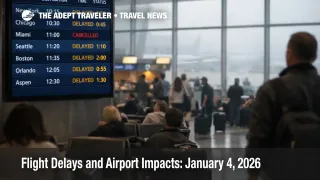
Air traffic disruption risk is elevated across several U.S. hubs today because the FAA's Air Traffic Control System Command Center flagged multiple airport specific constraints and active flow programs that can reduce capacity quickly. Travelers are most exposed in the Northeast corridor, Florida, and ski country markets, where snow, wind, fog, and seasonal volume can trigger ground delay programs, gate holds, and missed connections. The practical move is to check FAA status before leaving for the airport, add transfer buffers, and set a clear cutoff for rebooking if your itinerary depends on a tight connection or a last flight.
January 4 2026 flight delays are most likely to spike in the afternoon and evening banks, when demand is highest and even a small arrival rate reduction can lock up gates and strand aircraft out of position. In the FAA's operations plan effective 10:00 a.m. ET and later, the Command Center listed terminal constraints at General Edward Lawrence Logan International Airport (BOS) for snow, Newark International Airport (EWR) for wind, Tampa International Airport (TPA) and Orlando International Airport (MCO) for fog and low ceilings, Minneapolis St Paul International, Wold Chamberlain Airport (MSP) for freezing rain and ice pellets, San Francisco International Airport (SFO) for low ceilings and visibility, and Seattle Tacoma International Airport (SEA) and San Diego Lindbergh Field Airport (SAN) for low ceilings. The same plan also kept multiple flow constrained areas and reroute programs active, including Florida and ski country initiatives that can push delay time back to your departure gate.
At the snapshot level, several large airports were still reporting general delays of 15 minutes or less on FAA status pages late Sunday morning in the U.S., including BOS, EWR, Los Angeles International Airport (LAX), SFO, MCO, MSP, and SAN. That "looks fine until it is not" posture is common on weather and volume days because the delay system often turns on in discrete steps, once visibility, runway configuration, or traffic management thresholds are crossed.
Who Is Affected
Travelers connecting through the Northeast are the biggest group at risk because the corridor shares dense demand and tightly coupled airspace, so snow in Boston and wind impacts near New York can compound into arrival spacing increases, longer taxi times, and gate congestion. Even if your origin airport looks normal, your inbound aircraft can arrive late and break your connection plan, and the reaccommodation queue builds fastest on hub to hub routes.
Florida bound passengers are also exposed, including anyone connecting into MCO or TPA, because the FAA flagged fog and low ceilings for those terminals and also posted a staffing trigger for Tampa operations through 1800Z, which is 1:00 p.m. ET. When the airspace system meters Florida volume, you can see gate holds at distant origin airports, then arrive into a compressed connection bank with fewer open seats.
Ski and mountain market travelers should expect outsized disruption relative to flight time. The FAA listed an active ground delay program for Aspen Pitkin County Airport (ASE) into Sunday evening, and seasonal ski country flow programs were also in effect, which is the combination that turns short hops into long waits and makes diversions harder to unwind.
West Coast travelers have a different failure mode. Low ceilings were flagged at SFO, SEA, and SAN, and the FAA planning picture included the possibility of more restrictive programs later, which matters because evening departure banks carry high load factors and limited same day recovery options if a ground stop or a ground delay program is issued.
What Travelers Should Do
Act now to protect your itinerary, not after your first delay posts. If you have a connection under an hour in the Northeast, Florida, or West Coast coastal hubs, treat it as fragile today and build a buffer, especially if your onward segment is the last flight, a cruise embarkation, or a same day event ticket. Check the FAA airport status page for your departure and destination, then recheck again before you leave home, because delay programs often activate around bank peaks rather than gradually.
Use clear decision thresholds for rebooking versus waiting. Rebook early if your connection buffer drops under 45 minutes, if your destination airport shifts into a ground delay program or a ground stop, or if you see your flight's inbound aircraft running late enough to break your legal crew duty window. Waiting is rational only if you have multiple later protected options on the same ticket and you can absorb a late arrival without paying for a new hotel night or losing nonrefundable ground arrangements.
Monitor the signals that matter over the next 24 to 72 hours. Watch whether MSP moves from "possible" to active constraints after 1600Z, whether SFO sees a late day program after 2300Z, and whether Florida low ceiling conditions turn into wider gate holds as volume rises. If you are trying to decide whether to cancel and request money back, compare your situation to DOT refund guidance and controllable delay commitments, because your best leverage depends on whether the disruption is weather driven, air traffic management driven, or airline controllable.
How It Works
The FAA Air Traffic Control System Command Center manages national demand when airport or airspace capacity drops, using tools such as ground delay programs, ground stops, reroutes, and flow constrained areas. In the January 4 planning picture, the Command Center combined terminal constraints, staffing triggers, en route thunderstorm risks, and seasonal volume programs, which is the classic recipe for delays that appear first as gate holds and then propagate into missed connections later in the day.
Disruption spreads through the travel system in layers. First order effects show up at the constrained airport, arrival rates drop, gates stay occupied longer, and outbound departures wait for late arriving aircraft and crews. Second order ripples spread across connections and crew legality, so a delay at a hub can cancel or misconnect downstream departures in unrelated cities, even when those cities have clear weather. Third order impacts hit traveler logistics, including missed last mile transfers, hotel compression near major hubs, and higher rebooking prices once inventory tightens. For background on why these constraints persist and why staffing and modernization debates matter to travelers, see U.S. Air Traffic Control Privatization: Reality Check, and for pattern comparison in this week's winter operations, see Flight Delays and Airport Impacts: January 2, 2026 and San Diego Storm SAN Diversions, Cancellations Spike.
Sources
- ATCSCC Current Operations Plan Advisory (ATCSCC ADVZY 067 DCC 01/04/2026)
- ATCSCC Current Reroutes
- BOS Real Time Status, ATCSCC
- EWR Real Time Status, ATCSCC
- LAX Real Time Status, ATCSCC
- SFO Real Time Status, ATCSCC
- MCO Real Time Status, ATCSCC
- MSP Real Time Status, ATCSCC
- SAN Real Time Status, ATCSCC
- SEA Airport Status and Delays, FAA
- RSW Airport Status and Delays, FAA
- TPA Airport Status and Delays, FAA
- Refunds, U.S. Department of Transportation
- Airline Cancellation and Delay Dashboard, U.S. Department of Transportation